MISSION

We are here to encourage the development of gifted young singers and to stimulate the growth of New York City's invaluable chamber opera companies. But we will not neglect the Metropolitan Opera either. Get ready for bouquets and brickbats.
Showing posts with label Hongni Wu. Show all posts

Saturday, August 13, 2022

BUTTERFLY DREAM


Kangmin Justin Kim and Mark Stone
(photo by Curtis Brown)


With our eyes closed, we might have thought the scintillating voice was that of a soprano; but no, it was the scintillating voice of counter-tenor Kangmin Justin Kim whose expressive instrument and superb control of the upper register was absolutely perfect for the role of Chinese opera star Song Liling. The opera M. Butterfly, commisioned by the Santa Fe Opera, is about deception, among other things. We humans are inclined to deceive ourselves based upon our wishes, our experience, and our preconceived notions. M. Butterfly tells the story of a minor French diplomat who falls in love with a male Chinese opera star who portrays female roles. Until confronted with the "naked evidence" the diplomat never accepts the fact that he has fallen in love with a man--not even after a years-long relationship.

The story originated as a play by David Henry Hwang whose tales of China have entertained us going back to his play The Dance and the Railroad. The play M. Butterfly upon which the opera is based, was a huge success at its Broadway premiere and once again at its revival and then again as a film. We have enjoyed every iteration and was looking forward to the opera ever since it was announced.

So, we are wondering why, in spite of some dazzling performances, we were somewhat disappointed in the opera. To cut to the chase, the story worked just fine as a play.  The play did not yearn for music, not even the fine music of Huang Ruo. The references to Puccini's Madama Butterfly, scattered throughout the score, only served to point out the superiority of Puccini's vocal lines. Mr. Ruo's instrumental writing is eclectic and interesting, but the vocal lines were not. This complaint of ours is not unique to Mr. Ruo. Most contemporary operas seem to have the same deficiency.

Although Mr. Hwang and Mr. Ruo have worked together before, we did not feel the union of libretto and music that we hoped for. The "recitative" (95% of the opera) was declamatory, prosy, and repetitive. The nail was hammered so hard it went right through the wood! Is it not taught to dramatists to "show, don't tell"? There were a couple arias in Act III that allowed the artists to show their stuff but were not at all melodic.

Perhaps we were alone in our assessment because there was a standing ovation at the conclusion; however we believe the thunderous applause was meant for the performances. Baritone Mark Stone sang the role of the duped accountant/diplomat René Gallimard with fine rich tone whilst creating a sympathetic and believable portrayal.

Mr. Kim's lustrous counter-tenor added to his consummate acting skills. We can see how Mr. Gallimard was fooled! All of the gestures and movements were as feminine as one could imagine and, at the end, when he appeared as a man (in full frontal glory) it came as a shock, even though we knew the artist was male.

This kind of gender fluidity is far less shocking than it was some decades ago and we do admire Mr. Hwang and Mr. Ruo for tackling issues of racial, cultural, and gender stereotypes, along with the issue of cultural misunderstanding.  The references to Puccini's opera serve to remind us how many changes have occurred in the past century.

Let us return to the quality of the performances and the production. We particularly enjoyed hearing mezzo-soprano Hongni Wu as Song Liling's communist "handler" who set the espionage in motion. We always feel great to see Asian artists cast in Asian roles, although there are other opera lovers who think it doesn't matter.

Tenor Joshua Dennis (a former apprentice) livened things up as Mr. Gallimard's tennis-playing childhood friend, appearing as a memory. Bass Kevin Burdette was fine as the somewhat arrogant French ambassador to China who promotes Mr. Gallimard, seems to admire his acquisition of a Chinese mistress, and then sends him back to France.

Adding greatly to the production was the choreography of Seán Curran who managed to combine communist tropes with the movements we have seen in Chinese opera, an art form we particularly enjoy.

Maestro Carolyn Kuan led the orchestra with a firm hand; our only regret was that more Chinese instruments were not employed. We liked the way she brought out the references to Puccini's Madama Butterfly.

Once more, we admired Chorus Master Susanne Sheston for creating a behind the scenes choral rendition of Mr Ruo's very own "Humming Chorus". The apprentices sounded great there and also as they portrayed members of French society in several scenes--as bored expats living in China, and as French citizens laughing at Mr. Gallimard's benightedness.

Director James Robinson kept the action moving along and Allen Moyer's set design was superb, especially Ms. Liling's sexy red boudoir. Christopher Akerlind's lighting made an impressive addition. James Schuette's costumes were right on point. Even the projections of Greg Emetaz were fine since they contributed location information instead of the distractions produced by other projection designers that we have found annoying.

In sum, Santa Fe Opera can be commended for commissioning a provocative and original work and for giving it a first-rate production. It is just our personal taste that wanted a more memorable vocal line and a more poetic libretto. Still, it was an interesting evening in term of getting us to think about the issues mentioned earlier. But for sheer auditory pleasure and a climax that leaves us shaken, we will choose Puccini.

© meche kroop

Tuesday, May 8, 2018

ADES COMPETITION WINNERS RECITAL

Craig Rutenberg, Shaina Martinez, and SeokJong Baek

This is the time of year when singers we know and love are graduating from our three local music conservatories; it is a bittersweet time for us. We are thrilled for their accomplishments and excited about their summer programs and young artist programs; we feel sad because we will miss them; we always hope they will stay in touch and let us know how they like their "new homes".

Thankfully, Opera America's Emerging Artist Recitals series (the last of the season) presented two singers who won the Alan M. and Joan Taub Ades Vocal Competition; the purpose of the competition is to select singers who possess outstanding talent and potential for careers in opera. As pointed out by Dona D. Vaughn, Artistic Director of the MSM Opera Theater, the winners' prize money is used to support the singers' professional development in many ways, subject to approval.

Competitors are selected from among students getting their degrees from Manhattan School of Music.  The top three winners this year were baritone SeokJung Baek, mezzo-soprano Hongni Wu (who just won the Met National Council competition) and soprano Shaina Martinez, all of whom are being awarded their Masters of Music degree.

Onstage last night in Scorca Hall at the National Opera Center were Ms. Martinez and Mr. Baek, both covering wide musical territory that revealed their versatility. They were accompanied by the always wonderful Craig Rutenberg whose light touch and sensitivity toward the singers always impresses us.

Ms. Martinez opened the program with "Come scoglio", from Mozart's Cosi fan tutte; Ms. Martinez' sizable soprano was put in the service of Fiordiligi's resoluteness in the face of temptation. Whilst negotiating the huge leaps Mozart wrote (purportedly to embarrass an unpopular soprano) and some lovely embellishments, she managed to portray a young woman who "doth protest too much". 

This soprano is poised onstage and able to use expressive gestures to amplify her expressive voice. She switched gears for two selections from Poulenc's Fiançailles pour rire which shows Poulenc's lighter side--the languorous "Violon" and "Fleurs" with its delightful piano part. Her French was quite good.

But, for reasons of our own, we got the biggest thrill from her singing in Spanish, a language that resonates with us on par with Italian. We heard a trio of songs by the 20th c. Argentinean composer Carlos Guastavino. Ms. Martinez' partnership with Mr. Rutenberg was outstanding in "Pampamapa" with its vigorous rhythms. In "Abismo de sed" she sings "Soy cantor" (I am a singer) and we smiled. The third song was "Hermano".

Even better was "Hija del amor" from Gonzalo Roig's zarzuela Cecilia Valdés in which a mother vows to protect her daughter from the romantic betrayal she has endured.  The air was thick with passionate intensity and we were transported.

This versatile artist, having done justice to opera, art song, and zarzuela, joined Mr. Baek for the duet "Nedda! Silvio!" from Leoncavallo's Pagliacci. The pair left no doubt about the high stakes they were facing. Ms. Martinez limned Nedda's conflict; Mr. Baek used every strategy he could to persuade her to leave Canio--seduction, promises, and even guilt. Meanwhile, Mr. Rutenberg's piano sustained the tension.

Mr. Baek is similarly versatile and we were very happy to hear two of his "signature arias" which he performed in 2016 when we was an Opera Index Competition winner. His facility in French has gotten even better with more legato in the line; his interpretation of Valentin has also grown. His baritone is capable of silky smoothness and also vigor. In "Avant de quitter ces lieux" he used the vigor as he sang of battle and a smooth tenderness when he spoke of his love for Marguerite. His voice swelled to a passionate climax.

The other "signature piece" is Tosti's "L'alba sepàra dalla luce l'ombra" sung with great depth of feeling. We think we understood the meaning of the song for the first time.

Renato's rage at Amelia, the wife he wrongly suspects of infidelity, is the subject of the aria "Eri tu ce macchiavi quell'anima" in Verdi's Un ballo in maschera. Only an artist can reveal both the outer contempt of Renato whilst letting the grief and pain peek through. Looks like we have a new Verdi baritone worth celebrating! 

In yet another manifestation of versatility, he captured the wry humor of "La Maîtresse volage" by Poulenc.  Two other songs from Chansons gaillardes were "Madrigal" and the rather naughty "L'Offrande" in which Mr. Rutenberg's piano portrayed the postulate's innocence.

From Copland's Old American Songs we heard the tender "Long Time Ago" and the jaunty "The Boatmen's Dance". They were sung in crystal clear well-enunciated English and given the grace and simplicity they require.

It was over all too soon.  Mr. Baek leaves for San Francisco Opera's Merola Program and then will be a resident artist at Lyric Opera of Kansas City. 

We wish all good things to these artists but also to all of the wonderful students getting their degrees from MSM this month. We wish we might have heard all of their graduation recitals.

(c) meche kroop


Sunday, April 22, 2018

MATCHING BRACELETS

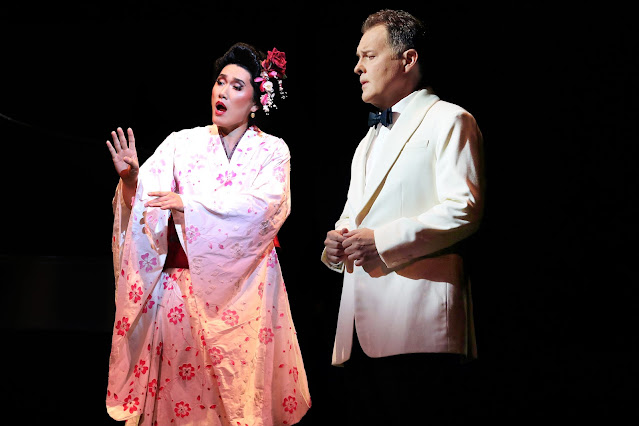
Philippe L'Esperance and Hongni Wu in Rossini's La Cenerentola


Once upon a time our parents read us the softened version of Cinderella, cleaned up so as not to frighten small children; you know, the Disneyfied version.  Since then we have read the original violent and scary versions by Charles Perrault and Wilhelm Grimm.  

We do not know which version librettist Jacopo Ferretti adapted but he wrote the libretto in three weeks (repurposing some music already written), replacing the wicked step-mother with an abusive step-father and the fairy godmother with the kindly tutor Alidoro. Similarly, the glass slipper was replaced by a bracelet. It is believed that the circumstances of production in 1817 did not allow for elaborate magical effects.

Nonetheless, there are elaborate magical effects in the music, created by Gioacchino Rossini in barely more than three weeks! That guy could sure work under pressure.  He was but 25 years old and already had Il Barbiere di Siviglia under his belt. We love Rossini for his sparkling tunes, his lively ensembles, and also because he wrote such great roles for the mezzo-soprano fach.

Last night we attended a performance of this comic masterpiece held at the very suitable Gerald W. Lynch Theater at John Jay College, utilized because the theater at Manhattan School of Music is under construction. We had the most marvelous time!

Everything worked in concert to provide an evening that proved that high culture and entertainment can coexist. Probably, in Rossini's day, opera was just entertainment, but in our time, people expect opera to be a bit forbidding.  It doesn't have to be, as this rollicking production has proven.

A highly talented cast revealed not a single weak link. As the much put upon title character, we heard mezzo-soprano Hongni Wu, whose distinctive instrument and engaging onstage presence made a huge impression. We have heard her several times before and will hear her next Sunday at the Met National Council Finals. She fully deserves to win!

This opera cannot work unless the title character wins our heart. We do not care whether she is spunky or submissive, as long as she is engaging. We must want her to win the Prince!

We do want to say a word about technique. We came to the opera directly from a master class with Joyce DiDonato who coached a young mezzo in the final aria "Nacqui all'affanno...Non piu mesta". We are pleased to report that Ms. Wu was not just engaging but vocally perfect--legato where indicated and bursting with fireworks in the fioritura.

Her Prince Ramiro was portrayed by the princely tenor Philippe L'Esperance, also a familiar voice in our ear. His tenor is just as sweet as we would want it and his bearing was aristocratic. But he was not at all stiff.  Just watching his face as he observed his valet pretending to be him (and playing it way over the top) was a lesson in "reactive acting". To put a "plus" after the "A", all he needs is a bit more float in the top notes.

Baritone Dongwei Shen created a marvelous character--reveling in the opportunity to play the Prince, and playing it to the hilt. Swathed in red velvet and white "fur" trim, he courted the two step-sisters assiduously and successfully, but he couldn't succeed with Cenerentola whose heart was already stolen. We enjoyed his phrasing and pleasing tone.

Bass-baritone José Luis Maldonado has always impressed us with a voice as large as his frame and an easy dramatic focus that convinces us of whatever character he is playing.  Here, he is Cenerentola's mean step-father who has used her patrimony to provide lavishly for his two natural daughters.

Traditionally, Tisbe and Clorinda are played as stereotypically spoiled and vain. We are happy to report that no new ground was broken and we were able to enjoy lots of laughs at their expense. Soprano Kelly Singer as Clorinda and mezzo-soprano Polixeni Tziouvaras as Tisbe were as superb in their vocal harmony as they were vicious in their competitiveness.

The character that makes everything happen is Alidoro, Prince Ramiro's tutor. Bass-baritone Andrew Henry sang with marvelous musicality and was as convincing as the beggar as he was as the guiding force. Who needs a Fairy Godmother when you have such a wise and generous tutor!

Jay Lesenger's direction was always spot on with a number of clever touches that were unique to this production. We loved the scene in which Cenerentola's imagination runs away with her in Act II, Scene 2. Also notable was the scene in which the Prince's courtiers march on in unison, each bearing a rose for the fake Prince to snatch. The courtiers were played by Hyunsung Shin, Zachary Brown, Ethan Fran, Yongjae Lee, Wenjie Ma, Alexander Mason, Tommy Wazelle, and Shuo Yang. Their choral work was stellar, thanks to Miriam Charney.

Less was heard from the Ladies of the Court who only appear in the final scene--Nuriel Abdenur, Xiaotong Cao, Chia-Wen Chen, Qiyu Chen, Sulgi Cho, Peiyao Hu, Shinhye Kim, and Jianing Zhang. Their voices harmonized well and they looked great, thanks to Costume Designer Elizabeth Clancy.

Sets by Peter Harrison worked well. The home of Don Magnifico contained a chimney for Cenerentola to sweep at one end and a vanity at the other end, with dozens of hatboxes stacked up for Tisbe and Clorinda to demonstrate their self-absorption.

To portray the gardens and the vineyards of the palace, there were hedges and arches dropped from the flies and hoisted when not needed. We cannot forget the scene in which Don Magnifico proves his worthiness to become the wine steward with a tastevin around his neck. There is something very funny about well-performed intoxication.

We must say a word about Julie Duro's lighting design. It was an inspired choice to radically darken the stage and highlight the individual who was having a private moment, such as the aforementioned scene when Cenerentola has returned home and is beset by fantasies.

Gary Thor Wedow used his animated hands to elicit a musically marvelous performance from the MSM Opera Orchestra. None of the superb vocal performances could have happened without their devotion to Rossini's melodies.

(c) meche kroop


Sunday, November 19, 2017

FOUR SCENES-FOUR MOODS-FOUR LANGUAGES

Finale from Falstaff  performed by Manhattan School of Music Opera Theater


After our delightful evening at Juilliard last night it seemed like time to show Manhattan School of Music some love.  MSM has a great deal of depth in its vocal department, one of the top training programs in the world, and attracts talented young singers from all over the USA and worldwide. Over 40 countries are represented. Their list of alumni looks like a Who's Who of the opera world.

Last night the MSM Opera Theater, of which the esteemed Dona D. Vaughn is Artistic Director, presented four opera scenes, apparently chosen for variety of mood and language, and to show off the special skills of the current crop of graduate students. There wasn't a disappointing voice to be heard.  As a matter of fact, the vocal glories were abundant.

In place of orchestral accompaniment, we had four hands at two pianos--a pair belonging to Jorge Parodi and another to Scott Rednour. Maestro Vlad Iftinca conducted sans baton; he clearly was involved with every singer and every phrase, using both hands to bring out everyone's best.

What made the evening so enjoyable, aside from the splendid singing, was the professionalism of all concerned. Director Laura Alley never fails to honor the piece and does not torture the libretto to fit into a self-serving "concept".  The pieces were staged with a minimum of props but nothing was missed. Costumes were not lavish but were appropriate and tasteful. We ourselves prefer creativity and imagination over distracting extravagance.

The program opened with "The Presentation of the Rose" from Richard Strauss' Der Rosenkavalier, one of our favorite operas. The nouveau riche Herr Faninal (resonant baritone Shuo Yang) is excited about his daughter's marriage into nobility. Young Sophie (crystalline voiced soprano Yesul Yeon) considers her obligations as a wife, whilst her chaperone Marianne (lovely mezzo-soprano Madalyn Luna) tries to keep Sophie's exuberance in check.

Octavian arrives in the person of the marvelous mezzo Hongni Wu in travesti who falls instantly in love with the beautiful Sophie. The two singers created marvelous chemistry together which made the scene work beautifully.  Even if you never saw the opera you could tell that Sophie will never ever marry the old Baron Ochs to whom she is affianced. The duet between Ms. Yeon and Ms. Wu told us everything we needed to know. We observed that Maestro Iftinca was in love with both of them!

An abrupt change of mood took place for the second scene which we believe was actually the entirety of Ned Rorem's 1951 opera A Childhood Miracle. The libretto by Elliott Stein was based on a creepy Hawthorne story in which two little girls (convincingly portrayed by mezzo-soprano Charlotte Merz and soprano Kristina Brost) play in the snow and build a snowman (tenor Elijah Graham) which comes to life.

Their mother (mezzo-soprano Monica Talavera) is sitting indoors with her sister Emma (mezzo-soprano Polixeni Tziouvaras) doing needlework and gossiping. Father (bass-baritone Andrew Henry) is upset to see his daughters with a strange man and insists that he come indoors where he melts. The daughters run outside into the snowstorm and turn into snow, or something else which wasn't exactly clear.

It is our opinion that magic realism is best done by Latin Americans, like Gabriel Garcia Marquez. Perhaps some Victorian touches would have helped.  The story seemed more tragedy than miracle. Still, the singing and acting were exemplary and Rorem's writing was more musical than most 20th c. writing. Thanks to English diction coach Kathryn LaBouff, every word was clear.

The mood turned again to a more somber contemplative scene from Gluck's Iphegénie en Tauride. Gluck's music gave us plenty of variety, expressing the mood of the ocean from calm to stormy. If the lovely mezzo-soprano portraying Iphegénie (Yunlei Xie) has not had ballet training we would be rather surprised since her physical movement was as graceful as her phrasing. 

In this scene of prayer for protection, she is surrounded by a chorus of Priestesses and we were impressed by the unison feature of their singing and movement. French coach Elsa Querón must get some credit! There is a lot of depth in this chorus and evidence of intense rehearsal. The two chief priestesses were sung by sopranos Si-Yeon Kim and Sasha Gutiérrez Montaño. The staging here was particularly lovely with the chorus dressed in black and carrying candles.

The final work on the program was the final scene from Verdi's Falstaff, fortunately not updated to the 1950's, as it is in "the big house". We think José Maldonado absolutely owns the role of The Fat Knight. His voice is as expansive as his girth and his acting conveyed every nuance of terror, humiliation, abject self-realization, and finally humorous self-acceptance.

The cast seemed to be having as much fun onstage as we experienced in the audience. We cannot deny that we enjoyed seeing ill-behaved men getting their comeuppance at the hands of some aggrieved women, nor can we deny drawing an analogy with the present day politics.  Plus ça change!  It is so much more fun when the director doesn't shove it down your throat.

The old Dottore Caius (Mr. Graham) gets married to Bardolfo (tenor Samuel White) disguised as Nannetta (soprano Hee So Son) who gets to defy her father's choice and marry the man she loves--Fenton (tenor Philippe L'Esperance). But not until they get to sing a beautiful duet. We have admired Mr. L'Esperance's voice on prior occasions.

The role of Ford was sung by baritone SeokJong Baek who always turns in a fine performance. Soprano Celeste Morales made a fine Alice whilst Meg was sung well by mezzo Elizabeth Harris. Mezzo Michelle Blauman did justice to the role of Mrs. Quickly and bass-baritone Matthias Villwock took the role of Pistola.

The staging was great fun, especially when the huge Falstaff is rolled around the stage with the entire cast prodding him with sticks. If Falstaff isn't fun we feel we've been shut out of something that Verdi and his librettist Arrigo Boito intended. This scene left us grinning from ear to ear.

The evening was perfect, although we could have enjoyed a few more scenes. The time seemed to fly by.

(c) meche kroop

Thursday, April 6, 2017

HONGNI WU....WOOOO!

Jeremy Chan and Hongni Wu

Showered with flowers! Not every recitalist commands this much admiration and affection from her colleagues but Hongni Wu is special in many ways. Her recital last night at Manhattan School of Music marked her achievement of a Master of Music degree from that esteemed institution. We first heard Ms. Wu as Prince Orlofsky in Johann Strauss Jr.'s Die Fledermaus last summer as part of Martina Arroyo's Prelude to Performance. It was a breakout performance. We heard her again as Sesto at the MSM production of Mozart's La Clemenza di Tito. We wondered at this young woman who could do justice to two such very different roles.

Ms. Wu has a distinctive mezzo-soprano instrument that has unique overtones and resonance. It sounds like chocolate tastes, rich and creamy.  But there is a sparkle to it as well. This puts her head and shoulders above the many mezzos who all sound alike. Moreover, she has an abundance of onstage presence and the ability to get a song across.

We asked her about her singing in French, Italian (Venetian dialect, no less), and German without actually speaking those languages and were told that she learns the songs phonetically but knows what each word means.  This is amazing to us because, as she sings, the phrasing is easy and fluent--just as fluent as it was when she closed her program with songs in Mandarin.

She opened with a trio of songs by Gabriel Faure--the romantic "Chanson d'amour", the melancholic "Automne", and the bitter "Fleur Jetee".  The long luxurious lines were well phrased and each song elicited a different coloration.

Rossini loved mezzo-sopranos and wrote his best music for them. La regata veneziana is a show-piece and gives the singer three different moods to establish. The heroine Anzoleta is flirtatious before the competition, excited during it, and celebratory afterward. It also requires singing in Venetian dialect, a challenge even for speakers of Italian.

Robert Schumann's Frauenliebe und leben is another cycle that requires changes of mood and coloration and Ms. Wu was wise to have chosen such pieces to highlight her unique artistry. "Seit ich ihn gesehen" was sung with the wonder of discovery and a bit more rubato than we are accustomed to but the fermata was actually quite lovely. In "Er, der Herrlichste von allen", the singer is overcome by idealization; in "Ich kann nicht fassen, nicht glauben", by excitement. The devotion in "Du Ring an meinem Finger" is quite plain;  the young woman begins to grow up and accept the responsibilities of womanhood. All this was made clear. 

We have only one small nit-picky criticism. Ms. Wu has the habit of so many non-German-speaking singers of inconsistency with the "ch" sound. At times it was perfect, at other times it was glossed over.  This should be easy to remedy with a little attention.  Most people would probably not notice it but our ears always pick it up. Some day we hope to hear Ms. Wu sing the entire cycle and by then, the "ch"s will be perfect.

If there is one mid-to-late 20th c. composer whose works we enjoy it would be William Bolcom. We have gone long distances to hear cabaret artist Kim Smith sing "Song of Black Max".  Ms. Wu's interpretation was different but rivaled his with one exception. Her accent made a few words unintelligible and this is a song in which every word counts. The same problem was noted in "Amor" which is our favorite encore piece. The expression and gestures were perfect in both songs but there needs to be a little work on English enunciation.

In Bolcom's "Waitin'" the words are simple and less important so it didn't matter.  The hymn-like melody was delivered simply and effectively.

The program concluded with songs from China. Jeremy Chan brought out the beautiful melody of Rui Zhang's "Condolent speech" which was written in A-B-A form. We do love the sound of Mandarin! The second piece Xianglin Zhou's "A glass of wine" was lighthearted and rhythmic, strangely reminding us of Latin music.

The encore was also in Mandarin--"My Love is Waiting for You".

We are so happy to learn that Ms. Wu will continue her profession studies at MSM because it means we will have further opportunities to hear her.

(c) meche kroop

Saturday, July 9, 2016

COMEDY TONIGHT!!!

Prince Orlofsky's ball--Act II of Die Fledermaus (photo by Jen Joyce Davis)

Thursday night at Prelude to Performance's La Bohème we wept and couldn't stop the tears; last night at their performance of Johann Strauss Jr.'s Die Fledermaus, we laughed, we giggled, we guffawed--- along with the rest of the enchanted audience.

Comedy is more difficult than tragedy to perform; the cast must play it straight so we can laugh at their foibles.  They are funny because they take themselves seriously. Nothing is worse than a performer working at being funny. We are happy to report that the totally terrific cast of this Prelude to Performance production got everything right. We can't remember having a better time.

The libretto by Karl Haffner and Richard Genée sparkles with wit and takes delight in poking a finger in the eye of 1874 Vienna with all of its hypocrisy. The entire story is one of deception and pretense. Dr. Falke (portrayed by the excellent baritone Thaddaeus Bourne) has orchestrated an elaborate charade to get revenge on his friend Gabriel von Eisenstein (brilliantly performed by Jonathan Tetelman, whose change of fach from baritone to terrific tenor was a wise choice);  Eisenstein once abandoned his friend drunk and in full chiropterological drag. (Now that morning return home must have been some "walk of shame").

Falk has invited all the characters in his little drama to a ball given by the idiosyncratic Russian aristocrat Prince Orlofsky (in a star turn by mezzo-soprano Hongni Wu, whose voice has a gorgeously unique timbre). Orlofsky is bored by life and only wants to be amused.  Amusement he gets!  In Spades!

Eisenstein has been invited to the ball as a last gasp of wild fun before he serves a brief prison sentence. (Something akin to a bachelor party!) He hopes to flirt with some dancers there but becomes entranced by his own wife Rosalinde.

Rosalinde has been invited, and is bent on getting even with her deceiving husband. She is disguised as a Hungarian countess and if the role could have been better portrayed by anyone but stunning soprano Haley Sicking, we have yet to imagine it. Her comedic skills are prodigious and her lusty soprano shone in the Czardas--an over-the-top Viennese interpretation of Hungarian "soul". The scene of the husband trying to seduce his own wife was one of the many highlights of the evening.

Rosalinde's chambermaid Adele (charmingly sung by the sparkling soprano Shana Grossman) has also been brought to the ball under false pretenses. She thinks the invitation was from her ballerina sister but we learn that it is Falke's doing. She begs Rosalinde for the night off "to visit a sick aunt" and "borrows" a gown from her bosslady. She pretends to be an actress and entrances Frank, the prison warden who is also there under false pretenses.  He is delightfully portrayed by baritone Paul Grosvenor, pretending to be Chevalier Chagrin while Eisenstein is pretending to be the equally Gallic Marquis Renard. Another comedic highlight was witnessing the two faux Frenchmen trying to communicate in pigeon French.

There is a subplot of Rosalinde being caught in an almost compromising position by Frank in Act I when an old lover named Alfred (enacted by Spencer Hamlin whose ringing effortless tenor made him perfect for the part of a singing teacher) is having a nocturnal tête-a-tête with Rosalinde. To spare her being dishonored Alfred pretends to be her husband and goes to jail with Frank.

Another source of humor was the bumbling lawyer Dr. Blind, portrayed by Joseph Sacchi, who was literally chased out of the house by the Eisensteins. So much physical humor!

There is yet another source of hilarity--the bibulous Frosch, portrayed hilariously (and in English spoken dialogue) by Steven Mo Hanan.

With musical and dramatic values at such a high professional level, it would be a pity to miss this witty production, directed with a fine hand by Gina Lapinski.  It will be reprised at Sunday matinée with the same fine cast.

Strauss' tunes have stuck in our mind and we have been humming them all night while we write. From the first theme in the overture the melodies are completely captivating. Maestro Steven M. Crawford kept the energy flowing non-stop with much of the music being in waltz or duple time.  It was difficult to sit still! 

As if that were not sufficient, the gorgeous costumes of Charles R. Caine dazzled the eye and transported us to a glamorous time and place. Abdul Latif's choreography added to the delight. The party scene in Act II gave an opportunity for chorus members to strut their stuff, under the guidance of Chorus Master Noby Ishida.

The set was simple and seems to have served for both this production and La Bohème, neither enhancing nor detracting from the action. 

Both singing and spoken dialogue were performed in the original German and performed with clarity. Although Brett Findley's titles were excellent for non-German speakers, we confess to getting a kick out of understanding the well-enunciated German. Credit for German coaching goes to Vera Junkers. 

(c) meche kroop