MISSION

We are here to encourage the development of gifted young singers and to stimulate the growth of New York City's invaluable chamber opera companies. But we will not neglect the Metropolitan Opera either. Get ready for bouquets and brickbats.
Showing posts with label Joshua Dennis. Show all posts

Sunday, April 21, 2024

MORTE (more or less)


Jorell Williams, Melissa Harvey, Maestro Neal Goren, Laurie Rubin, and Joshua Dennis

In the first scene of Nadia Boulanger's only opera La Ville Morte, one of the characters saw something he couldn't describe. That is exactly how we feel about the performance of said opera last night at The NYU Skirball Center for the Performing Arts. As regular readers already know, we approach every opera  without reading advance materials. We have our very own criterion; let the work speak for itself. We would be surprised to find anyone in the decent sized audience who could have understood what happened onstage.

Upon returning home, we consulted Wikipedia (faut de mieux). "The story follows the lives and loves of an archeologist, Léonard, his sister Hebé, Alexandre, a colleague, and his wife Anne, amidst the ruins of Mycenae." 

It took us awhile to figure out how the characters were related. Hebé (performed by the fine soprano Melissa Harvey seems to have an affectionate relationship with Anne (played by the equally fine mezzo-soprano Laurie Rubin). Two men arrive separately. One is the fine tenor Joshua Dennis (whom we have written about many times since he launched his career at the Santa Fe Opera), and the other is baritone Jorell Williams (whom we have also written about many times in the past dozen years).  The relationships described in Wikipedia took some time to figure out.

The libretto was based on a play written by Gabriele D'Annunzio. The story is as obscure as that of Debussy's Pelléas et Mélisande and if you are a fan of the Symbolist movement you may enjoy that sort of non-storytelling but we do not.

Still, Nadia Boulanger was a major star in the musical firmament, responsible for teaching many other composers, and this is the only opera she wrote. She wrote it with her mentor (and possibly lover) Raoul Pugno in the early years of the 20th c. but its performance was prevented by the outbreak of World War II. The score was lost and had to be reconstructed. Unfortunately, the orchestrator neglected to include a harp. Other than that we heard some really beautiful passages for the winds and something interesting going on in the string section of the chamber orchestra presided over by Maestro Neal Goren, so well remembered for his Gotham Chamber Opera. 

We recall spending many interesting evenings with Gotham Chamber Opera. Some we loved (Charpentier's Le descent d'Orphée aux enfers), Montsalvatge's El Gato con Botas, and a Martinú comedy called The Bridge) and a few we didn't relate to. We were quite disappointed when GCO folded and were particularly happy to witness Maestro Goren's conducting once more.

In sum, Dear Reader, the orchestral music was well worth hearing, even if it wasn't exactly what the composers wrote; we enjoyed hearing two male singers with whom we have a long history; we were pleased to be introduced to two female singers who were unknown to us. So, the evening was not a total loss. However, we and our two musician friends left puzzled and unsatisfied. That the work received significant applause (and was well received in Athens when performed by the Greek National Opera) did not make us any happier.

A word about the direction by Robin Guarino, whose interpretation of Haydn's Orlando Paladino we enjoyed about ten years ago--we think she did the best with a non-story and inscrutable characters whose lines were not those of real people. Andromache Chalfant's set comprised a rather bare room with a single chair, a room in the form of a box that was elevated and reached by a ladder and a metal staircase. In front of this at ground level were reams of white fabric meant to represent a few different elements. Also there was a table with gold artifacts, puzzling until we read in Wikipedia that the male characters were archaeologists. Jessica Drayton's projection design comprised some abstract motifs which added to the inscrutability. Candice Donnelly's costume design was nondescript.

© meche kroop

Saturday, August 13, 2022

BUTTERFLY DREAM


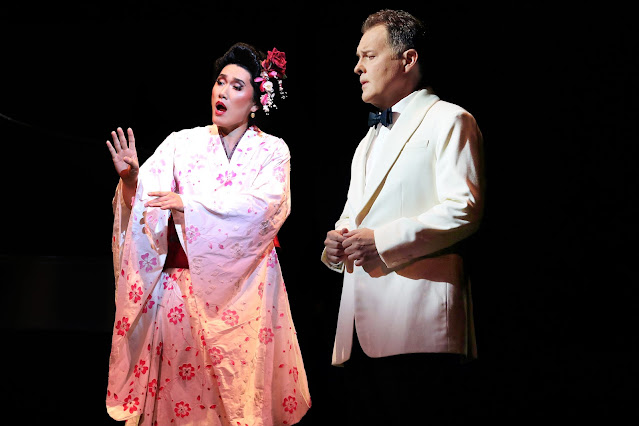
Kangmin Justin Kim and Mark Stone
(photo by Curtis Brown)


With our eyes closed, we might have thought the scintillating voice was that of a soprano; but no, it was the scintillating voice of counter-tenor Kangmin Justin Kim whose expressive instrument and superb control of the upper register was absolutely perfect for the role of Chinese opera star Song Liling. The opera M. Butterfly, commisioned by the Santa Fe Opera, is about deception, among other things. We humans are inclined to deceive ourselves based upon our wishes, our experience, and our preconceived notions. M. Butterfly tells the story of a minor French diplomat who falls in love with a male Chinese opera star who portrays female roles. Until confronted with the "naked evidence" the diplomat never accepts the fact that he has fallen in love with a man--not even after a years-long relationship.

The story originated as a play by David Henry Hwang whose tales of China have entertained us going back to his play The Dance and the Railroad. The play M. Butterfly upon which the opera is based, was a huge success at its Broadway premiere and once again at its revival and then again as a film. We have enjoyed every iteration and was looking forward to the opera ever since it was announced.

So, we are wondering why, in spite of some dazzling performances, we were somewhat disappointed in the opera. To cut to the chase, the story worked just fine as a play.  The play did not yearn for music, not even the fine music of Huang Ruo. The references to Puccini's Madama Butterfly, scattered throughout the score, only served to point out the superiority of Puccini's vocal lines. Mr. Ruo's instrumental writing is eclectic and interesting, but the vocal lines were not. This complaint of ours is not unique to Mr. Ruo. Most contemporary operas seem to have the same deficiency.

Although Mr. Hwang and Mr. Ruo have worked together before, we did not feel the union of libretto and music that we hoped for. The "recitative" (95% of the opera) was declamatory, prosy, and repetitive. The nail was hammered so hard it went right through the wood! Is it not taught to dramatists to "show, don't tell"? There were a couple arias in Act III that allowed the artists to show their stuff but were not at all melodic.

Perhaps we were alone in our assessment because there was a standing ovation at the conclusion; however we believe the thunderous applause was meant for the performances. Baritone Mark Stone sang the role of the duped accountant/diplomat René Gallimard with fine rich tone whilst creating a sympathetic and believable portrayal.

Mr. Kim's lustrous counter-tenor added to his consummate acting skills. We can see how Mr. Gallimard was fooled! All of the gestures and movements were as feminine as one could imagine and, at the end, when he appeared as a man (in full frontal glory) it came as a shock, even though we knew the artist was male.

This kind of gender fluidity is far less shocking than it was some decades ago and we do admire Mr. Hwang and Mr. Ruo for tackling issues of racial, cultural, and gender stereotypes, along with the issue of cultural misunderstanding.  The references to Puccini's opera serve to remind us how many changes have occurred in the past century.

Let us return to the quality of the performances and the production. We particularly enjoyed hearing mezzo-soprano Hongni Wu as Song Liling's communist "handler" who set the espionage in motion. We always feel great to see Asian artists cast in Asian roles, although there are other opera lovers who think it doesn't matter.

Tenor Joshua Dennis (a former apprentice) livened things up as Mr. Gallimard's tennis-playing childhood friend, appearing as a memory. Bass Kevin Burdette was fine as the somewhat arrogant French ambassador to China who promotes Mr. Gallimard, seems to admire his acquisition of a Chinese mistress, and then sends him back to France.

Adding greatly to the production was the choreography of Seán Curran who managed to combine communist tropes with the movements we have seen in Chinese opera, an art form we particularly enjoy.

Maestro Carolyn Kuan led the orchestra with a firm hand; our only regret was that more Chinese instruments were not employed. We liked the way she brought out the references to Puccini's Madama Butterfly.

Once more, we admired Chorus Master Susanne Sheston for creating a behind the scenes choral rendition of Mr Ruo's very own "Humming Chorus". The apprentices sounded great there and also as they portrayed members of French society in several scenes--as bored expats living in China, and as French citizens laughing at Mr. Gallimard's benightedness.

Director James Robinson kept the action moving along and Allen Moyer's set design was superb, especially Ms. Liling's sexy red boudoir. Christopher Akerlind's lighting made an impressive addition. James Schuette's costumes were right on point. Even the projections of Greg Emetaz were fine since they contributed location information instead of the distractions produced by other projection designers that we have found annoying.

In sum, Santa Fe Opera can be commended for commissioning a provocative and original work and for giving it a first-rate production. It is just our personal taste that wanted a more memorable vocal line and a more poetic libretto. Still, it was an interesting evening in term of getting us to think about the issues mentioned earlier. But for sheer auditory pleasure and a climax that leaves us shaken, we will choose Puccini.

© meche kroop

Sunday, August 11, 2019

FOR THE BIRDS

Jessica E. Jones and Tamara Mumford in The Thirteenth Child
(photo by Curtis Brown for the Santa Fe Opera)


In terms of audience appreciation, Mother Nature won out over the opera onstage last night at the Santa Fe Opera. Cannon rounds of thunder and jagged bolts of lightning garnered audience applause and cheers that outstripped what we thought was an overly generous show of applause at the end of the world premiere of The Thirteenth Child. Indeed the opera had to be suspended for some time until the show of sound and light abated.

Everything we loved about the prior night’s production (see review below) was missing from this disappointing evening. In fact we enjoyed reading Cori Ellison’s essay in the program book more than the opera itself.  The creators of the opera are highly esteemed but failed, in our opinion, to provide an evening of coherent entertainment. 

Librettists Becky and David Starobin created an interpretation of a Brothers Grimm fairytale that did more telling than showing. Important scenes were omitted with the intervening action described later by one or another of the characters. The dialogue was awkward and unpoetic, giving the lie to the claims made in the program book. Characters were not fully developed nor did they inspire identification. It was difficult to care about the outcome.

Poul Ruders' music was occasionally interesting in its orchestration but the vocal lines were unmelodic. Real operas have melody even in the recitativi. Here we had dialogue that wasn't even as melodic as sprechstimme.

The opera The Thirteenth Child is an adaptation of a genre of fairytales dealing with personal sacrifice in order to preserve the family. In his book The Uses of Enchantment, Bruno Bettelheim posits that fairy tales help children solve existential problems such as oedipal conflict, sibling rivalry, and separation anxiety.  Ms. Ellison’s essay described several volumes that categorize fairy tale themes that are universal, having iterations in many different cultures worldwide.

Personally, we love fairy tale operas. We have had no problem caring for Cinderella and identifying with her sibling rivalry;  the melodies of Massenet and Rossini just amplify the pleasure. Similarly, we care easily for the siblings of Hansel and Gretel as they deal with parental neglect.;  Humperdinck’s music serves to augment and legitimize our caring.

This fairytale, given better treatment, might have affected us in the same way. The story concerns a King (David Leigh) who is turned against his twelve sons by Drokan (Bradley Garvin) , the evil Regent of a neighboring kingdom who lusts after the King’s wife (Tamara Mumford) and crown. Fortunately his pregnant wife delivers a female child named Lyra (Jessica E. Jones). The boys have been banished but, in this opera, we don’t find out until 18 years have passed.

On the mother’s deathbed she tells Lyra about her twelve older brothers and Lyra goes off to find them. They are living in a forest and surviving by hunting.  The family reunion is a joyous one until Lyra innocently cuts the red lilies that represent their souls and the young men are transformed into ravens.  The dead Queen reappears and tells Lyra that only 7 years of silence will restore her brothers.

Prince Frederic of the neighboring kingdom, of which the evil Drokan is Regent, loves the mute Princess and plans to marry her. Drokan plots to destroy them and seize the crown. The 12 ravens rescue Lyra and the spell is broken.  All are returned to human form but the youngest brother Benjamin (Bille Bruley) has been fatally injured in the battle. He has sacrificed his life to restore the family. With all those unfamiliar Medieval names, we wondered about the name “Benjamin”.  Like much else, it just didn’t fit.

The dramatic performances were barely adequate, except for the winning portrayal of the youngest brother by Bille Bruley. We cannot comment on the singing due to the awkward libretto and unmusical vocal lines. The chorus of Santa Fe Apprentices sounded fine, as we have come to expect, under Susanne Sheston’s able direction.

Maestro Paul Daniel elicited fine playing from the orchestra and we heard some interesting sounds coming from the percussion section. Was that a celeste we heard?

The set design by Alexander Dodge comprised a post-modern assemblage of geometric forms with staircases leading nowhere. Strangely, there was a Thonet bentwood chair as the sole piece of furniture. Aaron Rhyne’s projections of flying birds brought the Hitchcock film to mind. Projections of greenery onto the set did not a forest make. York Kennedy’s lighting had to compete with Mother Nature’s. Rita Ryack’s costume design was apt, with the royalty dressed, well, royally, and the brothers dressed in garb suitable for woodland hunting. The chorus in the last act were costumed as if in Dialogue of the Carmelites.

The one entertaining moment of the evening occurred when the brothers arrived back to their (invisible) hut demanding types of meat, many of which would be known only to 21st century gourmets.

We don’t know what to say about Darko Tresnjak’s direction, given the libretto. We suppose he did his best to make the story clear. Still, we would have wanted to see more chemistry between the characters. 

We believe an opportunity was lost to provide some fairytale magic. The production seemed inert and we were often bored. The tender scene between mother and daughter begged for a lyrical duet. There was none. Must we abandon all hope for 21st c. opera? We keep ourself hoping based upon the incredible success of last year’s The (R)evolution of Steve Jobs right here at Santa Fe Opera.

© meche kroop

t

Wednesday, August 13, 2014

BEETHOVEN'S ONE AND ONLY

Alex Penda and Paul Groves (photo by Ken Howard)
How is it that Beethoven only wrote one opera and spent a dozen years doing it?  It must not have come easily to him.  Indeed, he rewrote the overture to Fidelio several times and the opera as well.  It premiered for the first time in 1805 in Vienna which was, at that time, under French rule.  Largely influenced by the ideals of the French Revolution it was denied performance by the censors and only achieved production due to the intervention of Hapsburg Empress Maria Theresa.

This was an unusual choice for the Santa Fe Opera.  Although it is considered an opera, it has a great deal of spoken dialogue.  Although it has a happy ending it is not a comedy.  It has two major themes: the sacrifices of marital love and freedom from tyranny.  It's message is as valuable today as it was 200 years ago.

The orchestral music is as ravishing as anything Beethoven ever wrote and the Santa Fe Orchestra under the baton of the illustrious Harry Bicket (newly appointed Chief Conductor) did it justice with clean textures and rhythmic thrust.  The vocal lines are memorably melodic but challenging to sing; the game cast managed to carry it off with style.

The staging began even before the overture and introduced Leonore, disguised as Fidelio and serving as assistant to the jailer Rocco.  We also get to see Rocco's daughter Marzelline fussing about the kitchen of Charlie Corcoran's two-story set.  Jaquino, Rocco's other assistant, is importuning Marzelline to make marriage plans but she has fallen out of love with him and fallen into love with the recently arrived Fidelio.  One by one the voices join for a stunning quartet.

As Marzelline, the strong and silky soprano of Devon Guthrie (seen as an apprentice in 2010 and 2012) contrasted well with the sharper-edged soprano of Alex Penda as the titular Fidelio.  Ms. Penda was totally convincing as a young man but she is also very petite and at least a head shorter than Ms. Guthrie.  Yes, it is true that sometimes very tall women fall for very short men but it did look rather unbelievable onstage.

As the nice-guy jailer Rocco, Austrian bass Manfred Hemm sang with intensity and created a believable character.  As the spurned Jaquino, tenor Joshua Dennis used his fine voice and dramatic skills to make more of the role than is customary.

Leonore's husband does not appear until the second act but tenor Paul Groves made up for it, giving his all to his difficult aria and still managing to look as if he'd been in a dungeon for two years, imprisoned by his vicious enemy Pizzaro, portrayed with nasty gusto by bass-baritone Greer Grimsley.

Appearing at the end as a deus ex machina, Don Fernando comes to free all the prisoners.  The powerful and imposing bass-baritone Evan Hughes filled the shoes well.  Two members of the Apprentice Program made fine showings in brief solos as prisoners: the marvelous young tenor Joseph Dennis and the astounding bass Patrick Guetti.  We fully expect to see both their careers advancing rapidly.  So much talent at such a young age!

Not enough fine things could be said about the chorus, enacting prisoners desperate for freedom. Susanne Sheston gets big props as Chorus Master.

In spite of the superb orchestral and vocal performances we found Stephen Wadsworth's concept and direction to be distressing.  It is true that oppression exists everywhere and in all epochs but we fail to see how the Nazi holocaust has much to do with the political imprisonment of a small group of people. The concept was revealed gradually.  At the beginning it seemed to be anytime/anywhere but then a portrait of Hitler was exposed and Nazi uniforms appeared.

We found this to be at odds with the intentions of Beethoven and his librettists.  (There were several as he continually revised the opera.)  It seemed to be a graft that did not take.  We would have preferred a less specific setting that would have allowed us to make our own connections.

Furthermore, there are references to "the King".  Huh??? Which King?  And British soldiers coming in to liberate the prisoners and to hang the Union Jack? We don't like to see operas manipulated to fit into a Procrustean bed.

We liked Mr. Corcoran's realistic set.  On the ground floor were Fidelio's room and across a passageway, the kitchen.  Behold Ms. Guthrie as a drab German hausfrau! (Costumes were by Camille Assaf).  On the upper level were Pizzaro's office and some kind of waiting room.  Colors were all grey.

Duane Schuler's lighting was effective.  We liked the torches illuminating the dungeon and the sunlight when the prisoners were freed.

German diction was so perfect that subtitles were scarcely necessary.  Even the spoken dialogue was crisp and clear.

(c) meche kroop