MISSION

We are here to encourage the development of gifted young singers and to stimulate the growth of New York City's invaluable chamber opera companies. But we will not neglect the Metropolitan Opera either. Get ready for bouquets and brickbats.
Showing posts with label Il Barbiere di Siviglia. Show all posts

Sunday, August 21, 2022

A CLOSER SHAVE


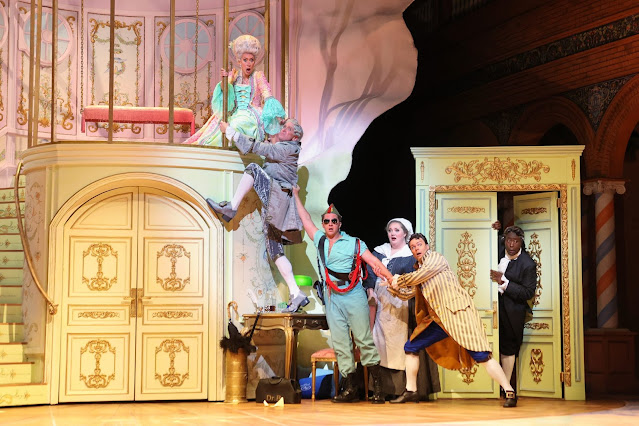
Murrella Parton (Berta), Joshua Hopkins (Figaro), Emily Fons (Rosina), Jack Swanson (Count Almaviva), Nicholas Newton (Don Basilio), Kevin Burdette (Dr. Bartolo), photo by Curtis Brown for the Santa Fe Opera 


When we tell people how much we love opera, they usually assume we are speaking about a "very serious art form". They seem surprised to learn that opera can be lighthearted and even funny. Yet some of our greatest masterpieces are considered comedies. Does Il barbiere di Siviglia qualify as a masterpiece? We say YES!  In the wrong hands it could be dull and overly long.  but in the hands of the Santa Fe Opera we can not think of Rossini's work as anything but a masterpiece.  No wonder it is the hit of the 2022 season!

Stephen Barlow has directed with admirable panache. Not a single funny stone was left unturned. Andrew D. Edwards has designed sets and costumes with style and wit aplenty. The columns flanking the set were neither Dorian nor Ionian; they were "Barberian"--the familiar old-fashioned striped barber poles.

For us, the most important aspect of an opera is the singing and we cannot imagine better casting. In our review of Performance Santa Fe's recital, we admired the bel canto singing and believable chemistry between Emily Fons and Jack Swanson. What a perfect choice for the roles of Rosina and "Lindoro" (Count Almaviva). Both sounded even better than they did at the recital, and that's saying a lot. Rossini's elaborate vocal challenges were more than met. Fantastic fioriture and super scale passages, terrific trills, and commanding cadenze tickled the ear.

In the role of the eponymous barber, we heard baritone Joshua Hopkins, a Santa Fe regular whose performances we have always enjoyed. This role suited his vocal skills perfectly. His "Largo al factotum" was delivered with several original touches that rose above  the customary clichés.

Bass Kevin Burdette, another Santa Fe Opera regular, made a spectacular showing as Dr. Bartolo. The first time we saw him in a comic role we were astonished by his comic chops. Last night we were more impressed than astonished. We were not aware of the extraordinary flexibility of his body which he employed with as much artistry as he did his voice. The laughter when he slid out of his chair like a flow of lava just about drowned out the singing. The rapid patter of "A un dottor della mia forte" was executed with precision. 

The brilliant bass-baritone Ryan Speedo Green, making his SFO debut, brought his incredible artistry to the role of Don Basilio, using his magnificent instrument successfully, revealing a great sense of comic timing. We delighted in his aria "La calunnia" in spite of some excessive directorial touches which we will address later.

As a huge fan of the Santa Fe Opera Apprentice Program, we are most delighted to honor the performances of two apprentices who fulfilled their roles with equal aplomb.

Baritone Kyle Miller made a stylish Fiorello as he assembled his musicians to accompany Mr. Swanson's cavatina "Ecco ridente". Although the role is not a large one, he must set the stage for the serenade of his boss' lady love and this he did admirably.

Soprano Murrella Parton illuminated the role of Berta and was given some unusual stage business that increased her importance in the opera. We look forward to hearing more from these three gifted apprentices.

Also given quite a lot of importance was the chorus, so well prepared by Chorus Master Susanne Sheston. We are always dazzled by their vocalism but in this case they were given a great deal to do as Fiorella's musicians, each of whom had his own personality. Later they appeared as a swat team!  More on that anon!

Maestro Iván López Reynoso established the Rossinian pace right from the overture. We loved the contrast between the staccato themes and the legato ones. Just as the Finns should borrow some vowels from the Italians, so contemporary composers should borrow some tunes from Rossini! The master even borrowed from himself!

And now, we would like to address the issue of staging. Without a doubt, this production is a crowd pleaser and often the laughter drowned out the singing. We agree that humor is vital in an opera buffa but in this case we feel the direction was over the top and the high jinx frequently distracted from the singing. Surely the characters owe a debt to commedia del'arte but we want opera to build upon its origins and to rise above mono-dimensionality

We believe ours to be a minority opinion but we felt the work was over directed. Much of what we objected to involved the touches of contemporaneity. Count Almaviva, alone among the characters, is dressed in contemporary casual--a hoodie to be exact; and he pays Fiorella with a mafioso suitcase filled with cash. One of the musicians is drinking from a styrofoam coffee cup. Berta pushes a Hoover around the floor and describes the chaos to an unseen listener on the telephone. Don Basilio carries a laptop and takes selfies with his cellphone. Figaro reclines in Rosina's bathtub. The police who come to quell the chaos are a swat team. Berta emerges from her servant's uniform as a glamorous star surrounded by a chorus of men in top hats and tails. We could go on and on but we believe you, dear reader, will get the picture.

When every character acts bizarrely or inappropriately funny, the impact of comedy becomes lost. Among lots of peculiar characterization, the arrogant Dr. Bartolo was directed as a simpering fop. At one point, he donned a sweat band, spread out a yoga mat and began doing weird contortions.

This "originality" was echoed by the set. Dr. Bartolo's house was a plaster cast of Rossini's face.  His eyes were used as windows and his mouth as a door.  Hedges imitated a huge handlebar mustache. The audience applauded before the singing began. This stage element revolved to show the inside of the home. Below was a period parlor and above was Rosina's room. Bars around it suggested a cage, commenting on her imprisonment by Dr. Bartolo. She sat on a swing, going forward and back. Necessary stage elements like the doctor's piano were wheeled on and off.

If this sounds like your cup of tea, you will have a rollicking good time. On our part, we would like to "unsee" this production and remember the way the excellent cast sang Rossini's glorious music, the thrilling duets (not only the love duet but the one between Rosina and Figaro), and the many layered ensembles, so well crafted by the composer.

© meche kroop


Wednesday, July 28, 2021

SOMETHING FOR EVERYONE


            Maestro Will Crutchfield and The Teatro Nuovo Cast and Orchestra


Last night's production of Gioacchino Rossini's comic masterpiece Il barbiere di Siviglia at Damrosch Park was a joy to behold and a night to remember. The New York City opera community has been starved for live opera for over 16 months (but who's counting?) and Maestro Will Crutchfield served up a tasty dish that was completely satisfying but also left us eager for the next meal.

There was something for every taste.  Those who appreciate scholarship had access to some extensive program notes online which we were glad to have read in advance. Readers who are of the same mind can find them here

 https://www.dropbox.com/s/j8glxrj6qhmcrc5/The%20Barber%20of%20Seville%20-%20Preview%20Program.pdf?dl=0#

It was fun to learn more about the background of the opera, some of which we knew and other facts that were new to us. We never knew, for example, how flexible the composition was in terms of numbers that were created by the singers themselves. We were also unaware of the relative absence of fach in Rossini's operas. 

We'd always been told what a departure it was for a soprano to take on the role of Rosina, written for a mezzo-soprano. Not so; categories had yet to be written in stone. Last night's Figaro, for example, was sung by bass Hans Tashjian--and very well sung we might add. We hadn't heard Mr. Tashjian since his multiple appearances with Dell'Arte Opera about seven or eight years ago and were delighted to witness the growth in his artistry.

Maestro Crutchfield devoted a great deal of time and effort in stripping the opera of years of accretions and, truth to tell, we didn't miss the shtick. Thankfully, in spite of a few judicious cuts (necessitated by consideration for the neighbors living around Lincoln Center), all of the scintillating melodies were there, melodies which are still spinning around in our head. Our feet were dancing their way down Broadway, thanks to Rossini's rhythmic gifts.

We can't help wondering where is today's Rossini. He or she is probably writing for Broadway, not for the opera house. We sometimes fail to remember that in the 19th c., opera was a popular art form, an entertainment; it was not about someone grinding a political axe.

Do we care if opera is "relevant"?   No we don't. Do we criticize the presence of stock characters and stereotypes?  We do not. Do we judge the opera for its sociocultural sensitivity? LOL.  We want to have a good time, and last night we did. Pardon our rant but we just had to go there!

As much as we encourage you to read Mr. Crutchfield's exegesis, one didn't need to know a thing about operatic history or scholarship to delight in the wacky story of Cesare Sterbini's libretto. The familiar 19th c. story of a possessive old goat and his subjugated ward has been turned on its head by Sterbini's creation of the subversively rebellious Rosina who outwits the old goat with the help of the wily Figaro, one of opera's most endearing characters.

The role of Rosina was sung by mezzo-soprano Hannah Ludwig who possesses  plenty of strength in the lower register and a brilliant upper register, well employed in a spate of highly original embellishments which, as we learned, Rossini encouraged his singers to devise, as did Maestro Crutchfield  We hope that Ms. Ludwig's artistic evolution involves knitting the two registers more seamlessly, since the decorations often served to highlight the lack of continuity.

The role of Count Almaviva was portrayed by tenor Nicholas Simpson whom we remember as a superb Charles II in Little Opera Theater of New York's production of Carlisle Floyd's Prince of Players and also as having risen above the world's worst production of Wagner's Tannhaüser in the title role. His bright clear tone was perfect for the role; we wanted, however, more clarity in the scale passages and fioritura.

Scott Purcell made a marvelous Doctor Bartolo with first rate singing and acting. The lecherous Doctor is not a likable character but in Mr. Purcell's hands he became a figure of sympathy.

Soprano Alina Tamborini came to our attention just 2 years ago, not only through Teatro Nuovo but also through Talents of the World Competition. We can never forget her performance of "Adele's Audition Aria" from Johann Strauss' Die Fledermaus. How happy we were to hear her again in the role of Berta to which she lent her crystal clear soprano and lovely phrasing.

Daniel Fridley made a fine Don Basilio; we just loved the scene in which the other characters tried to get rid of him. It occurred to us that this is a theme of this particular opera. In Act I, Almaviva tries to get rid of the noisy musicians. Later, Dr. Bartolo tries to get rid of Almaviva who is disguised as a drunken soldier.

Wil Kellerman made the most of his role as an officer, singing with clarity and acting with purpose and conviction.

Kyle Oliver was successful as Fiorello trying to control his boisterous band of musicians accompanying Almaviva's serenade.

With the shtick removed from the big arias, we were able to focus more on the beauty of the duets and the elaborate construction of the ensembles which Rossini used to bring each act to a climax-- leaving everyone exhausted.

The Teatro Nuovo Orchestra filled the plaza with a gorgeous carpet of sound. Maestro Crutchfield led from the cembalo, following the tradition of the early 19th c. First violinist Jakob Lehmann made significant contributions, as did Peter Ferretti who handled his contrabass as one of the characters in the drama.

We would hope to see Maestro Crutchfield "version" with sets and costumes some day, although we think the cast did a fine job of getting the drama across in what is called a "semi's staged" production. So delighted were we to hear live opera, we were in no frame of mind to attack the amplification; nonetheless, it did not exactly improve upon the singers' natural voices.

Furthermore, we were feeling rather tolerant of the titles projected behind the orchestra.  Lucy T. Yates and Maestro Crutchfield himself were given credit for the titles which rhymed but were not direct translations from the Italian. We dealt with it by ignoring them when we couldn't reconcile them.

Those were our only quibbles with an evening of delights, made even more delightful by sharing the experience in public with fellow opera lovers. We began by describing the opera as having something for everyone. Academics could enjoy the research that went into restoring the opera to something close to its origins. Neophytes could enjoy it for its good humor and tunefulness. Many might not have been aware of the cuts, the eliminations, or the original contributions. But everyone had a good time!


© meche kroop

Thursday, August 27, 2015

A DIFFERENT BARBER

Na Young Ban and Ken Harmon (photo by Chris Fecteau)

Beaumarchais' 1775 play Le Barbier de Séville was adapted by many composers but last night Dell'Arte Opera Ensemble treated us to the Paisiello version which premiered in Russia in 1782. Rossini did not write his version until 1816. It took some time for Rossini's version to eclipse Paisiello's and it is the former that usually provides the delightful belly-laughs for today's audiences. Still, this season we were fortunate enough to hear the latter version twice in one season!  Only in New York, as they say.

The Paisiello is well worth hearing for its charming melodies.  One cannot help but wonder what might have happened if Rossini had not written his version. It is quite likely that this delightful opera would have been part of every company's repertoire.

The libretto by Giovanni Petrosellini hews closely to the Beaumarchais play and there are only a few differences from the Rossini in the storytelling. The adorable heroine Rosina is still the ward of the controlling Doctor Bartolo who holds her under lock and key. Il Conte d'Almaviva has followed her all the way from Madrid to Seville to court her and, being accustomed to getting what he wants, will find a way to get her.

The wily barber Figaro will help him--for a price, of course. The music teacher Don Basilio also figures in the plot as Doctor Bartolo's ally--until some money changes hands. Beaumarchais has written a comedy, a romance, and social commentary all at once. The only character missing from Petrosellini's libretto is Berta, the housekeeper. Instead we have comic relief from the sleepy and ironically named Lo Svegliato (Vigilance) and the elderly and equally ironically named Giovinetto (Youth).

We were delighted to catch Na Young Ban's sole performance as Rosina. With ample personal charm, a beautiful soprano, and superb Italian diction, Ms. Ban performed the role to perfection. Legato lines were well phrased and the decorations nicely handled. We particularly enjoyed the aria she sings when the Count is pretending to be her music teacher. The B-section is a lament in a minor key with a marvelous bassoon accompaniment. 

The Paisiello Rosina is not the spunky Rosina of Rossini but a gentler character. Her love duet with the Count "Caro tu sei il mio ben" was lovely.  Ken Harmon made a fine Count and his serenade to Rosina "Saper bramate", with her listening from behind the jalousies, provided a gorgeous tune for his tenor, with accompaniment by lute and flute, as well as horn and strings.

As a matter of fact, everything the Metamorphosis Chamber Orchestra played was perfect with Maestra Daniela Candillari conducting with classical precision, just right for the period. Her harpsichord introduction to Act II was particularly lovely. Special props for Matheus Souza's lute!

Baritone Jay Chacon performed the very important role of Figaro and filled it with fine sound and comedic instincts.

The buffo role of Dr. Bartolo was performed by Jeff Caldwell who created a character right out of commedia dell'arte. The trio "Giusto cielo" was excellently sung by Ms. Ban, Mr. Harmon, and Mr. Caldwell. Bass Rodolfo Nieto made a fine Don Basilio singing a different "La calunnia" than we are accustomed to in the Rossini.

William Mulligan and Colin Whiteman as Giovinetto and Lo Svegliato respectively had a very funny sneezing scene in harmony.

Stage Director Emilie Rault kept things moving along and gave each character enough motivation to sustain the story. Meganne George's Scenic Design was simple but effective. The chamber orchestra occupied the right side of the wide playing space of the Nagelberg Theater at Baruch College, and the action took place mainly on a bi-level set. Folding screens served as backdrop and shutters. It was up to the singers to mime the opening and shutting and locking of doors. Lighting Design by Scott Schneider enhanced the effect.

If there was a sole shortcoming of the production it would be the costumes which left us scratching our head in puzzlement. We could not fathom why the singers had gems, pearls, flowers and tiles pasted on their faces, nor why Don Basilio's face was painted green. 

The clothes made no sense whatsoever. Even when the Count is supposed to disguise himself as a military man, there was no suggestion of military attire. We learned after the performance that Costume Designer Carly Bradt was going for a Gaudí look. The opera takes place in Seville, not in Barcelona and architecture is not a good partner with clothing.

We are eager to follow Rosina's progress tomorrow night in Mozart's Le Nozze di Figaro.  She will, by then, be wed to the Count and treated with indifference. Does life imitate art or vice versa?

(c) meche kroop

Wednesday, June 10, 2015

A BARBER OF A DIFFERENT CUT

David Blalock, Rod Nelman, and Monica Yunus

It comes as no surprise that the innovative On Site Opera has come up with yet another daring idea--The Figaro Project--presenting all three Beaumarchais-based operas over a period of three years. Forget Rossini, forget Mozart, forget Corigliano. The three "alternates" are Giovanni Paisiello, Marcos Portugal and Darius Milhaud.

Paisiello's librettist for Il Barbiere di Siviglia, Giuseppe Petrosellini, hewed rather more closely than did Rossini's librettist Cesare Sterbini to the Beaumarchais comedy; the love interest between Rosina and "Lindoro" (Count Almaviva in disguise) was given more weight than the cleverness of the famed barber. The work premiered in 1782 and was wildly popular. Rossini's version did not enter the opera stage until 1816 and it took a long time for it to supplant the Paisiello. Today, Rossini's version is preeminent and Paisiello's has faded into obscurity.

Thanks to On Site Opera, this oversight has been remedied and we spent a delightful evening revisiting the story with "new" music at a particularly apt venue that added to the enjoyment.  We began the evening sitting in the courtyard of the Fabbri Mansion which dates back a century and has been landmarked. The singers were finely costumed by Candida K. Nichols in garb of that same period.

The sweet-voiced tenor David Blalock as Count Almaviva is nervously trying to serenade Rosina, the cloistered ward of the controlling Dr. Bartolo. Figaro, portrayed by baritone Andrew Wilkowske, is here a musician who has fallen on hard times and has taken up barbering. He and the Count recognize each other and set the plot in motion.

In Paisiello's version there is no band hired for the serenade but we did not feel at all cheated since the music coming from the chamber orchestra  was so delightful. Newly appointed Music Director Geoffrey McDonald (much enjoyed on prior occasions at the White Box Center's Alcina and Gotham Chamber Opera's El Gato con Botas) led a chamber orchestra comprising a string quartet augmented by woodwinds and a guitar which handled the recitativi better than any harpsichord.

At a balcony overhead, the doors parted and the lovely soprano Monica Yunus stepped out. We felt like part of the action, perhaps a neighbor witnessing the serenade. We love the idea of a site-specific work and the Fabbri Mansion worked perfectly well. One could see into the mansion from which emerged the foolish and controlling Dr. Bartolo who is cutting back on Rosina's fresh air privileges. Rod Nelman's hearty bass-baritone was perfect for the buffo role.

Also emerging from the mansion were two servants who provided plenty of comedy with their snuff-dipping, sneezing, and yawning. Baritone Benjamin Bloomfield portrayed Svegliato and later, lavishly bewigged, the notary who marries Rosina and the Count. In this production, the tenor role of Giovinetto was sung by the adorable soprano Jessica Rose Futran who kept us laughing.

When the action moved inside, the audience was ushered into the library of the mansion and seated along the two long sides of the room. Everyone had a good view of the action and many were involved in the performance to a small extent. We felt grateful to On Site Opera for taking us out of the theater and into a place that felt real.  A few props sufficed and the entire affair was subtly and effectively lit by Shawn Kaufman.

The dapper Don Basilio was portrayed by bass-baritone Isaiah Musik-Ayala who lived up to his name. "La Calunnia" was well sung but not nearly as well-developed as Rossini's version.

The scenes were pretty much the same as in the Rossini version and the melodies were charming. Every voice effectively expressed the character and the Italian was so fine that the projected titles were scarcely necessary. Clearly, leaving the concert hall requires no sacrifice of musical or dramatic values. General and Artistic Director Eric Einhorn has earned our admiration and respect. When we could tear our attention away from the action, we glanced around the room and saw rows of smiling faces.  Does one see that at the Met?

We can scarcely wait for next year's Nozze di Figaro, written by Marcos Portugal in 1800 and never before seen in North America. The following year we will get to see La Mère Coupable, written by Darius Milhaud.

If you move quickly you may be able to snag a seat for one of the three remaining performances on Thursday, Friday and Saturday. Last night there was not a seat to be had. On Site Opera has only been around for a couple years but word has gotten out. We know quality when we see/hear it.

(c) meche kroop

Sunday, July 13, 2014

FROM TEARS TO CHEERS

The cast of Prelude to Performance's Barber of Seville (photo by Jen Joyce Davis)
The tears from the prior night's performance of La Traviata had barely dried when we submitted to gales of glee at Il Barbiere di Siviglia.  No comic shtick was too broad for the mostly young audience at the Kaye Playhouse of Hunter College where Prelude to Performance is concluding its tenth season.  Through this program, the much honored and beloved soprano Martina Arroyo has ushered countless young singers into satisfying careers.  Indeed, we just saw/heard one of the earliest graduates, tenor Michele Angelini, turn in a superb performance at Caramoor as Gennaro opposite Angela Meade as the eponymous Lucrezia Borgia in Donizetti's rarely performed masterpiece.

Il Barbiere opens with a tender serenade by Count Almaviva, "Ecco, ridente in cielo" accompanied by bibulous musicians he has hired, led by one Fiorello, charmingly portrayed and well sung by the excellent baritone Paull-Anthony Keightley.  The serenade was directed toward Rosina, the beautiful ward of one Dr. Bartolo who plans to marry her himself that very day.

Kirsten Scott, whom we have enjoyed in Mozart, Puccini and Offenbach, had a wonderful time as Rosina, fearlessly tackling Rossini's daunting coloratura in "Una voce poco fa".  She succeeded in winning over the audience; we all wanted her to outwit the controlling Dr. Bartolo, sung by the excellent bass Jacopo Buora who created a thoroughly unlikable character. His "A un dottor della mia sorte" was properly pompous.

Figaro is the mastermind who, for a large fee, helps the Count to get the girl.  Samuel Thompson had the voice and the personality to fill the stage and turned in a most winning performance.  His Act I duet with Rosina "Dunque io son" was one of many highlights of the evening.  Of course, his "Largo al factotum della città" brought down the house.

As the Count, tenor Alasdair Kent seemed to be somewhat indisposed, cracking on some of the elaborate ornamentations.  In Act II, he sounded better and we were able to appreciate the lovely tone of which he is capable.

Jennifer Lazarz made a strong Berta and tickled us with her performance as the much put-upon housekeeper.  Paul Grosvenor as Don Basilio the music teacher was obliged to overcome a rather grotesque wig and makeup.  We always enjoy his aria "La calunnia è un venticello" about rumors and slander, in which Rossini builds to a wonderful climax. 

We were thrilled by Maestro Willie Anthony Waters' conducting which had perfect impetus and a much better balance than was achieved the night before.

Charles Caine designed some wonderful period costumes and Joshua rose repurposed the set from La Traviata in a very creative manner.  Stage director Anthony Laciura leaned heavily on slapstick humor that may not be our cup of tea but seemed to please the audience.  We ourselves find sufficient humor in the ridiculous behavior of the characters, the preposterous situations and Rossini's frisky music.

Although there was only one native Italian speaker in the cast (Mr. Buora) we found the Italian diction completely comprehensible (coaching by Sergio Stefani) and Cori Ellison's titles right on the mark.

This weekend of opera has been like an oasis in the summer dessert.  Thanks Martina!

© meche kroop


Thursday, June 19, 2014

PRELUDE TO PRELUDE TO PERFORMANCE

Ira Siff, Master Teacher (amongst other things)


Since the very first time we attended a performance by the young artists in Martina Arroyo's summer program we have been convinced that opera will survive the many threats people talk about--financial and artistic.  We found ourselves marveling over each performance, saying to anyone who would listen "Wow, that was the best Contes d'Hoffman (insert anything in its place) we have ever seen!" or "I never enjoyed L'Elisir d'Amore that much".

It Italy under Berlusconi, funds for "high culture" have evaporated and the patrimony of that country is nearly on its deathbed.  But here in New York opera is alive and well in the hands of the conservatories giving exceptional training to ambitious young singers and in the hands of small opera companies giving these artists opportunities to be on stage.

Prelude to Performance is a program that provides comprehensive post-graduate training to these gifted young artists.  Those talented and fortunate enough to get accepted receive the most refined training free of cost over a period of six weeks. The roles must be memorized in advance so the students can focus on stagecraft, movement, dramatic interpretation, psychological motivation of the character, diction and even historical perspective.  This is a total immersion program!

Individual coachings are augmented by master classes given by superb teachers like the beloved Ira Siff who spent three hours yesterday coaching the singers who will assume the roles in the upcoming La Traviata and Il Barbiere di Siviglia (July 10-13) and also to those who will cover these roles.  

We were fortunate enough to sit in on Mr. Siff's class and were duly impressed by the wisdom and experience he offered so generously; we were equally impressed by the alacrity with which the students absorbed his suggestions given in the most supportive and unthreatening manner without a trace of any attempt to control.

We were particularly impressed by his work with soprano Cecilia Lopez who will be singing the role of Violetta.  She sounded completely amazing to our ears at the beginning but after working with Mr. Siff there were numerous subtle improvements based on a deeper understanding of the character's psychology.  

In "E strano...Ah forse lui" Violetta can deliver the first one rather matter
-of-factly to set up the repeat in which she realizes just how strange her unexpected feelings are. She is struggling with her ambivalence and Verdi's elaborate markings of the score, when obeyed, are blueprints for the illustration of her emotional state.  For example, there are several instances of three staccato notes followed by two accented notes--a heartbeat motif.  We have never heard this before but we certainly will be hearing it from now on!

In the "Sempre libera" there are also staccato notes that here indicate Violetta's frenetic state as she builds up a case for being a party girl.  This is the only act in which our soprano gets to use her coloratura for which Ms. Lopez has great aptitude.

This was only one of five coachings in the three hour session but we hope we have given you a flavor of the finely detailed work which took place.  

If you are in town in July you needn't complain about the dearth of opera.  You will have an opportunity to hear opera the way it is meant to be heard and seen--with sets and costuming (always apropos) and full orchestra at the Kaye Playhouse of Hunter College.  DO NOT MISS!

One final point given to you (unsolicited by Ms. Arroyo)--all donations to the Martina Arroyo Foundation are tax-deductible and support opera the way YOU want to see and hear it with fresh young voices given the finest training.  Do consider this!

© meche kroop