MISSION

We are here to encourage the development of gifted young singers and to stimulate the growth of New York City's invaluable chamber opera companies. But we will not neglect the Metropolitan Opera either. Get ready for bouquets and brickbats.
Showing posts with label Geoffrey McDonald. Show all posts

Friday, February 23, 2024

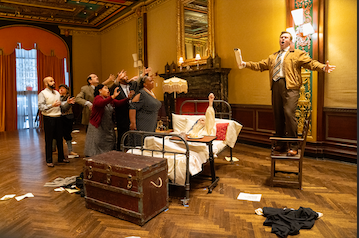
I WANT MY COFFEE!


 Bernard Holcomb, Philip Cokorinos, and Christine Lyons
(photo by meche kroop)

No other company we know of does what On Site Opera does; they make a perfect match between an opera and a venue, taking us to many places we have not previously visited. Two of our favorite matchings were their production of Mozart's La Finta Giardiniera in a community garden on the Upper West Side and the production of Puccini's Il Tabarro on a vessel docked at the South Street Seaport.  Well, Dear Reader, we have added a third! Bach's Coffee Cantata taking place currently at The Lost Draft, a charming coffee shop on Broome Street. We regret to inform you that the run is sold out (as all of their productions are) so we will make an attempt to paint the picture for you.

After being welcomed into the premises, we were seated along the wall, the table in front of us set with coffee cups, cookies, and popcorn. Magically, the barista (Bernard Holcomb) became the narrator of the piece, a 45 minute comic opera written in the 1730's by J.S.Bach and (get this!), presented in a coffee house in Leipzig. And here we are three centuries later immersed in a family drama between an authoritarian father (Philip Cokorinos) who wants his rebellious daughter (Christine Lyons) to stop drinking coffee.

Papa uses all manner of manipulations and threats to convince her to give up her addiction. She only agrees if she is allowed to marry; she secretly plans to ensure that the marriage contract contains a clause that allows her to caffeinate herself to her heart's content. It is a simple story and we had no problem with its adaptation  to contemporary times.

Total immersion involved the artists going behind the counter, making and serving coffee, whilst the actual employees of the coffee shop became supernumeraries, although there was no chorus, LOL. Everything was happening in real time and three different coffees were served. We could readily imagine being in a Leipzig coffee house in the 1730's even though dress was contemporary (costuming by Beth Goldenberg) and the work was sung in English, with a very fine loose translation by Music Director Geoffrey McDonald.

We confess that Bach has never been one of our favorites. Aside from this winning piece of fluff, he never wrote an opera and we find oratorios and cantatas ponderous. However, the charming nature of this piece allowed us to recognize his compositional skills, particularly his intricate counterpoint, as it served the witty dialogue perfectly.

The singing was delightful and there were titles available by using one's cell phone but we preferred not to take our eyes off the action, directed by Sarah Meyers. The charming score was performed by a quartet of fine musicians, comprising the American Modern Ensemble-- Violinist Nikita Yermack, cellist Valeriya Sholokova, guitarist Dan Lippel, and flutist John Romero who also played the recorder. Maestro McDonald's orchestration was completely on point. 

We have only one quibble.  It was over too soon. We enjoyed the flirtation between the barista and young lady and all the hijinks of the stage direction. We wanted a second act! We wish Bach had written about the interaction after the young lady gets married!

We raise our coffee cup to toast On Site Opera and the lovely staff at The Lost Draft!  And now, we are going to make ourself a cup of coffee!

© meche kroop

Monday, April 11, 2022

A WELL DONE CLASSIC

Laura León and John Riesen (photo by Richard Termine)
Cast of On site Opera's Gianni Schicchi (photo by Richard Termine)

Luis Ledesma (photo by Richard Termine)

Of all the opera companies we have missed, On Site Opera heads the list. Unique among opera companies, On Site Opera makes an asset out of "homelessness".  As they say, home is where the heart is, and On Site Opera's heart is wherever they can set a given opera in a meaningful locale. 
For tonight's delight, Director Eric Einhorn decided quite rightly that The Prince George Ballroom, ornate and dripping in luxury, would be the right home for Gianni Schicchi, Puccini's late life comedic masterpiece.

Any dramatist will tell you that comedy is more difficult to write and more challenging to act, than tragedy. It must also be true for composition because neither Puccini nor Verdi tackled the genre until the end of their writing careers.  As a matter of fact, it was the last work to which Puccini set his pen. Although he intended the work to be part of a trilogy, this trilogy has often been broken up and this work, the most popular of the three one-act operas, has been wed to quite a number of other one-act operas. On Site Opera chose to present it alone which, given the discomfort of sitting with a mask over one's breathing organs, was a wise decision. Coming in at one hour it was just right, leaving the audience with (sadly invisible) smiles on their faces.

How was this delight achieved? To start with, Giovacchino Forzano's libretto, derived from an 1866 edition of Dante's Inferno (based on real 14th c. Florentine characters), pokes fun at the greed of a selfish family of "aristocrats" and also at the contempt they had for the rising "middle class". Now isn't that the kind of satire we can relate to today? Do we not also get a secret kick out of scoundrels getting away with bad behavior? And what about that very very valuable mule?? There is something truly hilarious about this family fighting over said mule!

Secondly, Puccini's music is filled with humor. We cannot say what makes music amusing but likely a musicologist could elaborate on the rhythms and recurrent motifs lacing the score that tickle the ear and bring a smile to the face. There is a wonderful contrast between the dirge-like music as the family pretends to be grieving, the frisky music of everyone rushing around to create their false scenario, and the romantic music for the lovers. Geoffrey McDonald's conducting of his chamber orchestra--strangely but effectively situated behind the audience--brought out every twist and turn of the score such that we heard things we had not noticed in prior hearings. 

Finally, It is the joyful attitude of the cast who seemed to revel in their creation of characters drawn somewhat from the commedia del'arte tradition. In the title role we had the rubber-faced Luis Ledesma whose fine baritone filled out the role as effectively as his shape filled out the apropos costume of a man climbing out of the peasant class by means of a sharp wit and a lack of compunction about breaking the law.

This seems a rather odd association but we kept thinking about Tony Soprano, a criminal who won over his audience by charm. He kept his dirty dealings from his daughters, much the way Schicchi protected Lauretta by sending her out to feed the birds whilst he schemed and set up his self-serving plot. In the character's way of thinking, he was providing for his daughter's future, even risking hell for himself. There is nothing odd about a parvenu marrying into an aristocratic family headed for impoverishment, as we observed in Il Gattopardo, taking place at the time of the Risorgimento.

As Lauretta we heard the charming soprano Laura León who interpreted her character as a sweet innocent girl who loves Rinuccio for who he is, wealth or no wealth. To her is granted the most famous aria of the opera "O mio babbino caro" which, in a master directorial stroke, she delivered standing on top of a trunk, allowing her not only a sense of importance but also permitted her to mime throwing herself into the Arno. The winsomeness of her presence and the clarity of tone and phrasing made this an unforgettable performance.

As Rinuccio, tenor John Riesen turned in a similarly winning performance. He was successful in winning over his nasty squabbling relatives with his finely tuned tenor in "Avete torto... Firenze è come un albero fiorito" as well as winning over the audience. His duet with Ms. León was particularly fine with their voices blending in well balanced fashion.

David Langan's resonant bass and haughty demeanor were just right for Simone in an interpretation that we had not witnessed previously. As Zita Patrice P. Easton created a formidable matriarch who tolerated no nonsense. The lower part of her register was just perfect and at one point she took the artistic risk of growling out her line and we couldn't keep from laughing out loud.  It was one of those perfect moments.

Often, in an ensemble work like this one, it is difficult to differentiate the characters. However, up close and personal as this was, we were able to discern their individuality. Simone's son Marco and his wife La Ciesca were portrayed by baritone Jonathan R. Green and mezzo-soprano Alexandria Crichlow.  Poor relation Betto was sung by Jay Louis Chacon. The roles of nephew Gherardo  and his wife Nella were well sung by tenor Michael Kuhn and soprano Sarah Beth Pearson. Their son Gherardino was portrayed as a bratty kid who didn't want to run an errand without getting paid. The voluptuous Savannah McElhaney acted the part well without quite convincing us that she was a 7-year-old boy.

The small parts were also well cast and well performed. Brian McQueen managed to differentiate Dottore Spinelloccio and the Notario Amantio. Pinellino the cobbler was played by David Kahng. The non-singing part of the dying Buoso Donati was played by Martin Pfefferkorn.

We are aware that Woody Allen set the work in a tenement which makes no sense whatsoever. Lots of liberties have been taken with the work. Bringing it into the mid 20th c. by means of the costuming (Susan Memmott Allred) worked OK. But we couldn't stop thinking how this century-old work was composed at the time of the tragic flu epidemic and how that relates to the present. But these connections are best made in the minds of the audience.

© meche kroop


Monday, December 9, 2019

ON SITE ON POINT

Aundi Marie Moore, Benjamin Barham Wiese, Jonathan R, Green, Julius Ahn, Daniel Belcher, and Musa Ngqungwana

We have written a great deal about On Site Opera and their special niche on Planet Opera, always finding the perfect location to present an opera; it is not out of the question that the place itself might in fact inspire the choice of an opera. In either case, the Holy Apostles Church soup kitchen was the perfect place to present a unique slant on Gian Carlo Menotti's one-act opera Amahl and the Night Visitors.

It was the first opera commissioned for television by NBC in 1951. Menotti wrote the score, his partner Samuel Barber completed the orchestration, and Maestro Geoffrey McDonald brought the score to vivid life with musicians of the American Modern Ensemble. The music is tuneful and Maestro McDonald was in full command of his chamber orchestra.

There are operas whose time and place must be kept intact to seem valid; this one translated very well into contemporary times and also succeeded in calling attention to what is commonly called the "Christmas Spirit"--dealing with the rewards for unselfishness and forgiveness.

In this case, a homeless mother (Aundi Marie Moore) and her son (Benjamin Barham Wiese) interact realistically over his tendency to tell tall tales and her tendency to call him on it. He sees the star in the sky and the Wise Men at the door. Although the family has nothing to speak of, they do their best to provide for the travelers. The boy is crippled and using a crutch which he offers to send to the newborn King. He is thereby healed and able to walk.

An advantage we had over others is that we have never had a television and consequently were totally unfamiliar with the work. Consequently, we had no expectations of shepherds and sheep and were able to immerse ourselves in the story as Director Eric Einhorn so admirably presented it. The Three Kings appeared as homeless men pushing shopping carts. Clearly, their nobility resides in their generosity, not in their material wealth.

There were several moments that touched us deeply, especially when the boy defends his mother from the security officer (Jonathan R. Green) who is arresting her for stealing gold from the Kings. This did not exactly add up because one doesn't expect the homeless to be carrying gold! But this is a myth and we were able to accept the inconsistency.

We loved the moments when Kaspar (tenor Julius Ahn) sings about his magic box which contains beads and stones. His voice was particularly well-balanced with that of bass Musa Ngqungwana (as Kaspar) and baritone Daniel Belcher (as Melchior).

We also loved the dancing, choreographed by Winston A. Benons Jr. The dancers exhibited such spontaneity and gusto that we were swept along by the simple unpretentious movements.

The chorus comprised a group of folks who had experienced homelessness and were clients of Breaking Ground, an organization that establishes permanent supportive housing for the homeless; their fine singing, led by Michael A. Ciavaglia, sounded totally professional. Jessica Jahn's costumes were appropriate and rather fanciful for the Kings.

The singing was at the highest level and met all the musical demands of the score; the acting was similarly convincing and believable.

Everything we have written is about the artistic merits of the production. We would like to add some opinions about the social merits. It was a great idea to ask audience member to contribute some non-perishable food. This called attention to the fact that we were in a soup kitchen and there are people who need to be fed. The entire experience elevated the homeless beyond the level of societal outcasts and led us to see them as folks who are simply down on their luck.

By a strange coincidence we had just the night before read a contribution on Quora about what it is like to be homeless. Our awareness has been raised. We found ourself with tears streaming down our face. We glanced at our guest for the evening who was also weeping, as was the woman next to her.

That art should have such a profound effect on us is a wonderful thing. Too many times have we exited the Met thinking "that role was well sung" and forgotten the entire performance within the hour.

We loved seeing art performing what we think it capable of. It should hold a mirror up to society to show us what we are missing in everyday life. Bravo to On Site Opera for taking risks.

The opera was performed last year and we hope it will be scheduled again for next year.

© meche kroop


Saturday, October 26, 2019

AS THE SCREW TURNS

Ashley Emerson and Jennifer Check

We have just had an experience that compares with most operagoing experiences as a dinner at La Grenouille would compare with a fine dinner at home. It was way more than delicious and nourishing; it was one of those evenings that will be indelibly etched in our memory. It was Britten's Turn of the Screw performed on the beautiful estate Wave Hill.

Eric Einhorn's concept for On Site Opera is to produce just such experiences that add up to more than the sum of their parts. There is always a location that amounts to way more than seats in an audience facing a stage with sets. There is always an intimacy with the story and the singers. It must be quite a challenge to find just the right location for any given story but it always works.

There was not enough space for more than a fortunate few and we count ourself among them. Because you, dear reader, probably did not make the cut (the show having sold out within minutes of its announcement), we would like to cut right to the chase and describe the experience. Trust our judgment on the point that the parts were superbly cast and magnificently acted and sung and that Geoffrey McDonald's conducting of his chamber orchestra made the most of Britten's score, adding layer upon layer of anxiety and suspence. 

A team of guides handed each one of us a lantern and guided us through the pathways until we reached a gothic looking building with a balcony from which a narrator introduced us to the story. The opera is based upon a gothic ghost story--a novella by Henry James. Myfanwy Piper wrote the concise and effective libretto.

Next we met The Governess in the person of soprano Jennifer Check, in perfect period costume, who led us to the front door of the country house where she was to take care of two orphaned children, without ever bothering their uncle who had hired her. She shared her excitement and anxiety with us and even asked someone to hold her suitcase whilst she opened the front door.

From then on we felt like a fly on the wall, observing her meeting the housekeeper Mrs. Grose (mezzo-soprano Margaret Lattimore) and then her two charges who stood holding photographs of the former governess Miss Jessell and the valet Peter Quint, both of whom had died recently. 

The children had been instructed by Mrs. Grose to bow and curtsy but we knew instantly that something was wrong. One couldn't have seen the subtle facial expressions underlying their politesse at the Met but it was obvious from a few yards away.

It seemed clear to us that The Governess is not going mad when she sees the ghosts of Mr. Quint and Miss Jessell. (We have seen a film in which she is portrayed as hysterical and the children as needing to be rescued from her care.)

As Mr. Einhorn has so astutely directed the action, moving the audience from one room of the large mansion to another, the illusion of knowing the characters took hold and gripped us by the throat. We lost the concept of ambiguity from James' novella and identified strongly with the terrified Governess as she faced the two ghosts.

Dominic Armstrong was completely riveting as Peter Quint; the way Mr. Einhorn directed his scenes with Miles (counter-tenor Jordan Rutter) we were convinced that Quint had seduced the boy whilst he yet lived and was trying to snatch his soul now that he had died. We rarely see such a portrayal of evil onstage with Mr. Armstrong coloring his voice to match the text.

Adriana Zabala made a rather more sympathetic Miss Jessell. In a directorial coup,  there was a parallel scene with the current Governess and Miss Jessell walking the same pathway in tandem. This added to the gothic element of the storytelling and gave us the shivers. We wondered whether the poor (unnamed) Governess would also die. It is a mark of great storytelling and great acting that we were so caught up that we wanted to know what happened to her! Ms. Check made us feel on her side from the start.

As Flora, Ashley Emerson acted the part of a young girl with considerable success. As Miles, Mr. Rutter was totally convincing. He is small and slender of stature and his treble voice lent considerable verisimilitude. Both "children" gave evidence of secrets and secret lives.

Even Mrs. Grose, portrayed by mezzo-soprano Margaret Lattimore, seemed to have secrets, only some of which were shared with The Governess. At one point we saw her drop something in a cup of tea but were not sure for whom it was meant or whether it were poison or sedative. Ambiguity was everywhere and we believe James wanted us to be puzzled by unanswered questions.

The chamber orchestra was as Britten intended, comprising a string quartet plus a bass and one each of the necessary winds. The versatile instrumentalists seemed adept with the flutist handling piccolo and two registers of flutes; the oboist doubled on English Horn and the clarinetist switched to the Bass Clarinet, one of our favorite sounds in the orchestra. There was also a French Horn, a Bassoon, and a marvelous harpist who created quite an atmosphere. 

The pianist and the percussionist added to the texture; there were chimes, some soft Kettle Drumming, and what might have been a celesta. We meant to inspect the percussion section after the curtain call but we were still in some kind of state that lasted until we got home. The atmosphere of the performance was so intense that at one point we accepted what occurred onstage as reality and felt as if we were a ghost.

The costuming by Amanda Seymour was perfect and completed the illusion that we were back in the 19th c.  What a completely strange experience! Talk about total immersion!!!

On Site Opera's contribution to the New York opera scene is valuable and unique. Our only regret is that his productions cannot accommodate more people.

© meche kroop

Saturday, May 18, 2019

MURASAKI'S MOON

John Noh, Kristen Choi, and Martin Bakari


At a time when opera companies are struggling to survive, it is thrilling to watch On Site Opera thrive. In spite of high ticket prices, their productions are always sold out. It would appear that the originality of their concept and the deftness of their execution would account for their success. Snagging a ticket almost guarantees a rare and unusual experience.

In collaboration with MetLiveArts and American Lyric Theater, their latest production, Murasaki's Moon, served to heighten the interest of theater goers in the adjacent exhibit at the Metropolitan Museum of Art, an exhibit which the performance brought to vivid life in the hands of Artistic Director Eric Einhorn. 

The work is based upon The Tale of Genji, an 11th c. epic novel written by the noblewoman Lady Murasaki, perhaps the world's first novel. It is filled with characters beyond counting and illustrated lifestyles and customs of the Heian court. It was written by a woman for women in an archaic language used by women, a phonetic language. It was only in the 20th c. that the work was translated into modern Japanese.

English translations followed and the work has had a major effect on all of the arts of Japan, from 12 c. scrolls and screens to contemporary manga series and TV dramas. There was an opera written in 2000 but we were unable to learn anything about it.

The subject of the novel was Genji, the emperor's son whose mother was a lowly born, but favored, concubine. He led a wild romantic life, filled with illicit liaisons and several marriages. The production we saw, with libretto by Deborah Brevoort, did not attempt to tell any episodes from the story, but rather to focus on Lady Murasaki's relationship with her creation Genji, who served as muse.

So many contemporary issues were touched upon that there was no question of relevance. Take for example the issue of the loneliness of the writer. (Just ask us!) Lady Murasaki has a modest position at court, illustrated by her almost colorless three-layer kimono. She desperately wants a friend, but she is different from the other women at court and is the object of envy and rejection. She writes and Genji keeps her company. Many writers of fiction will tell you that they create characters and the characters write the story!

Although we have come a long way here in NYC, there are plenty of places around the USA where creative women are looked at with unkind eyes because they don't follow the wife/motherhood program. We could certainly identify with Lady Murasaki, the "misfit".

In the story we watched, she is angry at Genji for his philandering. He is untrue to her and disappears for periods of time, perhaps representing periods in which writers cannot summon their muse and go silent. On the other hand, putting on our psychological hat, it would seem that Genji is Lady Murasaki's animus, what Carl Jung called the inner representation of a woman's male characteristics. (And yes, men are purported to have an anima, representing their female qualities).

Murasaki makes several pointed observations about women gazing at their images in the mirror and making efforts to be more beautiful. Could anything be more relevant? In any case, we cannot stop thinking about the many layers of the story. 

The music added greatly to the story. Composer Michi Wiancko composed some beautiful instrumental music that combined Japanese instruments (Taiko drums and shakuhashi played by Kaoru Watanabe, percussion played by Satoshi Takeishi, and koto played by Yoko Reikano Kimura) with Western music performed by the Aizuri String Quartet. All was conducted by Geoffrey McDonald who integrated the two seamlessly.

The vocal line was another story altogether. Like so much contemporary music, the vocal line was jagged and not at all melodic. Combined with a libretto that often rhymed but did not scan at all, we found little to enjoy, in spite of admirably convincing performances by Kristen Choi as Lady Murasaki, Martin Bakari as the ultimately repentant Genji, and John Noh as a Buddhist priest who himself became interested in Murasaki's writing, a scene we particularly enjoyed. There was one magical musical moment--a duet with gorgeous harmonies that told us that Ms. Wiancko could do better. We would have loved to hear more Japanese-inflected vocal lines. We would have loved to have heard it in Japanese!

Effective costuming was provided by Beth Goldenberg. Genji's bright blue costume and the Buddhist Priest's yellow robes were in high contrast with Murasaki's pale costume. The work was performed in the Astor Court of the Metropolitan Museum of Art. It was staged in a long narrow playing area with audience members seated along each side. 

We would like to add a few words about the titles. The three singers had such excellent diction that titles were unnecessary but we were interested in the technology that was used. Audience members were able to download the On Site Opera app on their phones where titles were available and perfectly matched to the singing. This appears to be the way of the future. We tried it to see if it was distracting and it was not.

The dramatic performances aroused our curiosity and we spent some time in the nearby exhibit, particularly enchanted by the court games that were played, utilizing scenes from the novel. Scenes from the novel also decorated so many artifacts. It was obvious how influential this novel was on a millenia of Japanese culture.

We were too lost in thought to consider any way of getting home other than walking through the park, accompanied by a full moon! We thought of it as Lady Murasaki's moon and felt a strong connection. Isn't that what art is all about?

(c) meche kroop

Thursday, March 22, 2018

ON SITE OPERA ON THE LOWER EAST SIDE

Joshua Jeremiah, Emily Pulley, and Jennifer Zetlan in Morning Star (photo by Pavel Antonov)

The hardy New Yorkers who braved the "fourth'easter" of the season were rewarded with a resonant evening, some insights into New York history, some fine music, and some very stiff necks. The latter point has to do with one of the hazards of staging works on site, which On Site Opera does very well; the space may be evocative but not comfortable.

Ricky Ian Gordon's Morning Star, originally commissioned by Cincinnati Opera, was staged in the sanctuary of the 1887 Eldridge Street Synagogue, now the Museum at Eldridge Street. General and Artistic Director Eric Einhorn has staged the work using all parts of the sanctuary, including the balcony. This worked dramatically but made viewing uncomfortable since much of the action took place at the rear.

The evocative story concerns a family of immigrants in 1911 and 1932. They came from Riga in Latvia where, we gather, some unspeakable things were done to Jewish folk. But this compelling story could be paralleled in present time with any new immigrant group trying to adjust to a difficult life in a new place. The destructive effects of family secrets and the effects of tragedy on successive generations are both common themes in the theater.

The story concerns the widowed Becky Felderman (performed by the powerful soprano Emily Pulley) who has immigrated to the USA with her three daughters. The eldest, Sadie (affectingly sung by mezzo-soprano Blythe Gaissert) is the smart one who has never felt loved. The second is Fanny (sweet voiced Jennifer Zetlan) who will marry Irving (terrific tenor Blake Friedman) who will not let her sing.

The youngest girl Esther (performed by soprano Cree Carrico who plays "adorable" very well) captures the love of Sadie's main squeeze, the teacher Harry (fine baritone Andrew Lovato). Poor Esther dies in the Triangle Shirtwaist Fire (about which we have more to say further along) on her wedding day.

Important to the family is Aaron Greenspan who never gives up on his romantic pursuit of Becky. . Joshua Jeremiah used his keen dramatic instincts to create a believable character.  His powerful baritone matched well with Ms. Pulley's soprano. We particularly liked a song he sang in Yiddish which was mostly understood by this German-speaking reviewer. He was reminiscing about what he missed about Riga. Becky joined in with some not-so-happy memories.

We enjoyed Martin Bakari's sweet tenor in the role of Prince, a street peddler.  Smaller roles were taken by mezzos Chrystal E. Williams and Allison Gish. Only David Langan's bass-baritone was stentorian and unattractive as the rabbi.

Music Director Geoffrey McDonald did his customary superlative job conducting the American Modern Ensemble, a dozen fine musicians who made the most of Bruce Coughlin's orchestration for chamber orchestra. The wind section was particularly notable. The chamber orchestra was situated at the rear of the sanctuary and the sound floated forward with ease.

We have nothing but good things to say about the orchestral writing but we have a hard time finding something to praise about Ricky Ian Gordon's writing for the voice. The puzzling part of this is that Mr. Gordon wrote the most beautiful vocal line for Irving--"Oh Morning Star", a love song sung to woo Fanny.  Would that all the writing had been this melodic!

We did like the way that arias became duets and duets became ensembles.  The voices blended beautifully.  We just wanted to hear some melody! We liked Becky's song "Men come, men go, family abides". "Three loving sisters" was an interesting trio evincing a complex collection of emotions. 

Of all the sisters, Sadie was the most disagreeable and yet Ms. Gaissert's performance left us with sympathetic feelings. Her jealousy and bitterness clearly came out of feeling unloved.  She sang "Smart never won a man's heart". The early 20th c. was not kind to smart ambitious women. Her defensiveness was revealed in "Is it my fault?".

There was a 21 year gap between Act I and Act II; Summer Lee Jack's costumes were appropriate for both periods. Emilia Martin's wigs were as unflattering as wigs usually are. Shawn K. Kaufman's lighting design was splendid, especially for the fire which was so convincing that we nearly forgot it was "theater".

The libretto by the late William M. Hoffman seemed just fine, although a substantial amount could not be understood. Anyone who can rhyme "latkes" with "hot kiss" is OK in my book!

And now we come to the Triangle Shirtwaist Factory Fire story, the worst workplace disaster in NYC history until the World Trade Center attack of 2001.  The death toll was 146 people; greed and carelessness were to blame. If you seek more information, we refer you to http://rememberthetrianglefire.org/

The pre-opera lecture we attended added a great deal to our appreciation of the work itself. Two member of the Remember the Triangle Fire Coalition spoke to the audience of their personal experience as relatives of women who lost their lives in the fire. These two generous speakers were Mary Anne Trasciatti and Suzanne Pred Bass whose memories brought the story alive for us. 

We were happy to learn that the tragedy had a silver lining in that the cause of labor was advanced; workplace safety has been addressed (and is still being addressed!) as was working conditions. The flagrantly indifferent owners of the factory were acquitted due to the efforts of a high-powered attorney who intimidated the young women witnesses.  So sad!

To bring the story to the present, Governor Andrew Cuomo has donated a significant amount of money to establishing a memorial so that this tragedy will be remembered.

(c) meche kroop

Wednesday, June 21, 2017

GUILTY AS CHARGED

Jennifer Black and Amy Owens in On Site Opera's production of Darius Milhaud's "La Mere Coupable" (photo by Fay Fox)


It was a grand idea of On Site Opera to present little known musical adaptations of Pierre Beaumarchais' trilogy of plays about la famille Almaviva. Two years ago we thrilled to Paisiello's version of The Barber of Seville.  Last year we thrilled to Marcos Portugal's iteration of The Marriage of Figaro. Last night we did not thrill to Darius Milhaud's The Guilty Mother, the final entry of the trilogy, taking place twenty years after The Marriage of Figaro. The superb performances were there. Eric Einhorn's direction worked well. The site chosen was interesting.  Maestro Geoffrey McDonald conducted the International Contemporary Ensemble with his customary artistry.

What went wrong?  Why would we be happy to hear the Paisiello and the Portugal again but not the Milhaud? The fault lay in the libretto and the music.  Great music can survive a flawed libretto and some stories are so compelling that mediocre music can be tolerated.  In this case, we found the libretto deficient in the sense that it was confusing in its adaptation from the Beaumarchais play, which was written in 1792, just before his exile. The fact that the adaptation was performed by his wife Madeline gives us a clue that this was a case of nepotism.

If you've ever wondered what happened after the Count and Countess reconciled and Figaro and Susanna were wed, here it is, according to Beaumarchais. The Count left on a long business trip. The Countess spent the night with Cherubino and bore a son named Leon. The Count was always suspicious of Leon's parentage. Never mind that he himself committed adultery and has taken the female child Florestine into his home to raise. She and Leon are in love.

A snake-in-the-grass, a scheming Tartuffe-like figure named Begearss has wormed his way into the household, taking advantage of aristocratic helplessness. Begearss plans to marry Florestine and acquire Almaviva's fortune. Thanks to bold action on the part of the resourceful Figaro, Begearss is thwarted and the two young lovers learn that they are not related by blood and are free to wed.  Happy ending.  Comedy?  Not quite! There may have been opportunities for comedy but they were missed.  This is a dreary work and the poorly fleshed out characters fail to win the audience's sympathy. What we love about the music of Mozart and Rossini is that it matches the characters and their actions.  That would seem to be a basic minimum requirement for writing an opera!

We understood that, at one point, Andre Gretry proposed setting this play to music and what a pity the project fell through. Putting this story into the hands of Darius Milhaud was not a fortunate move. The 1966 score is replete with ugly dissonances and never seems connected with the onstage action. The vocal lines are devoid of melody or any form of lyricism. The singers gamely did their best with the non-melodic vocal lines and projected well over the dense orchestration, with the exception of poor Andrew Owens whose allergic affliction left him inaudible. We do recall his sweet sound from Aureliano at Caramoor. We didn't mind because he acted well!

As the guilty mother, soprano Jennifer Black sang with strength and conviction. We last caught Ms. Black at the Met in the role of Lisa in  La Sonnambula. As Florestine, lovely coloratura soprano Amy Owens, so well remembered as Zerbinetta in Santa Fe, handled the high tessitura beautifully and very much looked the part. Mezzo-soprano Marie Lenormand, whom we enjoyed previously as La Perichole and also singing with NYOS, handled the part of Susanna very well and, as Figaro, baritone Marcus DeLoach made a forceful opponent to the slimy Begearss, well portrayed by bass-baritone Matthew Burns. 

The Count himself was sung by Adam Cannedy who has a fine baritone that showed up so well in the recent Glory Denied,: here he looked too young for the part. This was supposed to take place 20 years after the action of Marriage of Figaro. Come to think of it, Ms. Black also looked too young for the Countess.  Perhaps her night with Cherubino restored her youth!

Bass Christian Zaremba, last scene as the Commendatore in  Venture Opera's Don Giovanni,   was excellent in the small role of the notary who appears in the last scene. It was just in the last ten seconds of the opera, in the septet, that we heard a little bit of music to which one would want to listen.  Not enough! But it shows that Mr. Milhaud was capable of writing something listenable and chose not to do so.

The site chosen for this opera was an enormous garage near the West Side Highway.  Instead of scene changes, the two acts were staged in different parts of the huge space, with audience seating moved to accommodate. During the first act, we felt as one might feel at a tennis match with much head turning and neck stiffening in order to read the titles which were on either side and perpendicular to the stage. The second act offered some relief with titles projected above the action and readily readable.

We have no idea why the action was set contemporaneously with Mr. Milhaud's composition. It made no sense unless the characters underwent some sort of Rip Van Winkle phenomenon. And why was the furniture threadbare and the costuming so dowdy? In the play, the Count has been spending down his fortune to cheat Leon of his inheritance but he certainly wasn't spending it on furniture or clothing, nor on pay for his servants!

We will decline to mention the production team responsible for this ugliness but will say that Shawn K. Kaufman's lighting was fine and that the French diction was quite good all around thanks to Jocelyn Dueck.

Perhaps this was the only opportunity we will ever have to witness the sequel and for this we thank On Site Opera for this courageous (but misguided) bit of programming. It was, in fact, the United States premiere but was produced recently by the Theater an der Wien as a piece of shocking regietheater. This production was part of New York Opera Fest 2017 presented by the New York Opera Alliance, of which On Site Opera is a member. Partnership with the Darius Milhaud Society was a feature and the production was dedicated to the memory of Katherine Warne, a composer and founder of the society.

(c) meche kroop

Friday, May 12, 2017

BACK TO THE GARDEN

ON SITE OPERA CURTAIN CALL


Sitting in the fragrant and manicured West Side Community Garden on W. 89th St. we couldn't help thinking of that classic rock tune by Crosby, Stills, and Nash with the lyrics "And we got to get ourselves back to the garden".

Had On Site Opera's production of Mozart's The Secret Garden not been so compelling the gorgeous colors of the Spring flowers might have upstaged it.  Happily, nothing could have upstaged this production, one that left us with a big smile which should last us at least through the weekend. Looking at the faces of the audience members indicated that our joy was a shared experience

The wildly creative stage director Eric Einhorn has so many tricks up his sleeve that we never know what he will come up with next.  Except we do know and we will tell you a bit at the end of this review. The entire premise of On Site Opera is to match the production to an appropriate setting. Regular readers will know exactly what we refer to but others can enter "On Site Opera" into the search bar to fill in their knowledge, lest we repeat ourselves.

Right now, it is the current production that commands our attention and mobilizes our face into a goofy grin. What an inspiration to present Mozart's La finta giardiniera in a garden! The site was perfect with the audience sitting around the perimeter of a large grassy circle with the action taking place both within the circle and in the aisles around and behind the audience. The cast of seven could remain interacting with each other whilst the principal participants in that scene were "center stage". Occasionally, cast members interacted with members of the audience.

It seemed so organic but probably an incredible amount of labor was necessary to produce that effect of spontaneity. To our surprise the acoustics were excellent. Calzabigi's libretto was translated and obviously adapted by Kelley Rourke, and a very fine translation it was. The scene in which Sandrina and Count Belfiore go insane was wisely cut and the 90 minute production moved along swiftly, relying on spoken dialogue in place of recitativi to move the action forward. Readers may be shocked to learn that we enjoyed the English but there was great skill involved in converting this silly and unwieldy story into an hour and a half of pure delight. Focus was placed squarely on the interactions of the lovers.

The story concerns seven would-be lovers all at odds with one another until they learn certain lessons. The three male suitors must learn how to court the women they desire. Count Belfiore (beautifully sung by tenor Spencer Viator) has anger management issues that drove away his beloved Lady Violet (the marvelous soprano Ashley Kerr) who is hiding out working for the Mayor (performed by terrific tenor Jonathan Blalock), as a gardener named Sandrina,

Superb baritone Jorell Williams (a product of Martina Arroyo's Prelude to Performance some years ago) portrayed Lady Violet's servant who has accompanied her, also disguised; he learns to court the Mayor's servant Serpetta (splendid soprano Alisa Jordheim) in a foreign language which she clearly finds far more romantic than English.

The modest Ramiro (portrayed by marvelous mezzo Kristin Gornstein, well known from Heartbeat Opera) must overcome his diffidence and pursue the Mayor's niece Arminda. Soprano Maeve Hoglund created quite a character--what the French would call exigent. She only accepts Ramiro when he gets forceful. Faint heart never won fair lady, as they say.

We find mating behavior fascinating--pursuit, rejection, betrayal, reconciliation--far more than stories about terrorism, politics, and inventions. We wish more contemporary composers would write about romance. Don't we all love to see our foibles onstage?

There were plenty of sight gags to add to the fun. Props like rakes, spades, and garden hoses were put to good use which you will want to see for yourself.

So the story was engaging, the singers splendiferous, the setting delightful, the English diction perfect. Even the lighting (designed by Shawn K. Kaufman) was inventive with strings of white lights encircling the garden, changing to blue when the Count was desperate and to red when things heated up. Costume design by Beth Goldenberg was right on point with Arminda appearing quite glamorous in her Schiaparelli pink costume and hat. Even the shoes were perfect with Sandrina (Lady Violet) wearing yellow Wellies and the Count wearing violet patent leather.

But this is opera and we have yet to say a word about Mozart's music.  He was but 18 years old when he composed the work (and what's YOUR 18-year-old doing?). The melodies that tumbled out one after another from his teen-aged pen were brilliantly conducted by Maestro Geoffrey McDonald with his customary stylish verve. The reduced orchestration was accomplished by horn player Yoni Kahn and Thomas Carroll. Orchestration was effectively distributed among a pair of oboes, a pair of period clarinets, a pair of bassoons, a pair of horns, and a double bass. The group calls itself Grand Harmonie and lives up to its name. The vocal lines are all melodious and the ensembles filled with pleasing harmonies.

The fact that On Site Opera presented this gift to our community (a new initiative of theirs) is astonishing and surely merits one's consideration of a generous donation.

This is a co-production with The Atlanta Opera and will be presented at the Atlanta Botanical Gardens next weekend. So, unless you want to travel south, we strongly urge you to show up tonight and to show up early. The production begins at 7 so don't say we didn't warn you. Saturday night is the final performance. The address is 123 W. 89th St. in Manhattan.

W promised to tell you a bit about what On Site Opera has coming up.  The United States premiere of Darius Milhaud's The Guilty Mother will be presented at The Garage, 611 W. 50th St. on June 20, 22, 23 and 24. If you've ever wondered what happened to the folks DaPonte wrote about, this will be your chance.

Finally, we would like to mention that we have a lot more to say about this opera which we reviewed two years ago at the Santa Fe Opera. If you enter "Crazy in Love" into the search bar above, you will be directed to a funny psychological analysis which we wrote about their very fine traditional production.

(c) meche kroop

Sunday, October 2, 2016

I'M NOT GETTING MARRIED TODAY!

Blythe Gaissert and Leah Partridge (photo by David Andrako)

It's a grand old ballroom at the Stanford White designed Harmonie Club and we are all atwitter anticipating a glamorous wedding.  We are greeted by liveried servants with goblets of wine and take our seats at beautifully appointed tables.  The feast is about to begin.  There will be live music and we are happy to be seated near the musicians. Crystal chandeliers glisten overhead in 19th c. glory.

There is a gorgeous bride, a real beauty.  BUT THERE IS NO GROOM! Poor Aurelia Havisham has been stood up by Matthew Compeyson.  What a disaster!  But she was stood up many long years ago and has gone bonkers.  And who doesn't love a mad scene? Watching someone decompensate has a weird thrill.  What will they say? What will they do?

This wedding was another one of On Site Opera's devilishly clever concepts of immersive opera. This production inaugurated their sixth season of producing rarely seen operas in unusual locations that are well suited to the material. To do this successfully requires tight creative collaboration among highly talented people.

General Artistic Director (and Co-Founder) Eric Einhorn possesses finely honed directorial skills and exquisite taste. No doubt he helps his singers get inside the characters they portray--a necessary skill since they are often just inches away from an audience member. There is never a lapse of dramatic honesty and urgency.

Producer, Co-Founder, and Executive Director Jessica Kriger has the skills to bring all this together.  Under her guidance, On Site Opera has expanded its sixth season which now comprises three additional events.

Music Director Geoffrey McDonald handles his chamber orchestra with incomparable skill. He was fortunate to have the string quintet known as "Sybarites" augmented by seven winds, percussion, harp and piano, performing the score to Miss Havisham's Wedding Night the 1979 monodrama by Dominick Argento.  The orchestration was quite interesting with growling bass and profuse employment of percussion.

The Hector Berlioz 1829 monodrama La Mort de Cléopâtre served as curtain raiser but was anything but a throwaway. Mezzo-soprano Blythe Gaissert made a convincing Queen of Egypt with her gloriously smoky timbre, lyrical phrasing, and fine French diction. The vocal line varied from angular to lyrical, all of which she took in vocal stride. The libretto was written by Pierre-Ange Vieillard de Boismartin.

Her costuming by Fay Leshner was completely on the mark and the hair and make-up design by Affan Malik made her look exactly as we had imagined Cleopatra would look.

Although she was not ditched on her wedding day, her plight shared a common theme with that of Miss Havisham. After two successful liaisons with Anthony and with Caesar, she is unable to win the affections of Octavius and commits suicide by snake bite. The rubber snake was so cleverly manipulated that we thought it was real.

We were shaken by this performance although the main event was yet to come. Ms. Havisham was portrayed--NO! LIVED--by soprano Leah Partridge. It was so utterly convincing a portrayal of delusion and hallucination that we feared poor Ms. Partridge would go over the deep end.  Fortunately, she emerged unblemished at the end, her contorted face restored to its lovely shape.

Her voice is a thing of crystalline beauty and it was well employed in the service of the text written by John Olon-Scrymgeour who based her character on the character of the same name in Charles Dickens' Great Expectations. The phrases are wildly disjointed and make only the strangest kind of sense--something psychiatrists call "primary process thinking".

It is interesting that Miss Havisham does not lack self-awareness. She opens by singing "It is Miss Havisham's Wedding Day! Unique behavior is expected".  Later she admits "I am a little out of my wits". Costume, make-up and hair design all contributed to the feeling of disjointed reality.

In a directorial masterstroke, the monodrama ended with Cleopatra joining Miss Havisham for tea, thus linking the tales of abandoned women. The audience was served wedding cake before having the opportunity to greet the artists. Performing up close and personal like that with no other singer to bounce off seems to be the most demanding form of performance but Ms. Gaissert and Ms. Partridge deserved all the accolades they got.

Shawn Kaufman was responsible for the effective lighting design.

One rarely witnesses such an effective coming together of the arts. There are many excellent small opera companies in New York, each one with its own special take. This form of producing opera is original and highly affecting.  It is also costly to produce since the audience must be limited. We'd bet that the ticket income doesn't come close to meeting the costs of production. Financial support is always welcomed.

We are already on board for The Tell-Tale Heart, the premiere of a new opera by Gregg Kallor taking place in a secret crypt on October 26th and 28th. Don't miss your chance.  It is sure to be sold out.

(c) meche kroop

Wednesday, June 10, 2015

A BARBER OF A DIFFERENT CUT

David Blalock, Rod Nelman, and Monica Yunus

It comes as no surprise that the innovative On Site Opera has come up with yet another daring idea--The Figaro Project--presenting all three Beaumarchais-based operas over a period of three years. Forget Rossini, forget Mozart, forget Corigliano. The three "alternates" are Giovanni Paisiello, Marcos Portugal and Darius Milhaud.

Paisiello's librettist for Il Barbiere di Siviglia, Giuseppe Petrosellini, hewed rather more closely than did Rossini's librettist Cesare Sterbini to the Beaumarchais comedy; the love interest between Rosina and "Lindoro" (Count Almaviva in disguise) was given more weight than the cleverness of the famed barber. The work premiered in 1782 and was wildly popular. Rossini's version did not enter the opera stage until 1816 and it took a long time for it to supplant the Paisiello. Today, Rossini's version is preeminent and Paisiello's has faded into obscurity.

Thanks to On Site Opera, this oversight has been remedied and we spent a delightful evening revisiting the story with "new" music at a particularly apt venue that added to the enjoyment.  We began the evening sitting in the courtyard of the Fabbri Mansion which dates back a century and has been landmarked. The singers were finely costumed by Candida K. Nichols in garb of that same period.

The sweet-voiced tenor David Blalock as Count Almaviva is nervously trying to serenade Rosina, the cloistered ward of the controlling Dr. Bartolo. Figaro, portrayed by baritone Andrew Wilkowske, is here a musician who has fallen on hard times and has taken up barbering. He and the Count recognize each other and set the plot in motion.

In Paisiello's version there is no band hired for the serenade but we did not feel at all cheated since the music coming from the chamber orchestra  was so delightful. Newly appointed Music Director Geoffrey McDonald (much enjoyed on prior occasions at the White Box Center's Alcina and Gotham Chamber Opera's El Gato con Botas) led a chamber orchestra comprising a string quartet augmented by woodwinds and a guitar which handled the recitativi better than any harpsichord.

At a balcony overhead, the doors parted and the lovely soprano Monica Yunus stepped out. We felt like part of the action, perhaps a neighbor witnessing the serenade. We love the idea of a site-specific work and the Fabbri Mansion worked perfectly well. One could see into the mansion from which emerged the foolish and controlling Dr. Bartolo who is cutting back on Rosina's fresh air privileges. Rod Nelman's hearty bass-baritone was perfect for the buffo role.

Also emerging from the mansion were two servants who provided plenty of comedy with their snuff-dipping, sneezing, and yawning. Baritone Benjamin Bloomfield portrayed Svegliato and later, lavishly bewigged, the notary who marries Rosina and the Count. In this production, the tenor role of Giovinetto was sung by the adorable soprano Jessica Rose Futran who kept us laughing.

When the action moved inside, the audience was ushered into the library of the mansion and seated along the two long sides of the room. Everyone had a good view of the action and many were involved in the performance to a small extent. We felt grateful to On Site Opera for taking us out of the theater and into a place that felt real.  A few props sufficed and the entire affair was subtly and effectively lit by Shawn Kaufman.

The dapper Don Basilio was portrayed by bass-baritone Isaiah Musik-Ayala who lived up to his name. "La Calunnia" was well sung but not nearly as well-developed as Rossini's version.

The scenes were pretty much the same as in the Rossini version and the melodies were charming. Every voice effectively expressed the character and the Italian was so fine that the projected titles were scarcely necessary. Clearly, leaving the concert hall requires no sacrifice of musical or dramatic values. General and Artistic Director Eric Einhorn has earned our admiration and respect. When we could tear our attention away from the action, we glanced around the room and saw rows of smiling faces.  Does one see that at the Met?

We can scarcely wait for next year's Nozze di Figaro, written by Marcos Portugal in 1800 and never before seen in North America. The following year we will get to see La Mère Coupable, written by Darius Milhaud.

If you move quickly you may be able to snag a seat for one of the three remaining performances on Thursday, Friday and Saturday. Last night there was not a seat to be had. On Site Opera has only been around for a couple years but word has gotten out. We know quality when we see/hear it.

(c) meche kroop

Tuesday, April 28, 2015

GETTING A HANDLE ON HANDEL

Brennan Hall, Anya Matanovič, Kiera Duffy, and Hadleigh Adams

If you attended Händel's Orlando last night at the WhiteboxLab/Sound Lounge and closed your eyes you would have heard five truly magnificent voices and a wonderful chamber orchestra making marvelous music. But then you might have missed the point.

Director R.B. Schlather has taken on an ambitious project--presenting three Händel operas adapted from Ludovico Ariosto's epic Orlando Furioso. We thoroughly enjoyed the first entry Alcina (review available from our archives by using the search bar) and were eager for his Orlando, composed by Händel in 1733. This groundbreaking opera was not a popular success at that time and lay dormant for over two centuries.  It's first American appearance was at Carnegie Hall in 1971.

Popular success arrived this week at the WhiteboxLab/Sound Lounge. Mr. Schlather's idea was to bring opera downtown and to highlight the actual process of creation of the opera as well as the final product. Rehearsals were live-streamed and also open to the public. Sadly, our schedule permitted only attendance for the live performance.

The playing area ran the length of the long room on an elevated platform with the seating of the audience in similar configuration so no one was far from the "stage". To the rear was the excellent chamber orchestra, sensitively led by Music Director Geoffrey McDonald who magically managed to define all the instrumental lines--using only his bare expressive hands and, at one point, exhibiting his bare chest as well. The listening experience was like getting close to a fabric and being able to recognize each thread composing the pattern. 

Instruments of the baroque period were in evidence and continuo was provided by harpsichordist Elliot Figg. There were some magical moments as when soprano Anya Matanovič in the role of Dorinda produced a stunning trill and the harpsichord echoed her trill. When Angelica (soprano Kiera Duffy) and Medoro (countertenor Brennan Hall) reminisce about the woods where they first fell in love, woodland sounds could be heard in the orchestra.

The story is silly and a straight presentation would never fly. The knight Orlando is obsessively in love with the princess Angelica who (of course) loves another--the Moorish prince Medoro whose wounds she healed in the cave of the shepherdess Dorinda.  Of course, Dorinda also loves Medoro. Orlando (countertenor Drew Minter) goes mad but is restored by the magician Zoroaster, performed by baritone Hadleigh Adams, who had enough strength in the lower register to qualify as a bass-baritone.

Mr. Schlather's daring direction and Terese Wadden's costume design presented these characters as denizens of downtown when downtown was delightfully decadent. Mr. Minter appeared as a derelict in pajamas under his street clothes and a raincoat on top. He looked frightfully seedy and disheveled. No wonder Angelica didn't love him! His last act aria "Vaghe pupille" was movingly delivered.

The role of Angelica was performed by Kiera Duffy whose bright soprano handily nailed Händel's embellishments. There was something uniquely affecting about the timbre of her voice with its just-right vibrato. She wore a short fur, straight out of a 70's thrift shop.

Dorinda's character was finely portrayed by Anya Matanovič; her lustrous soprano nicely served the character. When she sang about a nightingale in "Quando spieghi tuoi tormenti" she sounded like one. She sat for a long period of time behind a potted palm dressed in jeans and a t-shirt. Her consolation prize for losing Medora was....a Yankees pin and a cake provided by Zoroaster which she iced in blue. Musically, the trio "Consolati, o bella" for the two sopranos and Mr. Hall, was one of the highlights.

Zoroaster, being a magician, appeared in many guises, among them a Hell's Angel type motorcycle dude, Santa Claus, and a patissier. Then he appeared in a "onesie" looking like a serpent. Then he showed up in white body paint.  None of this distracted from his marvelously resonant voice as he sang "Sorge infausta una procella", another musical highlight.

Medoro merited no such costume extravagance, dressed simply in casual street clothes. His countertenor is sweet, pure, and youthful. His marvelous aria "Verdi allori" showed off his musicianship as well as his voice.

Paul Tate dePoo designed the set--a simple wooden bench with five spaces--and JAX Messenger was responsible for the apt lighting. Excellent titles by Jude Tietjen were projected on the far right and far left walls.  This was uncomfortable to negotiate but fortunately the singers' Italian diction was so fine that the titles became superfluous.

The opera concludes with Zoroaster having restored Orlando's sanity and successfully  gotten him to follow Mars instead of Venus. We left the Whitebox space somewhat dazzled and eager for the third entry in the trilogy--Ariodante. We are always overjoyed to see new iterations of old forms. Stay tuned!

(c) meche kroop


Tuesday, September 23, 2014

WHITE BOX-BLACK BOX

Jamie Van Eyck and Katharina Hagopian

Artistic values triumphed last weekend when R.B. Schlather directed a unique presentation of Handel's Alcina--and without sacrificing musical values, thanks to a strong cast of singers and  an octet of fine musicians under the direction of Geoffrey McDonald who conducted with admirable verve.

The atmosphere was casual with musicians and conductor clad in grey t-shirts and a mostly young audience crammed into a black box space painted white.  The stage at the far end was raised high enough for everyone to have a good view and the singers entered from below.  Scenography by Paul Tate DePoo comprised only a short staircase and the head of a fierce wild boar mounted on a side wall, representative of one of Alcina's lovers whom she had transformed. JAX Messenger's lighting was atmospheric.

Costumes by Terese Wadden were vivid, colorful and whimsical.  The sorceress Alcina (Katharina Hagopian) appeared in slinky black with a huge black hat, then in snakeskin and later in a flowing blue caftan and an eerie white wig (hair and makeup by Dave Bova).  Her sister Morgana (Anne-Carolyn Bird) was dressed like a Disney princess with a tiny crown and red sequined shoes.

The knight Ruggiero (Jamie van Eyck in travesti) wandered around in a red kimono, dazed and confused by Alcina's magic spell.  His lover Bradamante (Eve Gigliotti) comes to Alcina's magic island disguised as her own brother, complete with funny moustache and an eye patch. She is accompanied by the knight's old tutor Melisso (David Adam Moore) intent on rescuing Ruggiero.

Oronte (Samuel Levine) is Morgana's lover but in true observation of Baroque gender confusion, Morgana drops him in favor of Bradamante, now called Ricciardo.  Got all that?  It's just one small part of a long and fantastical epic poem called Orlando Furioso written in the 16th c. by Ludovico Ariosto. The segment Handel used in 1735 involves a lot of attractions, deceits, betrayals, rejections, reconciliations, revenge, and gender confusion.

Mr. Schlather made the story interesting by directing his singers to be highly physical with the physicality accompanying the heightened emotions of the text. The young singers handled this well in every case while still managing Handel's elaborate embellishments with aplomb. The voices were excellent and the parts well cast.  The artists worked well as an ensemble.  

Some touches we loved were Morgana's LED-lit magic wand and the way she wielded it, and the magic fruit substituted for the magic ring, a device meant to counteract Alcina's magic spell and to restore Ruggiero to sanity.  There were as well some directorial touches that we failed to fathom.  We didn't grasp why Bradamante appears to Ruggiero in clothes that Alcina had worn, unless we were meant to see her through Ruggiero's mistrustful eyes.  And Melisso at one point appears in one of Alcina's costume with a white mask through which he seems to be inhaling a drug that makes him "stupid".

The small orchestra comprised a string quartet augmented by a bass, a harpsichord and a pair of oboes.  We found no fault with the music and particularly loved  what is arguably the best known of the arias "Verdi Prati", beautifully sung by Ms. Van Eyck.

Titles by Steven Jude Tietjen were barely legible during Act I but with the dimmer lighting of Act II were fine.

Although we can get pretty testy when a director tampers with The Ring Cycle or La Traviata, in the case of a rarely produced opera with such a nonsensical plot, we welcome originality and had a thoroughly enjoyable evening.

(c) meche kroop