MISSION

We are here to encourage the development of gifted young singers and to stimulate the growth of New York City's invaluable chamber opera companies. But we will not neglect the Metropolitan Opera either. Get ready for bouquets and brickbats.
Showing posts with label On Site Opera. Show all posts

Friday, November 15, 2024

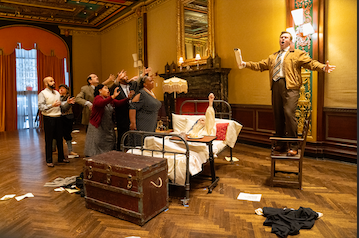
LUCIDITY


Eric McKeever, Lucy Shelton, Blythe Gaissert, and Cristina Maria Castro

Music and memory were the topics of Lucidity, the outstanding play with music presented by On Site Opera.  Wait a minute!  Wasn't this billed as a chamber opera? Yes it was. We can only report our own opinion. Lucidity worked as theater and the excellent music was fine to hear, as conducted by Maestro Geoffrey McDonald and performed by five fine instrumentalist, about whom more will be said later. But the vocal lines seemed boring and unmemorable; and what is opera if one cannot leave humming an ear worm?  We admit that David Cotes' libretto made excellent dramatic sense but, except for some fine vocal ensembles during the denouement, Laura Kaminsky's vocal lines added nothing to the text.

We would have enjoyed this more as a play with spoken dialogue, augmented by some musical performances where the scene called for them. The singers had fine voices but didn't have anything interesting to sing, just a lot of meandering recitativi. Surprisingly, their acting was superb and totally convincing.

The story concerns a retired opera singer/professor/composer named Lili, magnificently portrayed by Lucy Shelton who is actually a voice teacher at Manhattan School of Music. Lili suffers from dementia and she is dutifully (and resentfully) cared for by her adult adopted son Dante (well portrayed by Eric McKeever). Dante is talented in his own right but gave up his career as a pianist to care for his mother.

Under the direction of Dr. Klugman (portrayed by the excellent Blythe Gaissert), a neuroscientist suffering from writer's block, the young clarinetist/music therapist has been engaged to try to break through Lili's brain fog. Lili's problem is a neurological one, but the other three characters are psychologically blocked. Sunny, the music therapist (a winning Cristina Maria Castro), suffers from parental indifference to her career choice manifested by lack of support. And poor Dante is suffering from a hostile dependency on his mother and has blamed her physical neediness for his failure to thrive in the musical world.

The drama focuses on the effects the characters have on each other and the effect that music has on Lili's brain. We might add that this effect has been scientifically validated, a fact that lends verisimilitude to the story. Director Sarah Meyers succeeded in the storytelling arena and also in her direction of the characters. Fortunately this is not Hollywood and Dante and Sunny did not have a romance!

There was a moment when the story brought us to tears-- partially because we were moved by Lili's breakthrough and partly because she began to sing Schubert's "Der Hirt auf dem Felsen" the music of which touches us deeply, which contemporary music does not. If only Kaminsky's writing had the same impact!

This musical choice probably dictated the writing and directing which includes the onstage doubling of Sunny by clarinetist Yasmina Speigelberg and of Dante by pianist Kyle Walker.
 
By the end of the work, every character has had a breakthrough and in the final scene, Kaminsky's vocal writing became more lyrical as voices joined together in harmony.  Plays and musical pieces profit by a post climax peaceful resolution.

Staging  by Ms. Meyers was original and effective. The audience sat in elevated rows upstage at the Henry Street Theater of the Abrons Arts Center and the acting took place downstage and in the part of the theater where the audience usually sits. Scenic Consultant Cameron Anderson put Lili's home in this downstage space with minimal furniture, bookshelves, and a piano.  The remainder of the theater became Dr. Klugman's office and varying rooms in Lili's apartment. The apt costuming was by Beth Goldenberg.

Let us give props to the fine musicians of the American Modern Ensemble, comprising percussionist Brandon Williams, violinist Nikita Mozorov, cellist Dave Eggar, as well as the aforementioned pianist and clarinetist both of whom moved readily from the orchestra pit to the stage where they doubled the actor/singers.

Once more, On Site Opera has given us a thoughtful and artistic work which we will remember even when the music has been forgotten.

© meche kroop


Friday, February 23, 2024

I WANT MY COFFEE!


 Bernard Holcomb, Philip Cokorinos, and Christine Lyons
(photo by meche kroop)

No other company we know of does what On Site Opera does; they make a perfect match between an opera and a venue, taking us to many places we have not previously visited. Two of our favorite matchings were their production of Mozart's La Finta Giardiniera in a community garden on the Upper West Side and the production of Puccini's Il Tabarro on a vessel docked at the South Street Seaport.  Well, Dear Reader, we have added a third! Bach's Coffee Cantata taking place currently at The Lost Draft, a charming coffee shop on Broome Street. We regret to inform you that the run is sold out (as all of their productions are) so we will make an attempt to paint the picture for you.

After being welcomed into the premises, we were seated along the wall, the table in front of us set with coffee cups, cookies, and popcorn. Magically, the barista (Bernard Holcomb) became the narrator of the piece, a 45 minute comic opera written in the 1730's by J.S.Bach and (get this!), presented in a coffee house in Leipzig. And here we are three centuries later immersed in a family drama between an authoritarian father (Philip Cokorinos) who wants his rebellious daughter (Christine Lyons) to stop drinking coffee.

Papa uses all manner of manipulations and threats to convince her to give up her addiction. She only agrees if she is allowed to marry; she secretly plans to ensure that the marriage contract contains a clause that allows her to caffeinate herself to her heart's content. It is a simple story and we had no problem with its adaptation  to contemporary times.

Total immersion involved the artists going behind the counter, making and serving coffee, whilst the actual employees of the coffee shop became supernumeraries, although there was no chorus, LOL. Everything was happening in real time and three different coffees were served. We could readily imagine being in a Leipzig coffee house in the 1730's even though dress was contemporary (costuming by Beth Goldenberg) and the work was sung in English, with a very fine loose translation by Music Director Geoffrey McDonald.

We confess that Bach has never been one of our favorites. Aside from this winning piece of fluff, he never wrote an opera and we find oratorios and cantatas ponderous. However, the charming nature of this piece allowed us to recognize his compositional skills, particularly his intricate counterpoint, as it served the witty dialogue perfectly.

The singing was delightful and there were titles available by using one's cell phone but we preferred not to take our eyes off the action, directed by Sarah Meyers. The charming score was performed by a quartet of fine musicians, comprising the American Modern Ensemble-- Violinist Nikita Yermack, cellist Valeriya Sholokova, guitarist Dan Lippel, and flutist John Romero who also played the recorder. Maestro McDonald's orchestration was completely on point. 

We have only one quibble.  It was over too soon. We enjoyed the flirtation between the barista and young lady and all the hijinks of the stage direction. We wanted a second act! We wish Bach had written about the interaction after the young lady gets married!

We raise our coffee cup to toast On Site Opera and the lovely staff at The Lost Draft!  And now, we are going to make ourself a cup of coffee!

© meche kroop

Saturday, September 23, 2023

AND A NIGHTINGALE SANG... IN MANHATTAN WEST


Chrystal E. Williams and Bernard Holcomb

(Photo by Fadi Kheir, courtesy of Brookfield Properties)

Something special happens when an artistic creation hits all the right notes. At its conclusion we feel satisfied; we may be smiling or we may be tearful, but we have been moved as well as entertained. We want to share the experience with our friends. Sometimes we may be stimulated to learn more about a subject or a time period. Sometimes we go back to the source, be it a play, a novel, or an epic poem.

Such is the case with the charming one-act opera we saw Thursday night, Song of the Nightingale presented by the always wonderful On Site Opera in partnership with Brookfield Properties Arts and Culture. We hope you will read this review and reserve a place  next weekend downtown at Brookfield Place. Tickets are free and we consider this a generous and priceless gift to the people of New York City.

First we would like to tell you about the performance and, if you stay with us, we will share with you a bit about the consequences of our attendance. The work is a rather loose adaptation of a Hans Christian Anderson fairy tale in which a Chinese emperor hears of a nightingale with a remarkable voice which he manages to get installed in his porcelain palace. The nightingale is displeased with the confinement and escapes. The Japanese emperor sends a mechanical bird which eventually wears out. The emperor is dying and the nightingale returns and sings Death away and sings the emperor back to health. She agrees to keep him informed of what is going on as long as she has her freedom.

Having read the "Spark Notes" and also the original story, we conclude that the moral of the tale is that one cannot confine what is beautiful and meaningful; grasping is destructive and freedom is best. There are other themes, of course, and most notable is the healing property of good music. Another is that true inner beauty may hide beneath external drabness.

In this case, the "good music' was provided by composer Lisa Despain who has dispelled my grumblings about contemporary music with a lively score notable for being melodic and accessible.  Melisa Tien's clever libretto has taken Anderson's folk tale and adapted it to suit modern times. (Unlike current "adaptations" of classic works that make no logical sense, her libretto makes perfect sense).  A wealthy collector, sung by Chrystal E. Williams, substitutes for the Chinese emperor, and, as effectively directed by Katherine M. Carter, demonstrates the obsessive qualities of a person who must possess what she craves.

Substituting for the Emperor's minion we have The Curator, sung by Bernard Holcomb, who is responsible for The Collector's acquisitions.

As The Nightingale, we heard the gorgeous coloratura of Hannah Cho whose fabulous fioritura could bring tears to anyone's eyes, just like in the Anderson fairy tale.

As the mechanical nightingale we heard the lovely voice of Nicole Haslett who furthered the subsidiary theme that what is fancy and artificial can never replace what is natural and pure. Ms. Haslett also portrayed the part of the Frog who interacts with Nightingale, along with Cow, portrayed with good humor by Jonathan R. Green.  

All of the performances were exceptional and were well supported by the chamber orchestra, comprising flute, clarinet, violin and cello, conducted by Cris Frisco. Orchestration was accomplished by Scott Ethier.  The inventive costumes were designed by Kara Harmon. Although we are no fan of amplification we admit that Beth Lake's sound design was effective and did not distort the sound of the voices. 

Although everything worked just fine in the public space of Manhattan West, we would love to see it again in a proscenium situation with subtitles. Performances  in the round carry their own drawbacks with performers often facing away from you. And looking at one's phone to read titles takes attention away from the stage. In spite of these minor inconveniences, the performance amounted to a most well spent hour that flew by. We were particularly delighted to witness such enthusiasm from the audience and by the feel-good conclusion of the work in which all the characters unite in celebration of freedom and nature.

We were inspired to come home and read the original story, the language of which is a bit archaic but possesses a wealth of captivating detail about the life of the emperor and also about his near-death experience. None of the summaries achieved the same satisfaction.

Next we recalled an operatic experience at the Santa Fe Opera in 2014 in which Stravinsky's take on the tale, Le Rossignol, was paired with Mozart's one-act opera The Impressario. The concept was a clever one in which the singers from the Mozart opera performed the Stravinsky piece after an intermission. Our review (still available, if you are interested, by typing the name in the search bar) indicates a not totally successful pairing but some dazzling singing by Erin Morley in the title role. Stravinsky's opera hewed rather closely to the Anderson fairly tale.

 Next we started thinking about the word itself and how often it comes up in lieder; we now know the word for nightingale in many languages and it is always a beautiful word. It is used to symbolize the beauty and power of music.

Then we began to think about the role of birds in music. We will never forget the voice of Dawn Upshaw as the Forest Bird in Wagner's Siegfried. And how about Rimsky-Korsakov's The Golden Cockerel, which we heard at Santa Fe Opera in 2017. The bird warns the Czar of upcoming dangers.

By now, Dear Reader, you may have realized that we are just as obsessive as The Collector in Song of the Nightingale. We love to collect ideas, not things. We hope that you will snag a seat for this lovely work and that it leads to some searching on your part as well.

© meche kroop


Tuesday, May 16, 2023

REALISMO ON THE DOCKS


 Eric McKeever as Michele
(photo by Dan Wright Photography)

Giacomo Puccini's Il Trittico comprises three one-act operas. We have seen all three on one long evening and we have seen them separately, often paired with other one-act operas. Recently we have seen Gianni Schicchi , a comedy, and Suor Angelica, a tragedy of victimhood. Last night we saw Il Tabarro, a drama of thwarted love and revenge, presented in riveting fashion by On Site Opera, a company we revere for fitting the opera to the setting,

This has always been the least loved one of the three operas and we confess to not really getting it until last night, staged on the Lightship Ambrose (subbing for a barge), docked at Pier 16 of the South Street Seaport. Singers moved up and down the gangplank carrying heavy loads. Women gathered around the song-seller to acquire the latest sheetmusic. The realism of the setting served to amplify the realismo of the opera. 

As in Leoncavallo's earlier work Pagliacci, a man is rejected by his wife and finds revenge in murder, a story that must have resonated with audiences at the turn of the 20th c.  Come to think of it, one has only to read newspapers to know that the "plot" still exists, although crimes of passion are, in these days, more likely to be accomplished secretly. Fortunately we were not exposed to ridiculous attempts at modernization. Costuming was accurate and served to reinforce the sense of time and place.

Director Laine Rettmer did a superb job of telling the story and Maestro Geoffrey McDonald utilized the smallish orchestra in a manner that supported the singers and yet amplified the emotions of the characters when there was a lull in the singing. Speaking of amplification, we realize it was necessary in a noisy outdoor environment and we credit the sound design for keeping a fine balance. We heard from one of the singers that each singer heard differently and standing in different places often left the singer unaware of the volume. This makes the success doubly impressive. The loss of sound of unamplified voices was more than compensated by the achievement of reality.

Baritone Eric McKeever was outstanding as the captain of the barge, projecting a sense of kindliness both toward the stevedores in his employ and toward his wife, with whom he once shared tender loving moments. He succeeded in arousing our sympathy.  What could be more damaging to a man's sense of masculinity than having his embraces rejected by his wife. 

Soprano Ashley Milanese was fine in this role and also succeeded in arousing our sympathy as she sings of the child that died. Perhaps that was what destroyed the love she once shared with Michele. As she recalls her lovely home in suburban Paris and shares these reminiscences with Luigi, her stevedore lover who came from the same banlieu, we come to appreciate the bond between them and what Luigi represents to her.

The role of Luigi was well handled by tenor Yi Li who struggled with his passion for his boss' wife. Giuseppe Adami's libretto never makes him out to be a villain, just a man led around by his sexual passions who found a partner to return his lust.

With the major roles of this love triangle so effectively portrayed, one could also make note of the success of the subsidiary roles. Jose Heredia injected some humor and fine singing in the role of the bibulous Tinca, one of the stevedores who tries to dance with Georgetta and steps on her toes.

The other stevedore Talpa was sung by Artega Wright who, in contrast with Michele and Georgetta, seems to have a reciprocal relationship with his wife La Frugola, played with marvelous low voice and comic spirit by Sharmay Musacchio. The scene in which she distributes the many treasures of her dumpster diving  served to lighten the atmosphere.

There was a wonderful moment in which the Song Seller distributed sheet music to the gathering milliners and the orchestra played a theme from Puccini's masterwork La Bohême in which we just last week heard Mr. Heredia as Rodolfo! In any event, that Puccini was a clever devil!

Let us now name the members of The Ensemble who contributed so much vocally and dramatically, some of whom we have heard singing at our local conservatories or at competitions. Sopranos Yohji Daquio, Lindsey Kanaga, Theodora Siegel, and Kiena Williams; mezzo sopranos Claire Coven and JoAnna Vladyka; Tenor Daniel Rosenberg; Baritone Paul LaRosa; and bass Brian McQueen.

From the moment the opera began we were totally engaged. There was not a single longueur. It was as if a real event was unrolling before our very eyes and ears. It was an event to remember and cherish.


© meche kroop

Monday, April 11, 2022

A WELL DONE CLASSIC

Laura León and John Riesen (photo by Richard Termine)
Cast of On site Opera's Gianni Schicchi (photo by Richard Termine)

Luis Ledesma (photo by Richard Termine)

Of all the opera companies we have missed, On Site Opera heads the list. Unique among opera companies, On Site Opera makes an asset out of "homelessness".  As they say, home is where the heart is, and On Site Opera's heart is wherever they can set a given opera in a meaningful locale. 
For tonight's delight, Director Eric Einhorn decided quite rightly that The Prince George Ballroom, ornate and dripping in luxury, would be the right home for Gianni Schicchi, Puccini's late life comedic masterpiece.

Any dramatist will tell you that comedy is more difficult to write and more challenging to act, than tragedy. It must also be true for composition because neither Puccini nor Verdi tackled the genre until the end of their writing careers.  As a matter of fact, it was the last work to which Puccini set his pen. Although he intended the work to be part of a trilogy, this trilogy has often been broken up and this work, the most popular of the three one-act operas, has been wed to quite a number of other one-act operas. On Site Opera chose to present it alone which, given the discomfort of sitting with a mask over one's breathing organs, was a wise decision. Coming in at one hour it was just right, leaving the audience with (sadly invisible) smiles on their faces.

How was this delight achieved? To start with, Giovacchino Forzano's libretto, derived from an 1866 edition of Dante's Inferno (based on real 14th c. Florentine characters), pokes fun at the greed of a selfish family of "aristocrats" and also at the contempt they had for the rising "middle class". Now isn't that the kind of satire we can relate to today? Do we not also get a secret kick out of scoundrels getting away with bad behavior? And what about that very very valuable mule?? There is something truly hilarious about this family fighting over said mule!

Secondly, Puccini's music is filled with humor. We cannot say what makes music amusing but likely a musicologist could elaborate on the rhythms and recurrent motifs lacing the score that tickle the ear and bring a smile to the face. There is a wonderful contrast between the dirge-like music as the family pretends to be grieving, the frisky music of everyone rushing around to create their false scenario, and the romantic music for the lovers. Geoffrey McDonald's conducting of his chamber orchestra--strangely but effectively situated behind the audience--brought out every twist and turn of the score such that we heard things we had not noticed in prior hearings. 

Finally, It is the joyful attitude of the cast who seemed to revel in their creation of characters drawn somewhat from the commedia del'arte tradition. In the title role we had the rubber-faced Luis Ledesma whose fine baritone filled out the role as effectively as his shape filled out the apropos costume of a man climbing out of the peasant class by means of a sharp wit and a lack of compunction about breaking the law.

This seems a rather odd association but we kept thinking about Tony Soprano, a criminal who won over his audience by charm. He kept his dirty dealings from his daughters, much the way Schicchi protected Lauretta by sending her out to feed the birds whilst he schemed and set up his self-serving plot. In the character's way of thinking, he was providing for his daughter's future, even risking hell for himself. There is nothing odd about a parvenu marrying into an aristocratic family headed for impoverishment, as we observed in Il Gattopardo, taking place at the time of the Risorgimento.

As Lauretta we heard the charming soprano Laura León who interpreted her character as a sweet innocent girl who loves Rinuccio for who he is, wealth or no wealth. To her is granted the most famous aria of the opera "O mio babbino caro" which, in a master directorial stroke, she delivered standing on top of a trunk, allowing her not only a sense of importance but also permitted her to mime throwing herself into the Arno. The winsomeness of her presence and the clarity of tone and phrasing made this an unforgettable performance.

As Rinuccio, tenor John Riesen turned in a similarly winning performance. He was successful in winning over his nasty squabbling relatives with his finely tuned tenor in "Avete torto... Firenze è come un albero fiorito" as well as winning over the audience. His duet with Ms. León was particularly fine with their voices blending in well balanced fashion.

David Langan's resonant bass and haughty demeanor were just right for Simone in an interpretation that we had not witnessed previously. As Zita Patrice P. Easton created a formidable matriarch who tolerated no nonsense. The lower part of her register was just perfect and at one point she took the artistic risk of growling out her line and we couldn't keep from laughing out loud.  It was one of those perfect moments.

Often, in an ensemble work like this one, it is difficult to differentiate the characters. However, up close and personal as this was, we were able to discern their individuality. Simone's son Marco and his wife La Ciesca were portrayed by baritone Jonathan R. Green and mezzo-soprano Alexandria Crichlow.  Poor relation Betto was sung by Jay Louis Chacon. The roles of nephew Gherardo  and his wife Nella were well sung by tenor Michael Kuhn and soprano Sarah Beth Pearson. Their son Gherardino was portrayed as a bratty kid who didn't want to run an errand without getting paid. The voluptuous Savannah McElhaney acted the part well without quite convincing us that she was a 7-year-old boy.

The small parts were also well cast and well performed. Brian McQueen managed to differentiate Dottore Spinelloccio and the Notario Amantio. Pinellino the cobbler was played by David Kahng. The non-singing part of the dying Buoso Donati was played by Martin Pfefferkorn.

We are aware that Woody Allen set the work in a tenement which makes no sense whatsoever. Lots of liberties have been taken with the work. Bringing it into the mid 20th c. by means of the costuming (Susan Memmott Allred) worked OK. But we couldn't stop thinking how this century-old work was composed at the time of the tragic flu epidemic and how that relates to the present. But these connections are best made in the minds of the audience.

© meche kroop


Monday, January 27, 2020

YEE-HAW

Justine Aronson as Gutrune in On Site Opera's Das Barbecü (photo by B A von Sise)

We have seen more than our fair share of Ring Cycles and we have spent quite a bit of time in The Lone Star State; both of these experiences contributed to our enjoyment of On Site Opera's current expression of their mission to present opera in venues relevant to the material.  Only this time it wasn't an opera but a wildly inventive musical called Das Barbecü, starring trained opera singers.

Do you need to have seen Wagner's Ring Cycle to appreciate this original production?  Not really, although a basic familiarity with the story might add to your enjoyment of the parody.  Do you need to have been to Texas to appreciate the Texas tropes? Not really, since you have probably been exposed to Texas stereotypes by film or television. Who wouldn't appreciate the emphasis on barbecue and guacamole, our favorite song being "Makin' Guacamole". And of course, there was a chart in front of the musicians to explain the plot for you.

What we are trying to say is "Go see it!". Your intrepid reviewer was there for opening night and urges you to get tickets to one of the several remaining performances, if there are indeed any left. You will have a swell time and you will enjoy a fine family-style dinner of Texas brisket, barbecued chicken, mashed sweet potatoes, and mac 'n cheese (which Texans consider a vegetable)--all included in the ticket price.

It would be unfair to say that the show condensed 15 hours of Wagner's epic into 2 plus hours; the emphasis is mainly on Götterdammerung and much of the plot from the preceding three operas is revealed in flashbacks. Of course, that is also a feature of Wagner's epic narrative with characters often bringing other characters up to date on what had previously happened.

The show was commissioned in 1991 by General Director of the Seattle Opera Speight Jenkins who offered it as a light-hearted accompaniment to the Seattle Ring Cycle for subscribers to enjoy. The book and lyrics by Jim Luigs are clever and the music by Scott Warrender offers a variety of music from faux Country Western to sincere ballads--all of it tuneful.

We are reluctant to give away too much of the plot or any of the hilarious one-liners. Let us just say that Valhalla is now a ranch with Fricka (Zuri Washington) keeping house and resenting the philandering of her husband Wotan (Robert Wesley Mason). Alberich (David Hughey) is still vying with Wotan for the "Ring of Gold" and the pair reach a surprise reconciliation. Siegfried (also Mr. Hughey) is an earnest but not-too-smart cowpoke who is given a spiked drink at a honky-tonk bar, causing him to forget his bride Brünnhilde (a spunky Jessica Fishenfeld) who gets carried off by the not-too-smart Gunther (Mr. Mason) who arranges for Siegfried to wed his sister Gutrune (Justine Aronson).

One of the best numbers in the score has the two abandoned brides devouring the wedding dinner all by themselves and making friends in the process. 

If all this sounds confusing, rest assured that rapid costume changes and acting skill serve to identify each character. Seeing a cast of five accomplish all this complex storytelling is impressive in and of itself. We haven't even mentioned the hilarious scene with the three Norns and the even funnier scene in which the adorable Ms. Aronson in the role of Freia gets taken by the two giant carpenters and... oh, we will stop here. You will want to see that for yourself!

Direction by Eric Einhorn and Katherine M. Carter kept up a frenetic pace. Whitney Locher's costumes were just right with Brünnhilde's wedding dress taking the cake and evoking one of the bitchiest one-liners in the show.  No, we will not divulge it here!

Music Director Emily Senturia played keyboard with a second keyboard played by Riko Higuma. Liz Faure was swell on guitar and Victoria Paterson fiddled away in true Country and Western style. Clara Warnaar was in charge of the drums. We particularly enjoyed the Texas two-step which they really do dance in Texas!

Looking around at the audience, we have never seen so many grinning faces. We could not tell whether they were simply enjoying the show or were also enjoying witnessing Wagner's complex plot being transmogrified and parodied.

If we were to find one fault with this entertaining evening, it would have to do with the staging and sound. Although it was kind of fun to have the cast moving around the room and between the long picnic tables, it also required quite a bit of rubber-necking. 

Complicating this was the amplification. Fortunately, it was certainly not ear-splitting but it was impossible to tell where the voices were coming from, making the rubbernecking even worse.

We know nothing about sound design so we are unable to say how that problem could be surmounted. Nonetheless, we had a great time and left happy.  And so will you!

© meche kroop


Monday, December 9, 2019

ON SITE ON POINT

Aundi Marie Moore, Benjamin Barham Wiese, Jonathan R, Green, Julius Ahn, Daniel Belcher, and Musa Ngqungwana

We have written a great deal about On Site Opera and their special niche on Planet Opera, always finding the perfect location to present an opera; it is not out of the question that the place itself might in fact inspire the choice of an opera. In either case, the Holy Apostles Church soup kitchen was the perfect place to present a unique slant on Gian Carlo Menotti's one-act opera Amahl and the Night Visitors.

It was the first opera commissioned for television by NBC in 1951. Menotti wrote the score, his partner Samuel Barber completed the orchestration, and Maestro Geoffrey McDonald brought the score to vivid life with musicians of the American Modern Ensemble. The music is tuneful and Maestro McDonald was in full command of his chamber orchestra.

There are operas whose time and place must be kept intact to seem valid; this one translated very well into contemporary times and also succeeded in calling attention to what is commonly called the "Christmas Spirit"--dealing with the rewards for unselfishness and forgiveness.

In this case, a homeless mother (Aundi Marie Moore) and her son (Benjamin Barham Wiese) interact realistically over his tendency to tell tall tales and her tendency to call him on it. He sees the star in the sky and the Wise Men at the door. Although the family has nothing to speak of, they do their best to provide for the travelers. The boy is crippled and using a crutch which he offers to send to the newborn King. He is thereby healed and able to walk.

An advantage we had over others is that we have never had a television and consequently were totally unfamiliar with the work. Consequently, we had no expectations of shepherds and sheep and were able to immerse ourselves in the story as Director Eric Einhorn so admirably presented it. The Three Kings appeared as homeless men pushing shopping carts. Clearly, their nobility resides in their generosity, not in their material wealth.

There were several moments that touched us deeply, especially when the boy defends his mother from the security officer (Jonathan R. Green) who is arresting her for stealing gold from the Kings. This did not exactly add up because one doesn't expect the homeless to be carrying gold! But this is a myth and we were able to accept the inconsistency.

We loved the moments when Kaspar (tenor Julius Ahn) sings about his magic box which contains beads and stones. His voice was particularly well-balanced with that of bass Musa Ngqungwana (as Kaspar) and baritone Daniel Belcher (as Melchior).

We also loved the dancing, choreographed by Winston A. Benons Jr. The dancers exhibited such spontaneity and gusto that we were swept along by the simple unpretentious movements.

The chorus comprised a group of folks who had experienced homelessness and were clients of Breaking Ground, an organization that establishes permanent supportive housing for the homeless; their fine singing, led by Michael A. Ciavaglia, sounded totally professional. Jessica Jahn's costumes were appropriate and rather fanciful for the Kings.

The singing was at the highest level and met all the musical demands of the score; the acting was similarly convincing and believable.

Everything we have written is about the artistic merits of the production. We would like to add some opinions about the social merits. It was a great idea to ask audience member to contribute some non-perishable food. This called attention to the fact that we were in a soup kitchen and there are people who need to be fed. The entire experience elevated the homeless beyond the level of societal outcasts and led us to see them as folks who are simply down on their luck.

By a strange coincidence we had just the night before read a contribution on Quora about what it is like to be homeless. Our awareness has been raised. We found ourself with tears streaming down our face. We glanced at our guest for the evening who was also weeping, as was the woman next to her.

That art should have such a profound effect on us is a wonderful thing. Too many times have we exited the Met thinking "that role was well sung" and forgotten the entire performance within the hour.

We loved seeing art performing what we think it capable of. It should hold a mirror up to society to show us what we are missing in everyday life. Bravo to On Site Opera for taking risks.

The opera was performed last year and we hope it will be scheduled again for next year.

© meche kroop


Saturday, October 26, 2019

AS THE SCREW TURNS

Ashley Emerson and Jennifer Check

We have just had an experience that compares with most operagoing experiences as a dinner at La Grenouille would compare with a fine dinner at home. It was way more than delicious and nourishing; it was one of those evenings that will be indelibly etched in our memory. It was Britten's Turn of the Screw performed on the beautiful estate Wave Hill.

Eric Einhorn's concept for On Site Opera is to produce just such experiences that add up to more than the sum of their parts. There is always a location that amounts to way more than seats in an audience facing a stage with sets. There is always an intimacy with the story and the singers. It must be quite a challenge to find just the right location for any given story but it always works.

There was not enough space for more than a fortunate few and we count ourself among them. Because you, dear reader, probably did not make the cut (the show having sold out within minutes of its announcement), we would like to cut right to the chase and describe the experience. Trust our judgment on the point that the parts were superbly cast and magnificently acted and sung and that Geoffrey McDonald's conducting of his chamber orchestra made the most of Britten's score, adding layer upon layer of anxiety and suspence. 

A team of guides handed each one of us a lantern and guided us through the pathways until we reached a gothic looking building with a balcony from which a narrator introduced us to the story. The opera is based upon a gothic ghost story--a novella by Henry James. Myfanwy Piper wrote the concise and effective libretto.

Next we met The Governess in the person of soprano Jennifer Check, in perfect period costume, who led us to the front door of the country house where she was to take care of two orphaned children, without ever bothering their uncle who had hired her. She shared her excitement and anxiety with us and even asked someone to hold her suitcase whilst she opened the front door.

From then on we felt like a fly on the wall, observing her meeting the housekeeper Mrs. Grose (mezzo-soprano Margaret Lattimore) and then her two charges who stood holding photographs of the former governess Miss Jessell and the valet Peter Quint, both of whom had died recently. 

The children had been instructed by Mrs. Grose to bow and curtsy but we knew instantly that something was wrong. One couldn't have seen the subtle facial expressions underlying their politesse at the Met but it was obvious from a few yards away.

It seemed clear to us that The Governess is not going mad when she sees the ghosts of Mr. Quint and Miss Jessell. (We have seen a film in which she is portrayed as hysterical and the children as needing to be rescued from her care.)

As Mr. Einhorn has so astutely directed the action, moving the audience from one room of the large mansion to another, the illusion of knowing the characters took hold and gripped us by the throat. We lost the concept of ambiguity from James' novella and identified strongly with the terrified Governess as she faced the two ghosts.

Dominic Armstrong was completely riveting as Peter Quint; the way Mr. Einhorn directed his scenes with Miles (counter-tenor Jordan Rutter) we were convinced that Quint had seduced the boy whilst he yet lived and was trying to snatch his soul now that he had died. We rarely see such a portrayal of evil onstage with Mr. Armstrong coloring his voice to match the text.

Adriana Zabala made a rather more sympathetic Miss Jessell. In a directorial coup,  there was a parallel scene with the current Governess and Miss Jessell walking the same pathway in tandem. This added to the gothic element of the storytelling and gave us the shivers. We wondered whether the poor (unnamed) Governess would also die. It is a mark of great storytelling and great acting that we were so caught up that we wanted to know what happened to her! Ms. Check made us feel on her side from the start.

As Flora, Ashley Emerson acted the part of a young girl with considerable success. As Miles, Mr. Rutter was totally convincing. He is small and slender of stature and his treble voice lent considerable verisimilitude. Both "children" gave evidence of secrets and secret lives.

Even Mrs. Grose, portrayed by mezzo-soprano Margaret Lattimore, seemed to have secrets, only some of which were shared with The Governess. At one point we saw her drop something in a cup of tea but were not sure for whom it was meant or whether it were poison or sedative. Ambiguity was everywhere and we believe James wanted us to be puzzled by unanswered questions.

The chamber orchestra was as Britten intended, comprising a string quartet plus a bass and one each of the necessary winds. The versatile instrumentalists seemed adept with the flutist handling piccolo and two registers of flutes; the oboist doubled on English Horn and the clarinetist switched to the Bass Clarinet, one of our favorite sounds in the orchestra. There was also a French Horn, a Bassoon, and a marvelous harpist who created quite an atmosphere. 

The pianist and the percussionist added to the texture; there were chimes, some soft Kettle Drumming, and what might have been a celesta. We meant to inspect the percussion section after the curtain call but we were still in some kind of state that lasted until we got home. The atmosphere of the performance was so intense that at one point we accepted what occurred onstage as reality and felt as if we were a ghost.

The costuming by Amanda Seymour was perfect and completed the illusion that we were back in the 19th c.  What a completely strange experience! Talk about total immersion!!!

On Site Opera's contribution to the New York opera scene is valuable and unique. Our only regret is that his productions cannot accommodate more people.

© meche kroop

Saturday, May 18, 2019

MURASAKI'S MOON

John Noh, Kristen Choi, and Martin Bakari


At a time when opera companies are struggling to survive, it is thrilling to watch On Site Opera thrive. In spite of high ticket prices, their productions are always sold out. It would appear that the originality of their concept and the deftness of their execution would account for their success. Snagging a ticket almost guarantees a rare and unusual experience.

In collaboration with MetLiveArts and American Lyric Theater, their latest production, Murasaki's Moon, served to heighten the interest of theater goers in the adjacent exhibit at the Metropolitan Museum of Art, an exhibit which the performance brought to vivid life in the hands of Artistic Director Eric Einhorn. 

The work is based upon The Tale of Genji, an 11th c. epic novel written by the noblewoman Lady Murasaki, perhaps the world's first novel. It is filled with characters beyond counting and illustrated lifestyles and customs of the Heian court. It was written by a woman for women in an archaic language used by women, a phonetic language. It was only in the 20th c. that the work was translated into modern Japanese.

English translations followed and the work has had a major effect on all of the arts of Japan, from 12 c. scrolls and screens to contemporary manga series and TV dramas. There was an opera written in 2000 but we were unable to learn anything about it.

The subject of the novel was Genji, the emperor's son whose mother was a lowly born, but favored, concubine. He led a wild romantic life, filled with illicit liaisons and several marriages. The production we saw, with libretto by Deborah Brevoort, did not attempt to tell any episodes from the story, but rather to focus on Lady Murasaki's relationship with her creation Genji, who served as muse.

So many contemporary issues were touched upon that there was no question of relevance. Take for example the issue of the loneliness of the writer. (Just ask us!) Lady Murasaki has a modest position at court, illustrated by her almost colorless three-layer kimono. She desperately wants a friend, but she is different from the other women at court and is the object of envy and rejection. She writes and Genji keeps her company. Many writers of fiction will tell you that they create characters and the characters write the story!

Although we have come a long way here in NYC, there are plenty of places around the USA where creative women are looked at with unkind eyes because they don't follow the wife/motherhood program. We could certainly identify with Lady Murasaki, the "misfit".

In the story we watched, she is angry at Genji for his philandering. He is untrue to her and disappears for periods of time, perhaps representing periods in which writers cannot summon their muse and go silent. On the other hand, putting on our psychological hat, it would seem that Genji is Lady Murasaki's animus, what Carl Jung called the inner representation of a woman's male characteristics. (And yes, men are purported to have an anima, representing their female qualities).

Murasaki makes several pointed observations about women gazing at their images in the mirror and making efforts to be more beautiful. Could anything be more relevant? In any case, we cannot stop thinking about the many layers of the story. 

The music added greatly to the story. Composer Michi Wiancko composed some beautiful instrumental music that combined Japanese instruments (Taiko drums and shakuhashi played by Kaoru Watanabe, percussion played by Satoshi Takeishi, and koto played by Yoko Reikano Kimura) with Western music performed by the Aizuri String Quartet. All was conducted by Geoffrey McDonald who integrated the two seamlessly.

The vocal line was another story altogether. Like so much contemporary music, the vocal line was jagged and not at all melodic. Combined with a libretto that often rhymed but did not scan at all, we found little to enjoy, in spite of admirably convincing performances by Kristen Choi as Lady Murasaki, Martin Bakari as the ultimately repentant Genji, and John Noh as a Buddhist priest who himself became interested in Murasaki's writing, a scene we particularly enjoyed. There was one magical musical moment--a duet with gorgeous harmonies that told us that Ms. Wiancko could do better. We would have loved to hear more Japanese-inflected vocal lines. We would have loved to have heard it in Japanese!

Effective costuming was provided by Beth Goldenberg. Genji's bright blue costume and the Buddhist Priest's yellow robes were in high contrast with Murasaki's pale costume. The work was performed in the Astor Court of the Metropolitan Museum of Art. It was staged in a long narrow playing area with audience members seated along each side. 

We would like to add a few words about the titles. The three singers had such excellent diction that titles were unnecessary but we were interested in the technology that was used. Audience members were able to download the On Site Opera app on their phones where titles were available and perfectly matched to the singing. This appears to be the way of the future. We tried it to see if it was distracting and it was not.

The dramatic performances aroused our curiosity and we spent some time in the nearby exhibit, particularly enchanted by the court games that were played, utilizing scenes from the novel. Scenes from the novel also decorated so many artifacts. It was obvious how influential this novel was on a millenia of Japanese culture.

We were too lost in thought to consider any way of getting home other than walking through the park, accompanied by a full moon! We thought of it as Lady Murasaki's moon and felt a strong connection. Isn't that what art is all about?

(c) meche kroop

Thursday, March 22, 2018

ON SITE OPERA ON THE LOWER EAST SIDE

Joshua Jeremiah, Emily Pulley, and Jennifer Zetlan in Morning Star (photo by Pavel Antonov)

The hardy New Yorkers who braved the "fourth'easter" of the season were rewarded with a resonant evening, some insights into New York history, some fine music, and some very stiff necks. The latter point has to do with one of the hazards of staging works on site, which On Site Opera does very well; the space may be evocative but not comfortable.

Ricky Ian Gordon's Morning Star, originally commissioned by Cincinnati Opera, was staged in the sanctuary of the 1887 Eldridge Street Synagogue, now the Museum at Eldridge Street. General and Artistic Director Eric Einhorn has staged the work using all parts of the sanctuary, including the balcony. This worked dramatically but made viewing uncomfortable since much of the action took place at the rear.

The evocative story concerns a family of immigrants in 1911 and 1932. They came from Riga in Latvia where, we gather, some unspeakable things were done to Jewish folk. But this compelling story could be paralleled in present time with any new immigrant group trying to adjust to a difficult life in a new place. The destructive effects of family secrets and the effects of tragedy on successive generations are both common themes in the theater.

The story concerns the widowed Becky Felderman (performed by the powerful soprano Emily Pulley) who has immigrated to the USA with her three daughters. The eldest, Sadie (affectingly sung by mezzo-soprano Blythe Gaissert) is the smart one who has never felt loved. The second is Fanny (sweet voiced Jennifer Zetlan) who will marry Irving (terrific tenor Blake Friedman) who will not let her sing.

The youngest girl Esther (performed by soprano Cree Carrico who plays "adorable" very well) captures the love of Sadie's main squeeze, the teacher Harry (fine baritone Andrew Lovato). Poor Esther dies in the Triangle Shirtwaist Fire (about which we have more to say further along) on her wedding day.

Important to the family is Aaron Greenspan who never gives up on his romantic pursuit of Becky. . Joshua Jeremiah used his keen dramatic instincts to create a believable character.  His powerful baritone matched well with Ms. Pulley's soprano. We particularly liked a song he sang in Yiddish which was mostly understood by this German-speaking reviewer. He was reminiscing about what he missed about Riga. Becky joined in with some not-so-happy memories.

We enjoyed Martin Bakari's sweet tenor in the role of Prince, a street peddler.  Smaller roles were taken by mezzos Chrystal E. Williams and Allison Gish. Only David Langan's bass-baritone was stentorian and unattractive as the rabbi.

Music Director Geoffrey McDonald did his customary superlative job conducting the American Modern Ensemble, a dozen fine musicians who made the most of Bruce Coughlin's orchestration for chamber orchestra. The wind section was particularly notable. The chamber orchestra was situated at the rear of the sanctuary and the sound floated forward with ease.

We have nothing but good things to say about the orchestral writing but we have a hard time finding something to praise about Ricky Ian Gordon's writing for the voice. The puzzling part of this is that Mr. Gordon wrote the most beautiful vocal line for Irving--"Oh Morning Star", a love song sung to woo Fanny.  Would that all the writing had been this melodic!

We did like the way that arias became duets and duets became ensembles.  The voices blended beautifully.  We just wanted to hear some melody! We liked Becky's song "Men come, men go, family abides". "Three loving sisters" was an interesting trio evincing a complex collection of emotions. 

Of all the sisters, Sadie was the most disagreeable and yet Ms. Gaissert's performance left us with sympathetic feelings. Her jealousy and bitterness clearly came out of feeling unloved.  She sang "Smart never won a man's heart". The early 20th c. was not kind to smart ambitious women. Her defensiveness was revealed in "Is it my fault?".

There was a 21 year gap between Act I and Act II; Summer Lee Jack's costumes were appropriate for both periods. Emilia Martin's wigs were as unflattering as wigs usually are. Shawn K. Kaufman's lighting design was splendid, especially for the fire which was so convincing that we nearly forgot it was "theater".

The libretto by the late William M. Hoffman seemed just fine, although a substantial amount could not be understood. Anyone who can rhyme "latkes" with "hot kiss" is OK in my book!

And now we come to the Triangle Shirtwaist Factory Fire story, the worst workplace disaster in NYC history until the World Trade Center attack of 2001.  The death toll was 146 people; greed and carelessness were to blame. If you seek more information, we refer you to http://rememberthetrianglefire.org/

The pre-opera lecture we attended added a great deal to our appreciation of the work itself. Two member of the Remember the Triangle Fire Coalition spoke to the audience of their personal experience as relatives of women who lost their lives in the fire. These two generous speakers were Mary Anne Trasciatti and Suzanne Pred Bass whose memories brought the story alive for us. 

We were happy to learn that the tragedy had a silver lining in that the cause of labor was advanced; workplace safety has been addressed (and is still being addressed!) as was working conditions. The flagrantly indifferent owners of the factory were acquitted due to the efforts of a high-powered attorney who intimidated the young women witnesses.  So sad!

To bring the story to the present, Governor Andrew Cuomo has donated a significant amount of money to establishing a memorial so that this tragedy will be remembered.

(c) meche kroop

Wednesday, June 21, 2017

GUILTY AS CHARGED

Jennifer Black and Amy Owens in On Site Opera's production of Darius Milhaud's "La Mere Coupable" (photo by Fay Fox)


It was a grand idea of On Site Opera to present little known musical adaptations of Pierre Beaumarchais' trilogy of plays about la famille Almaviva. Two years ago we thrilled to Paisiello's version of The Barber of Seville.  Last year we thrilled to Marcos Portugal's iteration of The Marriage of Figaro. Last night we did not thrill to Darius Milhaud's The Guilty Mother, the final entry of the trilogy, taking place twenty years after The Marriage of Figaro. The superb performances were there. Eric Einhorn's direction worked well. The site chosen was interesting.  Maestro Geoffrey McDonald conducted the International Contemporary Ensemble with his customary artistry.

What went wrong?  Why would we be happy to hear the Paisiello and the Portugal again but not the Milhaud? The fault lay in the libretto and the music.  Great music can survive a flawed libretto and some stories are so compelling that mediocre music can be tolerated.  In this case, we found the libretto deficient in the sense that it was confusing in its adaptation from the Beaumarchais play, which was written in 1792, just before his exile. The fact that the adaptation was performed by his wife Madeline gives us a clue that this was a case of nepotism.

If you've ever wondered what happened after the Count and Countess reconciled and Figaro and Susanna were wed, here it is, according to Beaumarchais. The Count left on a long business trip. The Countess spent the night with Cherubino and bore a son named Leon. The Count was always suspicious of Leon's parentage. Never mind that he himself committed adultery and has taken the female child Florestine into his home to raise. She and Leon are in love.

A snake-in-the-grass, a scheming Tartuffe-like figure named Begearss has wormed his way into the household, taking advantage of aristocratic helplessness. Begearss plans to marry Florestine and acquire Almaviva's fortune. Thanks to bold action on the part of the resourceful Figaro, Begearss is thwarted and the two young lovers learn that they are not related by blood and are free to wed.  Happy ending.  Comedy?  Not quite! There may have been opportunities for comedy but they were missed.  This is a dreary work and the poorly fleshed out characters fail to win the audience's sympathy. What we love about the music of Mozart and Rossini is that it matches the characters and their actions.  That would seem to be a basic minimum requirement for writing an opera!

We understood that, at one point, Andre Gretry proposed setting this play to music and what a pity the project fell through. Putting this story into the hands of Darius Milhaud was not a fortunate move. The 1966 score is replete with ugly dissonances and never seems connected with the onstage action. The vocal lines are devoid of melody or any form of lyricism. The singers gamely did their best with the non-melodic vocal lines and projected well over the dense orchestration, with the exception of poor Andrew Owens whose allergic affliction left him inaudible. We do recall his sweet sound from Aureliano at Caramoor. We didn't mind because he acted well!

As the guilty mother, soprano Jennifer Black sang with strength and conviction. We last caught Ms. Black at the Met in the role of Lisa in  La Sonnambula. As Florestine, lovely coloratura soprano Amy Owens, so well remembered as Zerbinetta in Santa Fe, handled the high tessitura beautifully and very much looked the part. Mezzo-soprano Marie Lenormand, whom we enjoyed previously as La Perichole and also singing with NYOS, handled the part of Susanna very well and, as Figaro, baritone Marcus DeLoach made a forceful opponent to the slimy Begearss, well portrayed by bass-baritone Matthew Burns. 

The Count himself was sung by Adam Cannedy who has a fine baritone that showed up so well in the recent Glory Denied,: here he looked too young for the part. This was supposed to take place 20 years after the action of Marriage of Figaro. Come to think of it, Ms. Black also looked too young for the Countess.  Perhaps her night with Cherubino restored her youth!

Bass Christian Zaremba, last scene as the Commendatore in  Venture Opera's Don Giovanni,   was excellent in the small role of the notary who appears in the last scene. It was just in the last ten seconds of the opera, in the septet, that we heard a little bit of music to which one would want to listen.  Not enough! But it shows that Mr. Milhaud was capable of writing something listenable and chose not to do so.

The site chosen for this opera was an enormous garage near the West Side Highway.  Instead of scene changes, the two acts were staged in different parts of the huge space, with audience seating moved to accommodate. During the first act, we felt as one might feel at a tennis match with much head turning and neck stiffening in order to read the titles which were on either side and perpendicular to the stage. The second act offered some relief with titles projected above the action and readily readable.

We have no idea why the action was set contemporaneously with Mr. Milhaud's composition. It made no sense unless the characters underwent some sort of Rip Van Winkle phenomenon. And why was the furniture threadbare and the costuming so dowdy? In the play, the Count has been spending down his fortune to cheat Leon of his inheritance but he certainly wasn't spending it on furniture or clothing, nor on pay for his servants!

We will decline to mention the production team responsible for this ugliness but will say that Shawn K. Kaufman's lighting was fine and that the French diction was quite good all around thanks to Jocelyn Dueck.

Perhaps this was the only opportunity we will ever have to witness the sequel and for this we thank On Site Opera for this courageous (but misguided) bit of programming. It was, in fact, the United States premiere but was produced recently by the Theater an der Wien as a piece of shocking regietheater. This production was part of New York Opera Fest 2017 presented by the New York Opera Alliance, of which On Site Opera is a member. Partnership with the Darius Milhaud Society was a feature and the production was dedicated to the memory of Katherine Warne, a composer and founder of the society.

(c) meche kroop