MISSION

We are here to encourage the development of gifted young singers and to stimulate the growth of New York City's invaluable chamber opera companies. But we will not neglect the Metropolitan Opera either. Get ready for bouquets and brickbats.
Showing posts with label Luis Ledesma. Show all posts

Monday, April 11, 2022

A WELL DONE CLASSIC

Laura León and John Riesen (photo by Richard Termine)
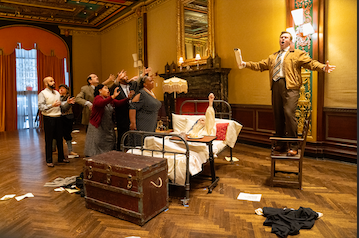
Cast of On site Opera's Gianni Schicchi (photo by Richard Termine)

Luis Ledesma (photo by Richard Termine)

Of all the opera companies we have missed, On Site Opera heads the list. Unique among opera companies, On Site Opera makes an asset out of "homelessness".  As they say, home is where the heart is, and On Site Opera's heart is wherever they can set a given opera in a meaningful locale. 
For tonight's delight, Director Eric Einhorn decided quite rightly that The Prince George Ballroom, ornate and dripping in luxury, would be the right home for Gianni Schicchi, Puccini's late life comedic masterpiece.

Any dramatist will tell you that comedy is more difficult to write and more challenging to act, than tragedy. It must also be true for composition because neither Puccini nor Verdi tackled the genre until the end of their writing careers.  As a matter of fact, it was the last work to which Puccini set his pen. Although he intended the work to be part of a trilogy, this trilogy has often been broken up and this work, the most popular of the three one-act operas, has been wed to quite a number of other one-act operas. On Site Opera chose to present it alone which, given the discomfort of sitting with a mask over one's breathing organs, was a wise decision. Coming in at one hour it was just right, leaving the audience with (sadly invisible) smiles on their faces.

How was this delight achieved? To start with, Giovacchino Forzano's libretto, derived from an 1866 edition of Dante's Inferno (based on real 14th c. Florentine characters), pokes fun at the greed of a selfish family of "aristocrats" and also at the contempt they had for the rising "middle class". Now isn't that the kind of satire we can relate to today? Do we not also get a secret kick out of scoundrels getting away with bad behavior? And what about that very very valuable mule?? There is something truly hilarious about this family fighting over said mule!

Secondly, Puccini's music is filled with humor. We cannot say what makes music amusing but likely a musicologist could elaborate on the rhythms and recurrent motifs lacing the score that tickle the ear and bring a smile to the face. There is a wonderful contrast between the dirge-like music as the family pretends to be grieving, the frisky music of everyone rushing around to create their false scenario, and the romantic music for the lovers. Geoffrey McDonald's conducting of his chamber orchestra--strangely but effectively situated behind the audience--brought out every twist and turn of the score such that we heard things we had not noticed in prior hearings. 

Finally, It is the joyful attitude of the cast who seemed to revel in their creation of characters drawn somewhat from the commedia del'arte tradition. In the title role we had the rubber-faced Luis Ledesma whose fine baritone filled out the role as effectively as his shape filled out the apropos costume of a man climbing out of the peasant class by means of a sharp wit and a lack of compunction about breaking the law.

This seems a rather odd association but we kept thinking about Tony Soprano, a criminal who won over his audience by charm. He kept his dirty dealings from his daughters, much the way Schicchi protected Lauretta by sending her out to feed the birds whilst he schemed and set up his self-serving plot. In the character's way of thinking, he was providing for his daughter's future, even risking hell for himself. There is nothing odd about a parvenu marrying into an aristocratic family headed for impoverishment, as we observed in Il Gattopardo, taking place at the time of the Risorgimento.

As Lauretta we heard the charming soprano Laura León who interpreted her character as a sweet innocent girl who loves Rinuccio for who he is, wealth or no wealth. To her is granted the most famous aria of the opera "O mio babbino caro" which, in a master directorial stroke, she delivered standing on top of a trunk, allowing her not only a sense of importance but also permitted her to mime throwing herself into the Arno. The winsomeness of her presence and the clarity of tone and phrasing made this an unforgettable performance.

As Rinuccio, tenor John Riesen turned in a similarly winning performance. He was successful in winning over his nasty squabbling relatives with his finely tuned tenor in "Avete torto... Firenze è come un albero fiorito" as well as winning over the audience. His duet with Ms. León was particularly fine with their voices blending in well balanced fashion.

David Langan's resonant bass and haughty demeanor were just right for Simone in an interpretation that we had not witnessed previously. As Zita Patrice P. Easton created a formidable matriarch who tolerated no nonsense. The lower part of her register was just perfect and at one point she took the artistic risk of growling out her line and we couldn't keep from laughing out loud.  It was one of those perfect moments.

Often, in an ensemble work like this one, it is difficult to differentiate the characters. However, up close and personal as this was, we were able to discern their individuality. Simone's son Marco and his wife La Ciesca were portrayed by baritone Jonathan R. Green and mezzo-soprano Alexandria Crichlow.  Poor relation Betto was sung by Jay Louis Chacon. The roles of nephew Gherardo  and his wife Nella were well sung by tenor Michael Kuhn and soprano Sarah Beth Pearson. Their son Gherardino was portrayed as a bratty kid who didn't want to run an errand without getting paid. The voluptuous Savannah McElhaney acted the part well without quite convincing us that she was a 7-year-old boy.

The small parts were also well cast and well performed. Brian McQueen managed to differentiate Dottore Spinelloccio and the Notario Amantio. Pinellino the cobbler was played by David Kahng. The non-singing part of the dying Buoso Donati was played by Martin Pfefferkorn.

We are aware that Woody Allen set the work in a tenement which makes no sense whatsoever. Lots of liberties have been taken with the work. Bringing it into the mid 20th c. by means of the costuming (Susan Memmott Allred) worked OK. But we couldn't stop thinking how this century-old work was composed at the time of the tragic flu epidemic and how that relates to the present. But these connections are best made in the minds of the audience.

© meche kroop


Saturday, October 22, 2016

NEW AMSTERDAM OPERA GALA CONCERT

New Amsterdam Opera Gala Concert at Riverside Theater

What a great variety of singers we heard last night!  Concerts of operatic arias are most fun when there is a variety of artists and the piano accompaniment is supportive. Both requirements were met as the New Amsterdam Opera presented their first gala concert in the comfortable theater belonging to Riverside Church. Their first event, a terrific Fidelio (review archived) was somewhat marred by some pretty awful acoustics.  We hope this theater will be their new home.

The opening duet is one of our favorites--"Belle nuit" from the Venice act of Offenbach's Les contes d'Hoffmann. The sweetness of Alyson Cambridge's Giulietta harmonized perfectly with Janara Kellerman's resonant Nicklausse.  Conductor Keith Chambers was the piano accompanist for the evening and set up the feeling of the imaginary gondola.

Another admirable duet was performed by mezzo-soprano Madison Marie McIntosh who created a wily Rosina for baritone Suchan Kim's Figaro in "Dunque io son" from Rossini's Il barbiere di Siviglia. We love the moment when she produces her secret note for Count Almaviva and Figaro gets flummoxed. Ms. McIntosh's upper extension remains the most impressive aspect of her voice with flexibility to spare for the fioritura.

Everything Mr. Kim does is superb. We were impressed with his creation of the deformed character of the eponymous hunchback in Verdi's Rigoletto which he accomplished without any humping or limping.  It was all in the voice! The part of Sparafucile was well handled by burly bass Kevin Thompson who projected just the right degree of menace in "Signor. Va! Non ho niente"

Another duet we enjoyed was "Là ci darem la mano" from Mozart's Don Giovanni. Coloratura soprano Amy Owens made a sweet Zerlina who was converted from her initial resistance by a most persuasive Don, portrayed by the robust baritone Luis Ledesma whom we so enjoyed in Florencia en el Amazonas.  

He is another artist who seems to do everything well.  His solo "Nemica de la patria" from Giordani's Andrea Chenier was powerful and affecting.

Another fine soloist was soprano Zhanna Alkhazova who created the unhappy character Elizabetta from Verdi's Don Carlo. Hers is a substantial instrument which she colored effectively in her exploration of the character's musings in "Tu che le vanità". We were hoping to hear more of her but that was her only appearance on the program.

From the same opera we heard veteran bass Stefan Szkafarowsky in "Ella giammai m'amo" making the hateful character of King Philip somewhat pitiful. Kevin Thompson sang The Inquisitor but being "on the book" detracted from his ability to connect with Mr. S.

The use of music stands also impaired the full impact of the stunning final trio from Strauss' Der Rosenkavalier. Ms. Owens made an appealing Sophie with mezzo-soprano Sarah Heltzel a fine Octavian. As the Marschallin, the excellent soprano Kirsten Chambers, whom we so enjoyed in Fidelio, came on too strong for Strauss' delicate writing which Mr. Chambers so elegantly captured on the piano.

There were other examples of performances too intense for the material. We love soprano Jessica Rose Cambio's powerful instrument but found it too heavy for the role of Nedda in the duet "Nedda! Silvio" from Leonavallo's Pagliacci. She also oversang and overacted as Cio-cio San in "Una nave da guerra" with Ms. Heltzel as her Suzuki.

The closing duet was "Tu qui, Santuzza" from Mascagni's Cavalleria rusticana in which baritone Ta'u Pupu'a Turiddu was a fine match for Janara Kellerman's desperate Santuzza. This redeemed him from his awkward performance as Des Grieux in "Tu, tu, amore, tu" in which he and soprano Kelly Griffin failed to gel as a romantic couple and just seemed miscast.

Ms. Griffin was far better however in "Pace, pace mio Dio" from Verdi's La forza del destino.  Our companion shared our opinion that this opera needs to be produced more often and we were absolutely thrilled to learn that this will be New Amsterdam Opera's next production!

One other duet failed to come together--Ms. Cambridge's Mimi did not connect with Mr. Ledesma's Marcello in "Mimi?...Speravo di trovarvi qui" from Puccini's La Bohême. We could not put our finger on the cause but she was excellent performing "Song to the Moon" from Dvorak's Russalka, with great depth of feeling.

A late edition to the program was soprano Ashley Becker who sang “Ben t’io invenni…Anch’io dischiuso un giorno” from Verdi's Nabucco.

The Mistress of Ceremonies for the evening was the famed soprano Diana Soviero. We would have been happier had she contributed more to the evening than a hasty recitation of the revised second half of the program.

(c) meche kroop


Monday, June 27, 2016

LOVE IN THE TIME OF CHOLERA

Elizabeth Caballero, Kevin Thompson, Lisa Chavez, Luis Ledesma, and Sarah Beckham-Turner on board The Eldorado (Photo by Sarah Shatz)

In 1985, the famous Colombian writer Gabriel García Márquez published his novel Love in the Time of Cholera, a brilliant work of magic realism, the themes of which seem to have influenced Daniel Catán's striking opera Florencia en el Amazonas. The opera, with libretto by Catán's student Marcela Fuentes-Berain, was the first Spanish language opera to be commissioned by a major United States opera company; indeed it was a co-commission by the Houston Grand Opera, the Los Angeles Opera, and the Seattle Opera; it premiered in 1996 and it took twenty years to get to New York!

As our readers may have noticed, we love the sound of the Spanish language which "sings" as well as Italian. We can scarcely believe that we were enthralled by a contemporary work but indeed we were. The music is lush and the orchestration lavish, not very far removed from Puccini.  Under the baton of Maestro Dean Williamson, the dense orchestration was given clarity and definition. New York City Opera presented it at the Rose Theater last weekend.

There was not a weak leak in the vocal department nor was there a single dramatic lapse. As the eponymous Florencia, soprano Elizabeth Caballero sang her heart out and was totally believable as a diva traveling incognito to the opera house in Manaus, where she hoped to reconnect with the lost love of her youth, not knowing whether he was dead or alive.

Also on board, for further romantic interest (we eschew modern opera when it is political--we want our operas to be about love) were two couples. Soprano Sarah Beckham-Turner was completely convincing as the young woman who has been taking notes for two years for a book she hopes to write about Florencia. Her focused instrument sailed over the orchestration.

Her potential love interest, the young nephew of the captain, is named Arcadio. He is vaguely unhappy with the tedium of shipboard life and longs to be free to explore the world. Terrific tenor Won Whi Choi inhabited this character perfectly and sympathetically.

In contrast with this young couple who are facing their fears of falling in love and relinquishing their independence, there is a second middle-aged couple suffering from the curdling of their love.  Paula (marvelous mezzo Lisa Chavez) and Alvaro (the gifted Mexican baritone Luis Ledesma) are painfully embattled, bickering over everything. It is only when he is washed overboard during a storm that she realizes that pride has overwhelmed her love for him.

Unlike the dissatisfied Arcadio, the captain of the Eldorado, strongly sung and played by bass Kevin Thompson, is thoroughly content with his lot in life, plying the waters of the Amazon. He represents stability and the world of reality.

The mystical world is represented by bass-baritone Philip Cokorinos, in the role of Riolobo (river wolf). His singing was superb but he was visually more believable as the sturdy first mate than as a spiritual being. His appearance as a butterfly was, well, kinda strange.

The last character of the opera was not sung.  It was the Amazon itself and well represented by the orchestra.  It gives life and it takes life.  The orchestra did a fine job of creating a wilderness of birdsong and waters that can be peaceful or churning. The latter was abetted by the agile dancers of Ballet Hispanico's BHdos who tumbled artistically in front of and below the stage proper.

This production originated from Nashville Opera, conceived by John Hoomes, who directed, with Barry Steele (Video and Lighting Designer) and Cara Schneider (Set Designer); it was bursting with creativity. Contributing enormously to its success were the effective rear projections; it made us feel as if we too were traveling on the riverboat with scenery passing by.  The shallow stage of the Rose Theater served well as the deck of the boat with ropes strung across and a captain's wheel.

When Florencia is alone in her cabin during the storm, we experienced the claustrophobia as well. Although magic realism lends itself more to the medium of the novel, the projections provided sufficient visual metaphors to realize the intentions of the story.  At the end, Florencia is transformed into a butterfly joining her beloved Cristóbal, a butterfly collector.

Ildikó Debreczeni's costumes were appropriate to the early 20th c. and quite lovely.

Some vocal highlights included not only Ms. Caballero's moving arias but the duets between Ms. Beckham-Turner and Mr. Choi. The point of the story seems to be that Florencia sacrificed her love for the sake of fame but came to realize that this love was the wellspring of her success. Hopefully, Rosalba and Arcadio will allow their love to blossom and find sustenance therefrom.

If you have read this far, we would like to share with you a linguistic point that you might have missed if you are not Spanish speaking.  Just as the boat approaches Manaus, the passengers cannot disembark for Florencia's recital because the city has been stricken by the fatal cholera.  The word "cólera" represents not just a disease but also means "passion, ire, anger". We believe that the librettist, as well as García Márquez, was making a point about love that endures for decades.  Please let us know what you think.

(c) meche kroop