MISSION

We are here to encourage the development of gifted young singers and to stimulate the growth of New York City's invaluable chamber opera companies. But we will not neglect the Metropolitan Opera either. Get ready for bouquets and brickbats.
Showing posts with label Lindsay Kate Brown. Show all posts

Monday, October 23, 2023

LONDON FOUNDATION RECITAL


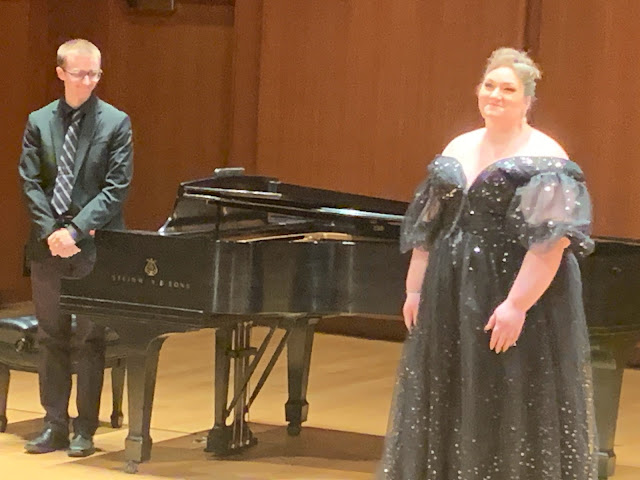
 Alex Munger and Lindsay Kate Brown

We recall hearing mezzo-soprano Lindsay Kate Brown over three years ago in the very same venue--The Morgan Library-- as one of the winners of the George and Nora London Foundation Competition. It was pre-Covid and there was a full house.  Yesterday Ms. Brown presented a beautifully planned recital in the same venue but the house was half empty. We realize that post-Covid, people are staying home more, so we are urging you, dear reader, to come out and support our vocal artists who work so diligently to bring artistry into our lives!

Ms. Brown entitled her program "Serenading the Hours: A Day to Night Recital" and it was evident that she put a great deal of thought into selecting a variety of composers; she sang in three languages--Russian, German, and English.  Having heard an entire concert of Rachmaninoff's music last night, our ears were particularly attuned to the Russian language and we were glad that political sentiment did not punish Tchaikovsky for Putin's transgressions. Art always trumps politics in our world!

The set of Tchaikovsky songs were well chosen, beginning with the haunting and melancholy "Autumn" and ending with the familiar "None But the Lonely Heart". Johann Wolfgang von Goethe's poignant text must have appealed to the composer who certainly had a lonely heart.  But it also appealed to Schubert who included "Nur ver die Sehnsucht kennt" in his Wilhelm Meister songs. But, on the other hand, it has also been set by Schumann and Beethoven. Someday we would love to hear all four settings on the same program!

Ms. Brown has an engaging onstage presence and chatted naturally with the audience, making us feel welcome. She has an ample instrument and one well suited to Wagner and Verdi but we found it most appealing in the rich lower register and especially in the pianissimo sections. At times when called upon to sing fortissimo in the upper register, we heard a sound that was harsh to our ears.

The "Day" section of the recital continued with songs in English by Jennifer Higdon who provided her own original texts; they were sung with clarity of diction. We particularly enjoyed the lyrical piano part performed by the excellent collaborative pianist Alex Munger

The section ended with songs by Alma Mahler who was sadly stifled by her husband, the famous composer Gustav Mahler. The composer's choice of text seems to indicate a woman of great passion. Our favorite was the gentle "Bei dir ist es traut" which showed off the part of Ms. Brown's voice that fell most pleasantly on our ear. The rippling piano in "Ansturm" was a further source of delight. "Erntelied" ended with a lovely vocalise.

The "Night" half of the program began with songs by Joseph Marx, a composer whose lieder should be more frequently heard.  His "Suss duftende Lindenblüthe" produced feelings of sweet nostalgia, underscored by gentle rippling in the piano. Mr. Munger also captured the rushing brook in "Erinnerung".

Ms. Brown is considerably fonder of Samuel Barber's songs than we are although "Sure on this Shining Night" has an affecting text by James Agee.

Closing the program were six songs from Alban Berg's Sieben frühe Lieder. Although Berg composed about the same time as Marx, his works are far less accessible. Even after multiple hearings we find them difficult to relate to. There is one, however, that enchants us and that is "Die Nachtigall". Theodor Storm's text is rather mystical but the melody lingers and leaves us satisfied. The nightingale sings and roses bloom. A young woman wanders deep in thought.

We don't think we have ever heard a nightingale sing, at least not the avian version, but we just did hear a human nightingale and that is enough for us.

© meche kroop

Saturday, February 22, 2020

GOIN' ON FIFTY

Terrence Chin-Loy, Cheyanne Coss, Teresa Castillo, Nicole Brooks, Tesia Kwarteng,
Ryan Johnson, Nora London, Monica Dewey, Alisa Jordheim, Danielle Beckvermit,
Justin Austin, Jana McIntyre, Anne Maguire, Jessica Faselt, Lindsay Kate Brown, and Katherine Beck

It's the competition we look forward to all year and it's been around longer than we have. Entering their fiftieth year of giving awards to promising young singers, the George London Foundation has earned our respect and admiration for a number of reasons: applicants and competitors pay no fee, pianists are provided (last night it was the absolutely first rate Lydia Brown), prizes are awarded immediately, and all finalists receive awards. No one is left standing on stage without appropriate recognition. We love that!

Planet Opera is a small world and we were tickled to learn that with only a couple exceptions, we were connected in some fashion with all the finalists. Some had received Encouragement Awards from The London Foundation in years gone by; some we knew through The Metropolitan Opera National Council Competitions, some from Opera Index Competitions, some from The Gerda Lissner Foundation Competitions, some from The Richard Tucker Foundation Competition, and some from the Santa Fe Opera Apprentice Program.

Let us begin with the women, in no particular order. Soprano Jessica Faselt made a large statement with Donna Anna's "Or sai chi l'honore", tackling the unrelenting tessitura and wrestling it to the ground without breaking a sweat. Nor were the subtleties lost in this riveting performance.

Soprano Jana McIntyre created a charming Amina, the now wide-awake somnambulist, exulting in Bellini's long phrases in a highly polished performance. There were some beautiful bel canto effects including a liquid trill at the top of the register.

Anne Maguire's chocolate-toned mezzo was just perfect for Fricka's passionate argument with Wotan from Wagner's Die Walküre--"Wo in Bergen du dich birgst". She was completely convincing and employed fine German. We wondered what was going through the mind of our favorite Wotan James Morris who was in the audience!

Another mezzo-soprano Lindsay Kate Brown had such strength in the lower register that we sniffed out a contralto in the making. In fine French, she did justice to the role of the unfortunate Léonor singing "O mon Fernand" from Donizetti's La Favorite. The lovely legato lines were beautifully realized.

Our third mezzo-soprano was Katherine Beck who filled out "Non piu mesta" from Rossini's La Cenerentola with joy and personality. Her bel canto technique was flawless and there was an evenness from the top of the register to the bottom. There is a terrific texture to her instrument that made the performance a singular one.

We loved the bell-like sound of soprano Teresa Castillo as she sang the "Bell Song" from Delibes' Lakmé. She used the entire stage and was generous with her gestures. The precision of the staccato passages was augmented by a gorgeous trill and a floated top note that we'd like to use as an example for some tenors we've heard!

Soprano Monica Dewey performed similar magic with "Caro nome" from Verdi's Rigoletto--precise staccato passages and facility with the fioritura. Her fine vibrato was particularly appealing.

Soprano Danielle Beckvermit has a pretty voice, just right for "Ain't it a Pretty Night" from Floyd's Susannah. Along with fine head resonance and clarity of English diction, we appreciated her acting. We could see the stars in the sky through her eyes.

Soprano Alisa Jordheim gave a fiery delivery of "Air du feu" from Ravel's L'enfant et les sortiléges. The florid vocal lines were wondrously negotiated. Our only complaint is that it is such a short aria and we wanted to hear more of her.

Soprano Nicole Brooks gave a splendid account of Frau Fluth's aria "Nun eilt herbei" from Nicolai's Die Lustigen Weiber von Windsor. She used her bright instrument and generous gesture to create a believable Alice Ford. We admired her German and her use of embellishments in tune with the text.

Tesia Kwarteng is an impressive mezzo-soprano who was completely new to us. She used an entire palette of colors to limn the character of the distraught Charlotte in the "Letter Scene" from Massenet's Werther. We enjoyed the dynamics and phrasing that she employed to show the character's deep feeling.

Soprano Cheyanne Coss performed "Comme autrefois" from Bizet's Les Pêcheurs des Perles in lovely French, exhibiting a wonderful top to her instrument.

There were only three men on the program  and we were happy to get another opportunity to hear baritone Justin Austin. "Bella siccome un angelo" was a wise choice since Mr. Austin has just the right dramatic skills to create the character of Dr. Malatesta from Donizetti's Don Pasquale. His beautiful tone and lovely legato made him a standout and every gesture and facial expression served the characterization.

Tenor Terrence Chin-Loy won our heart with a heartfelt "Che gelida manina" from Puccini's La Bohème. He has a warm quality to his tone and seemed to caress each word that he sang. He shaped his phrases well and came across as an ardent youth "selling himself" to a new love object with a newly found bravado.

Tenor Ryan Johnson, also new to us, began Lensky's aria from Tchaikovsky's Eugene Onegin in a rather stoic pose. He built from that position to a profound emotional impact as he revealed a range of emotions, recalling the events of the prior evening and his love for Olga.

We are happy not to have been one of the judges because we never could have narrowed down this field of stars in the making. All of them are delighting audiences around the country but we got to hear them all in one place on one glorious program. We felt so fortunate! We have added several new voices to our "Singers to Watch" list.

© meche kroop