MISSION
Monday, February 2, 2026
MA NON! THE MUSICAL!
Tuesday, October 15, 2024
SLAYLEM WITCH TRIALS
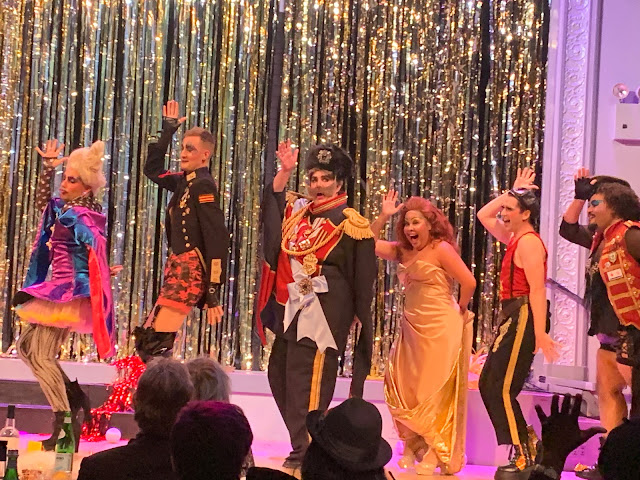
Those Heartbeat Opera mischief-makers were at it again with this year's version of their annual drag show, this year held at the venerable and oh-so-appropriate Judson Memorial Church, home to wild theatrical events since our earliest days in Manhattan. Here's a little secret "dish" for you, Dear Reader. Someone very famous in the opera world got his start there portraying The Operatic Prince in Al Carmine's radical interpretation of the fairy tale Snow White. What a glorious thing to return to our very first exposure to NYC's radical theatrical scene!
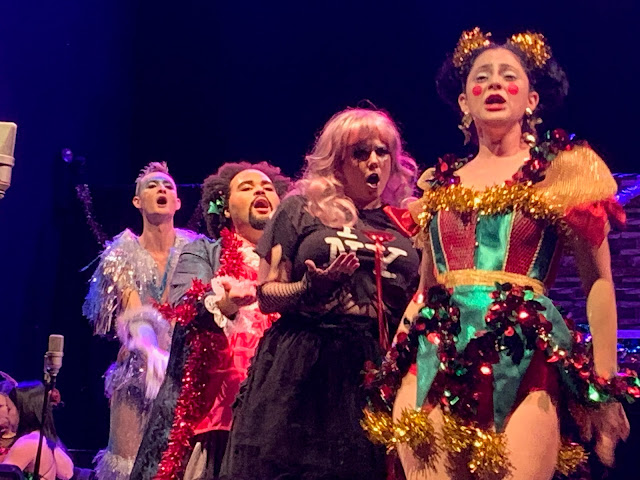
We have never missed any of Heartbeat Opera's annual drag shows, always marveling at the creativity, originality, and gender bending. One can always count on stunning performances and fabulous costuming and makeup. This year was no exception and an enormous crowd of revelers had the time of their lives enjoying the exposure of hypocrisy from America's past history.
In the 17th c. the colonies were not immune to the witch hunting craze consuming Europe. Arthur Miller chose to dramatize this embarrassing piece of history with a serious drama The Crucible, referencing McCarthyism, whilst Heartbeat Opera's devilish crew chose to treat the subject with satiric ridicule, which mass hysteria richly deserves. We hope at least some members of the audience were able to draw parallels with some of the issues being dealt with even today four centuries later.
It appears to us that Heartbeat is moving in a more popular direction than it has in prior years, engaging more of the audience by adaptation, changing of lyrics, and inclusion of more contemporary references for which we needed some assistance from our companion who is more familiar with pop culture and pop music than we are.
Some pieces were instantly recognizable such as the "Lacrimosa" from Mozart's Requiem, and "I am the Wife of Mao Tse Tung" from John Adams' Nixon in China. Our opera singer companion was able to identify some bel canto numbers that we missed. And who could have failed to identify Copland's "Simple Gifts" although we did not know it came from a ballet Appalachian Spring, written for the Martha Graham Company.
But this was not the point. The point was to entertain, to amuse, to play mind games by means of double entendre and gender bending, to poke fun at the pompous, and, above all, to make everything outrageously sexual as seen through the LGBTQ lens. The work brought the audience to their collective feet.
The performers got into their characters with glee, intensity, and over-the-top humor. The always notable John Taylor Ward made good use of his long lanky frame to portray The Judge and Jamilyn Manning White went from Abigail to a sexy red-clad devil. The similarly long and lanky Hans Tashjian portrayed Misery; Bernard Holcomb took the role of Clemency; Angela Yam performed the role of Rebecca; Mercy was portrayed by Rodolfo Girón; Chastity was brought to life by Curtis Bannister. Needless to say, the voices are operatic and nothing was out of their vocal reach. It was a real mind fuck to hear familiar melodies with new English lyrics and to be unable to identify the music!
These unexpected lyrics were supplied by Director Nico Krell, violinist Jacob Ashworth, and Co-writer Garrett Bell. Mr. Krell did a fine job of keeping the story moving with raunchy vignettes. All three are credited as "Creators".
Under the direction of Dan Schlosberg, the orchestra comprised Mr. Schlosberg himself at the piano, Mr. Ashworth playing violin, with Mira Williams playing viola and Julia Henderson playing cello. Just as fantastically costumed (see our entries on Facebook and Instagram) as the stage performers, they did a fine job moving seamlessly from classical music to numbers of the popular genre.
The fantastic costumes were designed by David Quinn and we were most impressed by Ms. White's red devil costume. A sexier devil we have never seen! The costumes of the Pilgrims were grim on the outside but often hid racier elements. Maiko Ando's makeup added to the effects.
This queer extravaganza ended with a touching group sing of "Make Our Garden Grow" from Bernstein's Candide. As Generation Z would say "They ate and left no crumbs.
© meche kroop
Saturday, April 6, 2024
THE EXTINCTIONIST
Katherine Henley and Claire Leyden
(photo by Russ Rowland).
How interesting that our companion for the evening (an opera singer) came up with the same thought as we did at the conclusion of Heartbeat Opera's production of The Extinctionist. "This would have made a great play!" Upon return home we took a look at the program for the first time, only to learn that the work was adapted from a play by Amanda Quaid! She wrote the libretto for this work, which is the first commission ever made by this risk-taking company.
There seemed to be two interwoven themes at play. One was a woman's fear of bringing a child into a dying world and the other theme being marital discord over the issue of starting a family. Fortunately, the play is not polemic and leaves the audience to decide for themselves. Good theater makes us think. We have heard that art is a mirror that gets us to see ourselves plainly.
Th woman in the story is well performed by Katherine Henly and her ambivalence about pregnancy resulted in palpable anguish. That she is the only character who feels threatened by catastrophic global warming makes us focus on her dilemma. On the one hand, a potential child comes to her in her dreams and we learn that she and her best friend, winningly played by Claire Leyden, had long planned to get pregnant at the same time (as did two sisters of our acquaintance). On the other hand, she is terrified by what she alone perceives as the end of the world as we know it.
A meeting between the two women had our main character shocked and distanced by her friend's rapture at being pregnant. "How could anyone bring a child into the dying world?"--a thought we ourself have shared.
The woman and her husband had been trying to achieve pregnancy for some time and one gathers that they may have married believing that they both wanted the same thing. The husband, ( played by Philip Stoddard) is not exactly sympathetic.
The most awkward scene we have ever seen onstage was the woman being given a pelvic exam by her gynecologist and later given a diagnosis which we will not reveal. We do wish the production team had consulted a genuine doctor as we found a couple inaccuracies in the dialogue and action; but perhaps the scenes with the physician (played by Eliam Ramos) were meant to be the woman's perception, rather than reality.
The work was well directed by Shade Ghaheri and Kate Noll's scenic design was stunning. The couple's bedroom was tasteful and modern, indicating that they were financially comfortable. It occupied one side of the wide stage whilst the other side served at times as a living area and at others as a gynecologists examining room. Bare trees and dying plants were scattered about the stage. Reza Behjat's lighting design subtly contributed to the mood of each scene Projection design by Camilla Tassi was apt, as is seldom the case. Scenes of weather disasters served to remind us what stirred the woman's anxiety. Costume design by Haydee Zelideth and Asa Benally was apt. The child puppet, created by Afsaneh Aayani, was adorable.
So, Dear Reader, as drama it worked. But, and this is a big but, this was billed as an opera. Was the music good? Yes, it was. Dan Schlosberg's original composition for piano, violin, viola, electric guitar and percussion would make an excellent curtain raiser on any symphonic program.
Although the instrumentals served to heighten the mood, the vocal lines were entirely unmusical. We wondered how the cast managed to learn their parts. And to sing with such excellent diction! This is a common feature of contemporary operas and the reason that they are rarely seen a second time. We want to leave the opera humming a melody. Our brains are programmed to want this!
It is likely that some of you, Dear Reader, will disagree with us and that is fine. We all attend live events for different reasons. We would just as soon have seen the play.
© meche kroop
Wednesday, April 3, 2024
EUGENE ONEGIN (the Cliff Notes)
Friday, November 10, 2023
THE GOLDEN COCK(erel)
Sunday, April 10, 2022
HEART FAILURE
We have reviewed Heartbeat Opera's productions from its inception. We have often written "Our heart beats for Heartbeat Opera". We have rushed home from their productions bursting with energy, eager to share their prodigious creativity with our readers. Last night our heart went into arrhythmia; had Quando lasted another moment, we might have had a heart attack. In any case we are heartbroken.
We always like to begin our reviews with something we enjoyed about a production. The only positive thing about last night was the venue. It is always fun to visit the McKittrick Hotel; the fellow who took us up in the elevator was pleasant.
We believe a work of art should stand on its own merit. Requiring a lengthy exegesis seems to portend disaster. It's like trying to "explain" a painting. You know the typical drivel from the Director' Notes--"The way I conceive this work is....yada yada yada". "What I am trying to illustrate here is....yada yada yada".
There were, of course, note for the press. We generally don't read these, preferring instead to meet a work face on. Either we "get" it or we don't. Well, dear reader, we did not. We were reminded of that species of "performance art" that is neither here nor there, but something existing in the self-absorbed mind(s) of the so-called creator(s). We decline to name the participants in this worthless production. They are probably filled with joy over the sold-out nature of the performances and we do not wish to rain abuse on their parade.
The performance began with a short film that made little sense, if any. A couple is sauntering down a dark street dressed in evening clothes. He thinks she is mysterious because she won't tell him her last name. They come close to an argument about protesting. She doesn't like his wealthy friends. He tells her they are not friends, they just have "deep pockets".
Suddenly he urges her to pick up the pace. She dawdles spitefully, listening to a street performer playing a saxophone. He leaves her there.
A butler dressed in white is handing out white costumes to some people in their undies. One is wearing "tighty whities". There seems to be some sort of protest with people carrying signs. There is an orgiastic quality.
The aforementioned woman arrives. She and the aforementioned man sing some operatic arias, including a love duet from Verdi's La Traviata. At this point, dear reader, we thought the idea was to expose members of the mostly young audience to opera, in which case the poor sound design did nothing to achieve the goal and did a disservice to the highly regarded singers who shall remain nameless. The woman appears to stab the man with what looks like a cello bow. He bleeds from the mouth. The "protesters" were horrified. So were we.
There was a 5 minute intermission during which we went to the ladies rest room to eavesdrop. Young women were gossiping about their lives and no one said a word about the performance. We asked the young man sitting next to me what he thought. "It's OK", was all he was willing to share.
The performance resumed. The women on the other side of me resumed their texting. The film was shown again and this time two characters called "Disruptors" made weird noises and hurled imprecations at the screen. The white haired woman banged the piano and played what seemed to be a flute. The young man banged on cymbals and scraped the edge of same with a bow. He cruised around the audience which remained impassive. The two reminded me of unruly schoolchildren. We felt like doing some disrupting of our own. Finally, we fled into the rainy streets, regretting the misuse of our Saturday night.
Clearly, the "creators" wanted to say something but they failed abysmally to get their point across. If they were trying to skewer traditional opera, they only managed to send us running back to The Metropolitan Opera which, for all its flaws, does occasionally bring beauty into the world. Quando was produced in collaboration with Long Beach Opera and this was the world premiere. We cry "bullshit"!
© meche kroop
Friday, December 17, 2021
FUN(D) RAISING
Thursday, December 12, 2019
WORTH A SECOND SHOT
Saturday, December 7, 2019
SHAKEN AND STIRRED
Saturday, November 2, 2019
(RED) HOT MAMA
Friday, May 3, 2019
AN UNLIKELY MARRIAGE
![]() |
| Patrick Kilbride, Paul Max Tipton, and Lucía Martín Cartón (photo by Russ Rowland) |
It seemed like a strange coupling but strange couplings often produce very special children and such is the case with the marriage of Heartbeat Opera with Opera Lafayette. Opera Lafayette is a longstanding (25 years) fixture in D.C. and we have enjoyed their annual visits to NYC for some time since they bring lovely productions of Baroque opera. Heartbeat Opera has been growing for only five years and is best known for their radical reinterpretations of the classics, thus achieving impressive recognition and honors from the opera community.
The lovechild of this visit was a riveting production of Alessandro Stradella's 1681 opera La Susanna, a retelling of the story from The Book of Daniel about an innocent young woman blackmailed by two venerable but lustful judges and condemned to death. The story has a happy ending due to a deus ex machina in the person of the youth Daniel who cross-examines the two judges, thus exonerating Susanna and condemning the wicked judges to death.
This story was the inspiration for Carlisle Floyd's 1955 opera Susanna and the Elders, remembered primarily for the soprano aria "Ain't it a Pretty Night". The story has been immortalized by many Renaissance painters; many of the works so inspired were exhibited in the Gallery of BAM Fisher where last night's opera was performed.
Ethan Heard's direction shed so much light on the issue presented by the story that we had tears dripping from our eyes. The story was presented with specificity, leaving us to identify with Susanna and her predicament; memories were evoked that left us shaken and angry. Good art should make us feel and think; this Mr. Heard accomplished, all while the Baroque ensemble soothed us with lovely harmonies.
If this had been set by a contemporary composer, it would likely have had a jagged atonal setting that would have just left us irritated. The contrast between the lovely music and the horrifying story worked to great advantage.
The framing device for the story was an academic lecture on female studies and also art history, since the scenes of the violation employed a stop-action or freeze strategy which imitated the many paintings we saw in the Gallery. This narration is generally performed by a male character named Testa, but was here performed by Sara Couden whose powerful contralto was employed both effectively and musically to further the characterization.
As the eponymous Susanna, the plangent soprano of Lucía Martín Cartón could not have been better. She radiated joy and innocence in Act I, and conveyed both fear and hope in Act II.
As the wicked judges we heard two fine singers who had the unenviable task of making us hate them. Tenor Patrick Kilbride and bass-baritone Paul Max Tipton were scarily convincing in their lust and deceit. Moreover they sang a particularly fine trio with Ms. Couden in Act I.
Soprano Ariana Douglas rounded out the cast. She didn't have much to do as a student in Act I but in Act II she portrayed Daniel as a White Knight who got involved by conducting the cross-examination whilst Ms. Couden's professor kept her distance.
These fine voices were matched by some splendid playing of the chamber orchestra off to the side. We never would have expected to hear Ryan Brown, founder and artistic director of Opera Lafayette and Jacob Ashworth, music director of Heartbeat Opera (as well as music director of Cantata Profana) sitting side by side bowing their violins! A theorbo, a cello, a bass, and a harpsichord completed the group.
Reid Thompson's scenic design was simple and effective. There was a large round vessel center stage which served well for Susanna's Act I bath, as well as a prisoner's docket for Act II. There were three enormous statues onstage, male authority figures--a statesman, a priest, and a soldier--representative of all types who have been involved in abuse of power toward women. All were carried offstage at the end. Lighting by Oliver Wason was effective.
Beth Goldenberg's costumes for Act I were perfect. Susanna wore a shimmering body suit for which, fortunately, she had the right body; it fostered the image of happiness, innocence, and moisture. (In place of water there were tiny sparkly confetti.) The judges were dressed in what appeared to be Renaissance robes.
In Act II, Susanna wore an orange prisoner jumpsuit which jolted us into contemporary times. Our main quibble was with the Professor who was costumed a bit too glamorously for someone giving an academic lecture. It would have been more appropriate had she been wearing a tailored pantsuit.
Emma Jaster's movement direction was as fine as we have come to expect from her.
Of course this story has contemporary resonance. What upset us the most, among the many memories that were evoked, was a documentary we saw that was smuggled out of a Middle-Eastern country in which an innocent woman was buried up to her neck and stoned to death--all captured on film. Every time we see a woman on the streets of New York who has been taught to cover up her beauty so as not to inflame a man's lust, we feel the same anger; oh, the injustice of it all!
The success of this particular treatment of this particular opera drove the point home without spoonfeeding, without hammering us on the head with contemporary examples. Therein lay the artistry.
Although opening night was sold out, perhaps you will be able to snag tickets for tonight, tomorrow or Sunday matinée. We recommend it highly. We reviewed two operas this past week in which the directors tried too hard to make the stories "relevant". This was different.
(c) meche kroop