MISSION

We are here to encourage the development of gifted young singers and to stimulate the growth of New York City's invaluable chamber opera companies. But we will not neglect the Metropolitan Opera either. Get ready for bouquets and brickbats.
Showing posts with label Glenn Morton. Show all posts

Thursday, May 15, 2025

SHOWCASE OR NEW OPERA COMPANY?


Enes Pektas as Michele


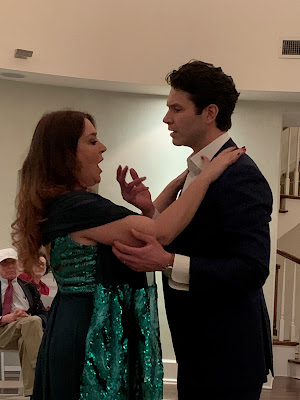
Sarah Stevens as Giorgetta and David Freides as Luigi


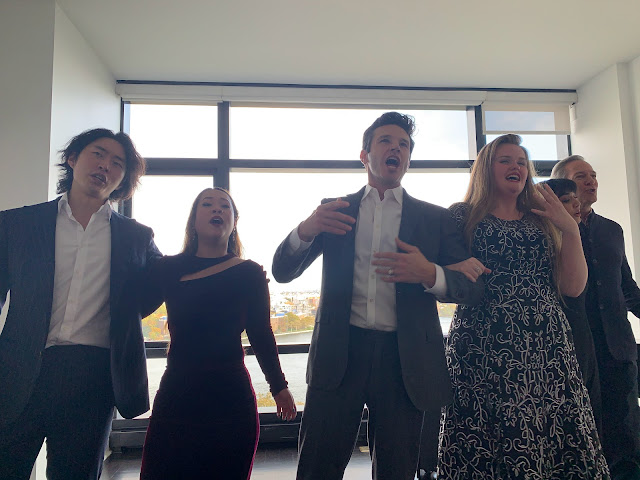
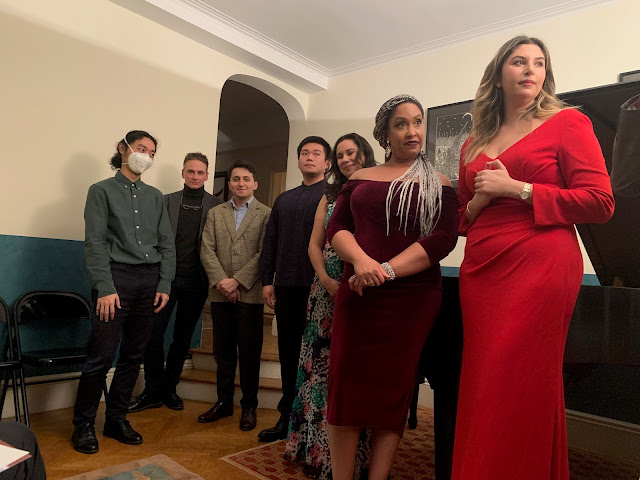
With his typical modest manner, Glenn Morton, Director of Classic Lyric Arts Vocal Academy, introduced CLAVA's debut opera performance at The Blue Gallery. As a member of the audience we are not obligated to be modest. As a matter of fact, we are over the moon about a completely engaging performance of Il Tabarro, one third of Puccini's  Il Trittico. The singing was stellar with major roles performed by members of CLAVA and supporting roles cast with graduates of CLA's  immersive summer programs in Italy, France, and The Berkshires.

Adding to the immeasurable vocal thrills of the evening were three factors. The finely tuned direction of Daniel Isengart (a CLAVA Faculty Member) told the timeless story with specificity of detail and characterological honesty.  The conducting by Maestro Michelle Rofrano  built the intensity of Puccini's score to a fever pitch, relaxing only briefly for the dancing scene. The piano artistry of Doug Han who, by some kind of magic, created all the colors of the orchestra.

Mr. Isengart's stage direction was so specific that our guest, who speaks no Italian, was able to relate the story to us after the curtain.  And no, he did not read the synopsis. This was an experiment because there were no projected titles. Not only was the story well told, but each character was believable, evoking memories of real people.

As Michele, the Captain of the barge, we heard baritone Enes Pektas, whose Master's Degree recital we recently reviewed. (You can, Dear Reader, enter his name in the search bar if you missed the review.) His acting was so intense and brooding that we lost sight of the artist as someone we have seen and heard before. He actually became the character and we felt the pain of being betrayed. Although Giuseppi Adami's libretto is set a century ago, the story is a timeless one. The narcissistic injury endured by a man in a loveless marriage unable to retain his wife's affection can easily turn to murderous rage. That story is not unknown today.  The sullen vocal color infused Mr. Pektas' portrayal whilst he preserved his beautiful tonal quality and phrasing.

As his unhappy wife Giorgetta, soprano Sara Stevens (also reviewed several times this year for her performances as a Master's Degree student at Manhattan School of Music) turned in a most affecting performance. By means of vocal coloration she demonstrated the coldness she felt for her much older husband and the feminine energy she projected with Luigi, a stevedore on the barge. By some fine acting one could sense that she and her lover had a past that they shared. Indeed they both came from the same suburb of Paris and probably grew up together. All this was conveyed with facial gesture and posture, but probably came from a deep belief in the character. 

There was the lighthearted side of Giorgetta as well, when she brought wine to the stevedores and danced. There was even a funny moment when Tinca (played by John Viscardi, once a CLA student but now Coach and Artistic Director) tried clumsily to dance with her and stepped on her toes.

The character of Luigi the lover was wisely drawn by tenor David Freides who was careful not to make him too sympathetic. Did he deserve his fate? That was left for the viewer to decide. That he sang with beautiful tone might have prejudiced the audience to more sympathy than he deserved.

It is said in the theater that there are no small parts and that seems to be true in opera as well.  As evidence we offer the fine performance of mezzo-soprano Sofia Durante as La Frugola who comes on board with trinkets and gossip that she shares with Giorgetta. She immersed herself so completely in this voluble role that it took us a few minutes to recognize her as someone we have heard in concert several times before. 

As her husband Talpa, Alejandro De Los Santos made an equally fine showing. The carefree domestic affection between this pair served as counterpoint to the tense relationship between Michele and Giorgetta. This is something we never perceived before and for this we thank the direction.

As far as the setting, there is no actual stage in The Blue Gallery. A metal bar stretched horizontally across the playing area and we had no trouble perceiving it as the railing of the barge. Stevedores toting large boxes across the stage added to the illusion and reminded us that much can be accomplished with minimal material resources and a lot of imagination.

The minor characters were portrayed by Samuel Ng and Sofia Gotch singing from behind the audience and in a space up near the ceiling. This was not a problem since it served to focus attention on the major characters. Costuming was minimal and timeless.

Everything served to show us that opera is theater with gorgeous voices. Famous names and elaborate sets are not as important as the music and the storytelling, of which we had the very best!

A couple years ago the late and lamented On Site Opera produced this same opera at The Seaport (review can be found in the search bar) with action taking place on a ship and the audience seated on the dock. We enjoyed the realism but the voices required amplification. This made last night's performance even more valuable as we heard Puccini's vocal lines delivered with musicality and authenticity.

Without the obligation of bringing in famous names to fill a huge theater, opera can once again be restored to its original function and we applaud this aim. This opera was chosen by CLAVA, not to please an audience, but because they had the right singers for the roles. Would this model work for a small opera company in Manhattan? We very much think so and will be first in line for their next venture. Was this experience valuable for the young artists who participated in CLAVA? We definitely think so. Academic institutions cast them in contemporary operas no one else will ever produce, or in weird productions of great operas. But to get a chance to perform in an authentic production of a great opera means that they can sing these roles anywhere in the world. And we hope that they will!!!!!

© meche kroop

Friday, December 13, 2024

A MOST GALA GALA


  A scene from Mozart's Cosi fan tutte

Unless you are new to Voce di Meche, you are familiar with our delight in institutions that share our goal of fostering the careers of young opera singers. Having impressed us year after year with results, Classic Lyric Arts tops our list of institutions worth supporting.  Recently expanded from their three summer programs of total immersion in Italy, France, and the Berkshires, yearling CLAVA (Classic Lyric Arts Vocal Academy) is now flourishing, providing advanced year-long training to a select group of students.

Last night we attended the annual gala in which students and alumni got to show off their vocal, linguistic, and dramatic skills. Following a two handed piano arrangement of the overture to Don Giovanni (I-Hsiang Chao and Hannah Harnest) we were treated to the tender duet "Ange adorable" from Gounod's Roméo et Juliette with Sofia Gotch lending her brilliant instrument to the role of the shy heroine with tenor Yulin Wang giving an affecting performance as the ardent Roméo. The French diction succeeded beyond the customary skill of most young singers, evidence of some fine coaching. Daniel Isengart's astute direction had the two circling each other in a dance of seduction.

Following was the delightful light hearted duet from Hahn's comic opera Ciboulette, an interesting choice to show off the charms of Alison Kessler and Kevin Douglas in the duet "Nous avons fait un beau voyage", sung in French that was as Gallic as one might wish for. Hyojeong Ham accompanied.

The crazy scene from Mozart's Cosi fan tutte was so cleverly directed by Mr. Isengard that the nonsense between the six main characters made sense and we were plunged right into the craziness. Ms. Harnest accompanied the frolic with Annelise Burghardt, Brigid Mack, Yunxin Dorothy Nie, Benjamin Truncale, Jongho Woo, and Brian Linares bringing the scene to vivid life with  Ferrando and Guglielmo feigning suicide to win the affections of Fiordiligi and Guglielmo, whilst Don Alfonso and Despina enjoy the chaos they created.

Soprano Kerrigan Bigelow used her delicate vibrato to portray the shy Micaëla in her Act I duet with Don Jose, convincingly portrayed by tenor Philippe L'Esperance who has never sounded better, although we have always enjoyed his performances. Ms. Ham accompanied.

A riveting and star-making duet from Bellini's Norma ("Mira, o Norma") gave an opportunity for stellar soprano Sara Stevens to tackle this difficult number with the well loved mezzo-soprano Briana Hunter providing fine harmony as Adalgisa. The acting was particularly effective as the two women drew closer to one another. Again, Mr. Isengart's staging was right on point. Ziyi Hong accompanied.

A different Fiordiligi, Haiming Wu, succumbed to the importunate Ferrando of Mr. Truncale in "Far gli amplessi", a bit further along in the story.  There was so much going on in the aforementioned sextet that we didn't have the opportunity to focus on any one singer, but in this duet we noticed Mr. Truncale's embouchure and how that contributed to his most Italianate sound. Ms. Wu gave an excellent rendering of Fiordiligi and I-Hsiang Chao accompanied.

Comedy filled the air as Mr. Wang showed that his Italian was just as good as his French in "Se inclinassi a prender moglie" a duet from Mozart's L'Italiana in Algeri in which Lindoro evades the wishes of Bey Mustafa, well portrayed by  Juan Angel Johnston-Chavez.  Shaobai Yuan accompanied.

If there is one scene in Massenet's Manon that moves us it is when the eponymous heroine seduces her former lover who has joined the priesthood! Soprano Brea Marshall used every vocal and dramatic device in her repertoire to accomplish her goal. Her victim Des Grieux was well sung by Jack Hicks and Hyojeong Ham accompanied.

John Viscardi, Executive Director of CLA, is well known to us in both the tenor and baritone fach and made a fine impression as he stepped right into the role of Marcello, lamenting his lost love in the final act of Puccini's La Bohême. Portraying his friend Rodolfo was tenor David Freides and we enjoyed the way the two men balanced each other. Marianna Vartikian accompanied.

Closing the program was a very funny scene from Rossini's Le Comte Ory, well staged by Mr. Isengart who, we might mention, is on the faculty of CLA. The most remarkable feature of his directing is that even an opera neophyte could understand what is happening in a scene, even without benefit of knowing the language. But there were also his well written and concise program notes as insurance! Ziyi Hong provided the lively accompaniment.

Artistic Director Glenn Morton, well known as a faculty member of all three music conservatories in New York City, gave a warm welcome to the guests who were also treated to a lovely reception before and after the program, giving guests an opportunity to mingle with the young artists and to compare notes on the performances. This format seems more agreeable than the customary costly sit-down dinner with a high price tag used by other foundations to raise money and celebrate young singers.

We don't have enough good things to say about our own experience with CLA, not to mention the feedback we get from the students, as well as the evidence of our own ears. Their format of total immersion seems most effective. There is something more to be told, Dear Reader, something we will announce in due time.  So....stay tuned, as they say.

© meche kroop


Monday, November 4, 2024

CLASSIC LYRIC ARTS SUPER-SALON


 Pianists Patrick Gallagher and Marianna Vartikian with singers Enes Pektas, Sophia Durante, 
Sara Stevens and David Freides

It was far more than a private salon that we attended yesterday in a gorgeous Manhattan penthouse. It was a celebration of the first year of Classic Lyric Arts Vocal Academy ( hereafter known as CLAVA) giving a chance to first year attendees to show off the impressive results of their intense post-graduate training. Young opera singers are not always getting the training they need at the conservatories in order to survive in the highly competitive and demanding world of opera. Through CLAVA they will get the rigorous training they need, at a more comprehensive level than the students at CLA summer programs get.

One has only to listen to the results to know that CLAVA is on the right track. Students are learning the repertoire that will get them jobs, not roles in obscure modern works that will never become part of the canon. That they are profiting mightily from this training is obvious. There were moments in the recital when we heard such a fresh connection between the music, the text, and the inner feelings of the character that we had chills, and, at one point, tears. This is what opera really should be!

We cannot describe the entire generous program but we would like to share a few highlights. If we have little to say about technique, it is because we were captivated by the way in which the technique dissolved into the emotions of the character.  No sets! No costumes! Just "acting" coming from such a deep place that the singer dissolved into the character.

Take, for example, the performance of soprano Sara Stevens in "Marietta's Lied" from Korngold's Die Tote Stadt.  We felt all the melancholy, the sehnsucht, the sense of the transitory nature of happiness.  Of course the German was perfekt and the dynamics contributed but our attention was taken by the emotions.

Similarly, soprano Sophia Durante completely inhabited the character of Rosina from Rossini's Il Baribiere di Siviglia, making her adorably spunky by means of lavish, daring, and accurate fioritura, thus illustrating Rosina's willful determination. We just wanted to see her get her way (forgetting, for the moment, the unhappy Countess she becomes in Mozart's Nozze di Figaro).

We haven't heard soprano Yvette Keong in a number of years and we were delighted to witness how she has grown as an artist. The clarity of her diction made every word clear in "My Ship Has Sails" from Kurt Weill's Lady in the Dark. The beautiful text was lent a hint of an unbalanced character that inspired us to look up the plot of this 20th century American opera (unfortunately called a "musical"--but that's just an opinion of ours that regular readers will understand). Indeed, the character is troubled and undergoing psychoanalysis. Could it be just an accident that Ms. Keong conveyed that? We think not.

There were two male artists performing as well, both new to us. Turkish baritone Enes Pektas enacted the clueless Count from Mozart's Nozze di Figaro, wringing from the text every ounce of male piggishness. By what magic can dynamics and phrasing create a character? We wanted to laugh at his pomposity but also felt sorry for him! We found Mr. Pektas to be quite the storyteller.

Tenor David Freides impressed us greatly. with "E lucevan le Stelle" from Puccini's Tosca. We have heard this aria sung by all the great singers of the world and admired their technique and tone but we don't think we have ever felt so invited into a man's heart at the point of his imminent death--the flood of happy memories tinged with the feeling of loss. It was at this point that we became a bit tearful, feeling Mario's depth of character, rather than admiring the overtones.

Not only was the singing first-rate but the piano accompaniment was right on point. Accompanying duties were shared by Glenn Morton, Patrick Gallagher and (new to us) Marianna Vartikian.

What an incredibly special afternoon it was! We not only enjoyed the superlative singing but we feel we learned something about the artistry that is too often neglected, overlooked, or overwhelmed by excessively showy "grandstanding".

© meche kroop

Thursday, May 9, 2024

CLASSICAL, LYRICAL, AND ARTISTIC


 Luc Cheng, Glenn Morton, Young Kwang Yoo, Kevin Jasaitis, Sofia Gotch,  Sofia Durante, Sara Stevens, John Viscardi, Eliza Masewicz, Maia Sumanaweera and Samuel Ng

Regular readers recall my enthusiasm for Classical Lyric Arts, a highly esteemed immersive summer training program for young singers  held in France, Italy, and the Berkshires. Here is some great news, Dear Reader! CLA has expanded into an all year program helping recent conservatory graduates to navigate the difficult period of launching a professional career. Assistance is given in many areas including (but not limited to)  navigating auditions and competitions,  choosing repertory wisely, choosing management, and of course the finer points of singing. We think of it as polishing the gems.

Last night a private recital was held to celebrate this launch and the fortunate members of the audience had an opportunity to hear a program of Italian love songs, arias, and duets. What better language than Italian to sing of love! Even speaking Italian sounds like a love song! Our host, Glenn Morton (Artistic Director of CLA), accompanied some of the singers and the talented Luc Cheng accompanied other singers , including Executive Director John Viscardi (a graduate of CLA) about whom more later.

If we have heard a better recital, we cannot recall. The CLA singers demonstrated fine technique in which we can find no flaws. Their Italian was universally perfect, evidence of the fine immersive training they received in Italy. What most astonished us however, was how each singer showed something we call stage worthiness. They not only understood the text and the emotions which generated it, but they managed to employ the dramatic skills learned from faculty member Daniel Isengart, using facial expression, gesture, and the physical space that was available to create believable dramatic situations.

There were about 15 pieces performed and we will attempt to describe a few to illustrate this. In Rossini's Il Barbiere di Siviglia , Rosina persuades Figaro to get a note to the Count. Mezzo-soprano Sofia Durante created the character of the spunky young woman who is going to get her way whilst baritone Kevin Jasaitis was absolutely taken aback by her anticipation of his plot. They were so effective that one could imagine everything that led up to that moment and everything that would follow.

Ms. Durante also showed her aptitude for breeches roles in two scenes. From Bellini's I Capuletti e I Montecchi, we heard "Ah, crudel d'onor ragioni" in which Romeo and his Giulietta (soprano Sofia Gotch) sing a duet of conflict and anxiety. She also made a fine Nerone in duet with Poppea (soprano Maia Sumanaweera) from Monteverdi's L'incoronazione di Poppea. We heard this duet recently in which the singers "sexed it up" which removed the chemistry we felt from this performance as the singers slowly approached each other, heightening the anticipation.  Yes, we all know that Nero and Poppea were terrible people but in this opera you have to want them to triumph and so they did.

In a scene from Mozart's Don Giovanni, Mr. Jasaitis--now suave and perfectly self-assured--seduced a flirtatious Zerlina, adorably performed by soprano Eliza Masewicz. Each showed impressive comprehension of the character at that particular point in the opera.  In a different scene the seductive Don (Mr. Jasaitis who seems to own the role) performed the serenade "Deh vieni alla finestra" gazing upward at an actual window with the unknown woman actually there, lending verisimilitude to the performance.

The Cherry Duet from Mascagni's L'amico Fritz was performed by  Ms. Sumanaweera and tenor Samuel Ng with such intense chemistry that no one could have missed foretelling the romantic ending to the opera.

There were two entries from Puccini's tragic love story La Bohême. The Mimi of Act I was performed in a touching fashion by Sara Stevens, possessor of a huge and gorgeous soprano, who gave her all to "Mi chiamano Mimi". This was followed by "O soave fanciulla" with  Mr. Viscardi as the ardent Rodolfo (a role he just performed in Colorado, a role that fits him like a custom tailored suit).

There were also several more arias and songs to tickle our ears. We love Tosti's songs and Mr. Ng's impassioned delivery of "Ideale" perfectly captured the Italianate style, as did Mr. Viscardi's performance of "Sola tu manchi".

Ms. Gotch created a memorable Gilda from Verdi's Rigoletto, adorning the vocal line with precisely rendered coloratura flourishes. Similar technical precision was evinced by Ms. Masewicz performing "Qui la voce sua soave" from Bellini's I Puritani. We don't want to end without mentioning a funny moment. We were surprised when the photographer (whose photos are guaranteed to be better than ours) was called upon to sing. It turned out that Young Kwang Yoo had been pressed into service as photographer for the event and is actually an opera singer of terrific talent.

© meche kroop


Sunday, October 22, 2023

CLA OFFERS FRENCH OPERA AND MÉLODIE


 Donghoon Kang, Yohji Daquio, John Viscardi, Sara Stevens, and Glenn Morton

Not even the stunning view across the East River could distract us from the fabulous French program presented by Classic Lyric Arts. CLA has, at present, summer programs of incomparable value in France, Italy, and The Berkshires, the latter focusing on the operas of Mozart. Graduates of these programs are showing off their acquired skills in theaters all over the world. One thinks of these programs as polishing the gems.

Yesterday's concert shed luminous light on the success of CLA's French program which provides an immersive experience for young singers who wish to up their game in French opera and mélodie. If this concert is accepted as evidence, the summer program in France has accomplished its objective beyond what one might hope for. The French language is notoriously difficult to master, largely due to the vowels, especially the nasal ones, and the necessity for long lines, almost free of the stresses one finds in English.

The program opened with CLA Artistic Director Glenn Morton accompanying Executive Director John Vicardi (a graduate of the programs from some years ago) in a moving performance of Henri Duparc's "Chanson triste". As staged by renowned director Daniel Isengart, the mood was fragrant with tristesse. This was no ordinary concert since each piece was lent dramatic impact and intent which augmented the very fine voices.

The gifted young pianist Xu Cheng accompanied the other singers in a program that seemed all too short. Most memorable were the following:  soprano Yohji Daquio singing Juliette's sparkling aria "Je veux vivre"  (from Gounod's Romeo et Juliette) with every ounce of impassioned young womanhood; baritone Donghoon Kang's  strutting demeanor as he created a formidable Escamillo, from Bizet's Carmen, capturing the hearts of the imaginary Spanish ladies (and perhaps those of the women in the audience as well); soprano Sara Stevens' performance of "Robert, toi que j'aime" from the rarely seen Meyerbeer opera Robert le diable.

We are glad that the collapse of Thaïs (Ms. Daquio) into the arms of Athanaël (Mr. Kang) from Massenet's Thaïs  was followed by the frisky "C'est l'amour" from Louis Ganne's Les Saltimbanques. The first brought us to tears and the second left us grinning from ear to ear.  And who doesn't love a happy ending!

© meche kroop

Friday, December 9, 2022

SO MUCH TALENT! SO LITTLE TIME!


 2022 Class Lyric Arts Gala


An hour wasn't nearly long enough to spend with the participants of Classic Lyric Arts, an ever-growing academy of opera that makes use of total immersion summer courses in Italy, France, and lately The Berkshires to hone the skills of young emerging artists of opera and piano. Over the past few years we have delighted in the growth of the young artists as well as the growth of the foundation, helmed by Artistic Director Glenn Morton, well known as a beloved teacher and coach at all three New York City conservatories.

 We will not go on and on about the merits of the training program but rather prefer to address the results which we enjoyed in one too-short hour. The evening began with a four-handed piano introduction. What could be more spirited than the overture to Mozart's Cosi fan tutte performed by the four hands of Billie Miller and Hannah Comia!

This led right into the charming Act I scene of this opera in which Ferrando and Guglielmo are interacting with the older wiser Don Alfonso. Tenor Bradyn Debysingh used his bright flexible tenor to create the character of Ferrando whilst Kevin Jasaitis' generous baritone joined in as Guglielmo.  And who should appear as Don Alfonso?  None other than the promising Christopher Lau whom we just heard as Giove in the Mannes production of La Calisto. Low voices like his take a bit longer to mature but we can already foresee a fine future for him. 

Mascagni's L'amico Fritz is not performed as often as it should be and the charming scene between Fritz and Suzel --"Suzel, buon di" was brought to life by the equally charming soprano Maia Sumanaweera and her courtly Fritz, sung by Samuel Ng. They evinced a lovely shy interaction with plenty of romantic undertones.

After all that excellent Italian diction, we were ready to hear the fine French of Charlotte Bagwell as Ophelia, and Wesley Diener as Hamlet in "Doute la lumière" from Ambroise Thomas' eponymous opera.  Ms. Bagwell successfully conveyed Ophelia's innocence whilst Mr. Diener created a nuanced portrait of the conflicted Hamlet. 

Doohyun Yoon's full tenor was employed with subtle dynamics in "Non piangere Liu" from Puccini's Turandot. It is courageous for a young singer to tackle an aria that is so famous, so beloved, and so often heard sung by great voices.  Mr. Yoon never shrank from the challenge and delivered a fine performance.

We love Bellini for his long lines and consider them a challenge for young singers. What a pleasure to hear soprano Jihye Seo as the eponymous Norma and mezzo soprano Monique Galvâo do justice to "Mira o Norma". The harmonies were exquisite and the astute dynamic variety made the most of this glorious duet.

Composer Jake Landau shared his composition "Mary's Song", setting a text by Marion Angus which was sung by Johanna Will. The piano writing struck us as dynamic and colorful.

The forbidden love of Nadir and the Hindu priestess Leila in "Ton coeur n'a pas compris le mien" from Bizet's Les pêcheurs de perles was expressed by soprano Julianne Casey and Mr. Debysingh;  in this tender duet  the two begin tentatively distanced and gradually move closer as emotions are given their due. The French was excellent and gave evidence of some fine coaching, for which CLA is known.

Der Rosenkavalier is one of our favorite operas and the trio of The Marschallin, Octavian, and Sophie is one of the grandest numbers in the operatic canon. What a treat to hear three young women perform it so splendidly-- soprano Hannah Cho as the gracious Marschallin, Ms. Sumanaweera as the innocent Sophie, and mezzo-soprano Arianna Paz as the bewildered and ambivalent Octavian. Xu Cheng made a special contribution at the piano, replacing Strauss' demanding but lavish orchestration.

In the scene from Offenbach's Les Contes d'Hoffmann ("Chère Enfant), we almost missed the marvelous vocalism, captivated as we were by Henry Griffin's mesmerizing.  maliciousness as Dr. Miracle. Soprano Sara Mortensen made an affecting Antonia, the sickly singer who would lose her life when driven to sing by Dr. Miracle's conjuring of her dead mother, played by Emily Gehman. What a splendid trio!

The entertainment was brought to a close by an ensemble singing "C'est la fiesta bohémienne" from an operetta by Lopez called La belle de Cadix. We have never even heard of this mid-20th c. operetta and may never get to see the entire work but we certainly did enjoy this rousing finale to such a delightful hour spent with these up-and-coming young artists. 

Piano accompaniment was provided by Mr. Cheng, Ms. Miller, Ms. Comia, and She-Yuan Ma.

We heard so much potential, so much evidence of hard work and dedication. Not all of these young artists will become stars, since talent and hard work are not enough; luck, grim determination, and good management also play a part. However, we are pleased to note the impressive success already achieved on the world stage by graduates of the CLA program.

Every year, one of the graduates gets to give a brief talk about how these summer programs have affected their artistic development. This year it was Ms. Galvão who shared her experience of cultural immersion in France, giving a joyful picture of exposure to culture as well as language.

May CLA continue to thrive and grow! May financial support increase! May a new crop of young artists get to participate in this valuable experience!

© meche kroop

Saturday, February 26, 2022

PAST, PRESENT, AND FUTURE

Donata D'Annunzio Lombardi and John Viscardi


On Wednesday evening we were privileged to attend Classic Lyric Arts' "Concert at the Castle" along with a crowd of CLA Supporters, all of whom were delighted to witness the past, present, and future of this estimable program. A warm welcome from Founder and Artistic Director Glenn Morton, well known in operatic circles for his astute coaching and pedagogy in all three NYC music conservatories, introduced us to the myriad achievements of CLA--not only the immersive programs in Italy and France but the newly initiated program in the Berkshires which began last summer, focusing on the operas of Mozart.

Representing the past of CLA was tenor John Viscardi, a major light on American opera stages, who serves as Executive Director of CLA. Mr. Viscardi is an alumnus of both CLA's French program and Italian program; his linguistic facility gives evidence.  He opened the concert program with the tender "Chanson Triste" by Duparc. The performance was marked by perfect French diction (of course) and consummate expressiveness, alternating tender moments with expansive ones. He also closed the program performing a stunning duet with a surprise guest artist; we are going to keep you guessing her identity until the end of the review.

Another alumna of CLA is the lovely Daniela Magura, a beautiful mezzo-soprano with a luscious tone. She showed off her fine French in "Tristes apprêts", an aria from Rameau's Castor et Pollux that was new to our ears.  Her "Habanera" from Bizet's Carmen, on the other hand, is almost overly familiar but we always enjoy hearing a singer whose take on the character is a bit different.  Ms. Magura's Carmen is more subtle than most, so confident in her ability to seduce that she can underplay it, thereby avoiding all the encrusted clichés. What an advantage to hear her diversity in two such different arias and to hear French sung so authentically in Gallic style.  More credit to CLA's French program which she attended twice.

Baritone Jared Werlein is new to us and we are always happy to hear a singer with comedic flair.  He is a student of Mr. Morton at Juilliard and his fluency in Italian surely comes from his prior attendance at CLA's Italian program. We were able to appreciate his ability to go from the well-known classic ("Madamina, il catalogo è questo" from Mozart's Don Giovanni) to a delightful 20th c British song, "The green-eyed dragon" by Wolseley Charles. The lyrics were so clever in their rhymes and the music so tuneful that we plan to search out more of Mr. Charles' music. Mr. Werlein did justice to both styles, more evidence of the versatility that we admire. 

Tenor Michael McDermott, another student of Mr. Morton at Juilliard also chose two very different pieces. His Italian selection was the well known and beloved Tosti song "Non t'amo piu" which he sang with Italianate passion and the multiplicity of emotions that the librettist intended. His use of pacing and dynamic variation brought intensity to the performance. Quite different was his more delicate delivery of "Ah, lève-toi soleil" from Gounod's Roméo et Juliette in which he showed an easily produced upper register and pleasing French which will be fine tuned this coming summer at CLA's French program.

New to CLA and representing its future is the beautiful soprano Julianne Casey who also alternated a French selection with an Italian one. "Il est doux, il est bon" from Massenet's Hérodiade was sung with youthful rapture and some lovely resonance in the upper register. We liked the expansive top in "Se come voi piccina" from Le Villi, an early opera by Puccini with which we are unfamiliar. We cannot wait to hear her after her attendance at CLA's Italian program next summer.

And now we will tell you dear reader, as promised, about the stunning surprise climax to the program. One of Europe's most sought after sopranos, Donata D'Annunzio Lombardi, performed the role of Tosca in the first act duet, with Mr. Viscardi as her Mario. We found ourselves captivated not only by the vocal excellence but by the characterization given by Ms. D'Annunzio. We felt as if we really understood Tosca, not only her devotion to Mario but the insecurity that underlay her display of jealousy and the good will that allowed her to turn the jealousy into a little tease.

Ms. D'Annunzio Lombardi is on the faculty of CLA and brings to their programs a very unusual method of teaching, the likes of which we have never seen. Suffice it to say that the changes wrought by her tutelage have been astonishing. We have the greatest respect for results and for those master teachers that add value. Students can consider themselves extremely fortunate to fall into her hands.

The collaborative pianist for the evening was the gifted Xu Cheng who never fails to keep pace with the singers and permits all of them to shine in their own fashion.

We advise keeping an eye on Classic Lyric Arts.  Their history is significantly worthwhile, their present shows the flexibility demanded by the Covid pandemic, and they have a brilliant future as they expand in new ways, some of which are in the works and some of which we foresee in our crystal ball.

If you, dear reader, care to see photos of the event, they will be on our FB page--Voce di Meche.

© meche kroop

Monday, December 13, 2021

GROWING WITHOUT GROWING PAINS


 Meet Classic Lyric Arts superstars--pianist Xu Cheng, director Daniel Isengart, tenor Scott La Marca, baritone Chen Xi, soprano Laura Soto-Bayomi, and mezzo sopranos Briana Hunter and Shannon Delijani!

Classic Lyric Arts, helmed by renowned professor, coach, and collaborative pianist Glenn Morton, is well known for its intensive summer programs in both Italy and France. They are now expanding into The Berkshires for yet a third program--this one focusing on the operas of Mozart. Staying that close to home this past summer because of Covid has made this new addition seamless. Growth is good! Students will have the opportunity to enroll in any or all of the programs.

We felt privileged to attend their soirée last week to hear some of our favorite artists, some of whom have sung at Voce di Meche's House of Music and others who were new to us. The evening was coached by Daniel Isengart who has added great performance value to CLA's intensive programs and is now an esteemed faculty member.

To avoid deciding which artist to mention first, let us go according to fach with pride of place given to Laura Soto-Bayoni who has a sizable soprano and a personality to match. Because of our focus on emerging artists, we rarely get to hear big voices and hearing Verdi was a special treat. An arresting account was given of "Non so le tetre imagine" from Il Corsaro. This aria is filled with emotion which colored her delivery of the text. The melodies are gorgeous and Ms. Soto-Bayoni leaned into them with effective phrasing and an affecting vibrato.

She was no less impressive in "Stridono lassu" from Leoncavallo's Pagliacci , showing a real flair for verismo. We are pleased to report that the birdsong so beautifully created on the piano by Xu Cheng entered our consciousness doubly as her stunning soprano convinced us that we could also see the birds in our mind's eye.  Now that's artistry!

More flexibility was demonstrated in a duet with Mr. La Marca--"Tornami a dir che m'ami" from Donizetti's Don Pasquale in which both young lovers expressed their affection by means of some lovely phrasing of Donizetti's charming vocal line. We do love duets and the two voices blended perfectly in happy harmony.

Shannon Delijani was heretofore unknown to us but we are glad to have this lack remedied. Ms. Delijani has a striking presence that seemed to announce the striking voice we heard. Our favorite piece was "O mon Fernand" from Donizetti's La Favorite. We have loved this aria so much in Italian and we didn't expect to enjoy the French version but, thanks to some perfect French diction we were similarly enthralled. We have a great enthusiasm for bel canto and it strikes us as more difficult to perform on French vowels but Ms. Delijani was undaunted. The handling of the lower register had just the right mix of chest and head voice. The cabaletta was powerful.

Her facility with French served her well in Chabrier's chanson "Les cigales" which requires rich coloration and good dynamic control.  Ravel's "Kaddisch" was performed in Hebrew which was made to sound as beautiful as French. We felt a sincere commitment, made doubly impactful by the spare and haunting piano accompaniment.

Mezzo-soprano Briana Hunter possesses an amazing repertoire of expressions and gestures, all of which were brought to bear on the Habanera from Bizet's Carmen. We forgot every time we had heard it before and experienced it as if brand new. Her Carmen is a mercurial one and each gesture and expression seemed to emerge from the text.

Ms. Hunter's complete comfort in the French language was heard in "Elle est la pres de lui" from Thomas' Mignon. It was emotional; it was believable; each gesture supported the voice. There is so much strength in the lower register!

Tenor Scott La Marca did his best work in Turina's "Los dos miedos" which he had  performed in our House of Music. Regular readers may recall how much we love Spanish music and this is one of our favorites; we have not heard it sung better. The text is psychologically valid; the musical line is apposite; the performance was stellar. As we said before, the romantic duet with Ms. Soto-Bayomi was a big hit in which Mr. La Marca paced his tenor part to perfectly match her soprano line. Beautiful blending!

As if that weren't enough, we had a surprise guest who wasn't on the program. Guest artist Chen Xi sang Tosti's "Ideale" with the same commitment we heard in the rest of the program--a feature which made it seem as new as the Habanera. We loved the resonance in his lower register.  This was the icing on the delicious cake served up by Classic Lyric Arts

Xu Cheng's collaborative piano served each piece, each style, each composer, and each singer. This versatility should serve him well in his future career.

© meche kroop


Saturday, November 9, 2019

CLASSIC LYRIC ARTS FALL GALA

Glenn Morton and participants in Classic Lyric Arts summer programs


The Classic Lyric Arts Fall Benefit Gala is a highly anticipated annual event; it is a golden opportunity to be introduced to participants in CLA's immersive summer programs in France and Italy. These stars of tomorrow have spent some very intensive time in the country of their choice--studying, coaching, learning the subtleties of the language, the culture, the food, and the music.

After a decade, the program is well established; young artists of promise are able to attend even if they cannot afford the tuition because, this year alone, 18 grants were made to help them along. Next year's goal is 28 grants and lovers of this very special art form could find no better means to make a valuable contribution.

The teachers and coaches have been selected for their dedication and desire to pass along their knowledge and expertise. Artistic Director Glenn Morton gave a wonderfully welcoming address to the select audience, pointing out that not every participant will achieve a major opera career; some will wind up in different capacities within the field and others will choose a different profession. But it seems that each and every participant soaked up what was offered to him/her and was greatly enriched.

Before and after the performance, we enjoyed a generous spread of goodies and an opportunity to mingle with the artists and to learn about their education and career goals, and also to hear them extol the benefits of their summer study. 

Alumna Caroline Lopez Moreno possesses a glorious soprano instrument that she uses well and which has captivated us on prior occasions. She has presence to spare as well, and spoke eloquently of her experience with CLA and her respect for Mr. Morton's astute and encouraging coaching.

She performed a divine duet with mezzo-soprano Sarah Fleiss, who is new to us. Rossini's Tancredi offers opportunities to show off and these two young women ran with it, giving an arresting account of this fraught scene in Act II. Rossini gave these conflicting lovers the most harmonious music; Ms. Moreno made a marvelous Amenaide and Ms. Fleiss sounded just grand as Tancredi. The overtones of each voice bounced off the overtones of the other. The fireworks in the cabaletta were dazzling.

We love listening to mezzo-sopranos who have a true mezzo texture to their voices and Ms. Fleiss surely does have the right sound. She was not the only one. Swedish mezzo Loella Grahn gave a winning performance as Rosina in the "note scene" ("Dunque io son") from Rossini's comic masterpiece Il barbiere di Siviglia. Ms. Grahn had all the right qualities--charm, presence, musicality, and good chemistry with her Figaro, wonderfully acted and sung by baritone Carlos Arcos.

Rossini's music is very kind to coloratura sopranos but Puccini demands a more substantial voice and we heard that in Johanna Will; she has a voice with plenty of substance that can effortlessly soar into the upper register. We greatly enjoyed her Cio-Cio San, singing in the Act I love duet from Madama Butterfly "Vogliatemi bene". Tenor Alexei Kuznietsov, whom we have written about several times, did an admirable job as Pinkerton. He just keeps getting better and better, a trajectory we love to witness in a young singer.

His versatility as an artist showed in the lighthearted "C'est l'amour" from Ganne's comic opera Les Saltimbanques, singing with Rachel Liss. We were excited to be introduced to a work and a composer that were new to us.

Similarly we got a kick out of  "Non, non jamais les hommes" from the Yvains operetta Ta bouche--another work and another composer new to us. The delightful Shannon Delijani was joined by Hannah Klein in this very cute number about how men can't understand women. In another number from this operetta, we heard Ms. Klein sing a duet with Wesley Diener entitled "Ta bouche a des baisers".

Soprano Lena Goldstein had a winning presence as Susanna in the scene from Mozart's Le Nozze di Figaro in which Susanna misunderstands the marital intentions of Figaro, here performed by Mr. Arcos who had to take a slap to the face which was quite convincing.

Marcellina was sung by mezzo Nanako Kato who also made a fine Isabella  in a scene from Rossini's L'Italiana in Algeri with Chang Liu singing the rejected wife of Mustafa (Mr. Arcos). 

There was a charming fluffy trio from Berlioz' Béatrice et Bénédicte with the voices of Temple Hammen, Bela Albett, and Melanie Dubil achieving perfect harmony.

We also enjoyed a sweet duet from Puccini's La Rondine--"Bevo al tuo fresco sorriso"-- with Ms. Lopez Moreno's Magda partnered by tenor Travis Benoit as Ruggero and a rousing "I Could Have Danced All Night" from Lerner and Loewe's My Fair Lady with Courtney Sanders singing Eliza Doolittle, joined by the chorus.

There seemed to be varying levels of experience in the singing. Some were "performance ready" and other showed promise. But all exhibited the kind of enthusiasm that warms our heart. And everyone sang with Italianate or Gallic style as the piece demanded. All had excellent diction which speaks well for their training with CLA.

Let us not forget the artistry of the collaborative pianists: Jake Landau, Migeun Chung, Vladimir Soloviev, Xu Cheng, and Ariela Bohrod. They too seem to have picked up a lot of French and Italian style during their residency abroad.

© meche kroop


Friday, November 9, 2018

CLASSIC LYRIC ARTS GALA-2018 EDITION

Classic Lyric Arts students in recital at the Kosciuszko Foundation

We have often written about the contributions made by Classic Lyric Arts to the field of opera. With summer programs in both Italy and in France, CLA offers total immersion programs for emerging artists--young singers who will eventually fill the stages of opera houses around the world. Vocal repertoire is taught through the prism of language, history, and culture--including food! We often recognize former students onstage around town; their linguistic and diction skills are always impressive.

Last night was CLA's 10th gala, heavily attended by supporters who enjoyed a lavish cocktail hour, followed by a thrilling recital, and ending with a dessert buffet at which an abbondanza of macarons were almost inhaled. It was notable that the glamorous servers were the young artists themselves!

President and Artistic Director Glenn Morton welcomed the crowd to the stunning upstairs salon of the Kosciuszko Foundation, speaking to us of the special impact of the human voice and describing the value of taking young singers to the source of the music they will sing, providing a means to become part of the culture and its history for a period of several weeks.

Two alumni of the program in Italy shared their experiences with CLA and how it has affected their lives and professional development. The work at CLA is very intimate and students often maintain relationships with their coaches after the program ends. Tenor Ganson Salmon attended the program in 2017 and baritone Xiaomeng Zhang (who sang so beautifully the prior night as an Opera Index winner) attended in 2014.  Being a fan of both these young artists, we can attest to the benefits they derived from their time in Italy. 

Of course, dear reader, you want to know about the singers and the program last night. The main point we'd like to make is how well every singer utilized the text in their delivery. Everyone sounded natural and authentic. There was no linguistic clumsiness to distract from the music making. It was evident from the several ensemble works on the program how well the singers were able to connect with one another.

The program began with the "Gloria tutti" scene which closes Mozart's delightful Nozze di Figaro and ended with the closing scene "Make our garden grow" from Bernstein's Candide. It seemed to us that the hard work in foreign languages had benefited the students in their English diction as well, since we understood every word. That is not to be taken for granted! Jonathan Heaney conducted the Bernstein from the piano.

A couple performances stood out for us and merit our focus. Baritone Fernando Cisneros, already quite well known on the international opera stage, made the most frightening Baron Scarpia we have ever heard. He created a character that was coming from a position of power more than lust. His vocal colors were chilling and his face actually snarled!  All this occurred in perfect Italian with a long legato line and no loss of vocal tone. Puccini would have loved it.

We might add that his interpretation of Count Almaviva down on his knees in apology to the Countess was humble and sincere with appropriate vocal coloration.  He is indeed versatile!

Mr. Zhang revealed his bel canto artistry as Belcore in "Venti scudi" a scene from Donizetti's L'elisir d'amore in which he manipulates the gullible and desperate Nemorino (the aforementioned Mr. Ganson) into signing up for the army. The two men worked well in bringing the scene to life. We think of this role as Mr. Zhang's "signature role" since we've seen him perform the entire opera with ARE Opera (now called City Lyric Opera) and recall thinking he was the best Belcore we'd ever heard.

We heard some very fine singing from tenor Zachary Goldman and baritone Sunyeop Hwang in everyone's favorite French duet for two men--"Au fond du temple saint" from Bizet's Les pêcheurs de perles. The Gallic phrasing and pronunciation were just right and the harmonies delightful.

Another delight was the duet from Mascagni's L'amico Fritz in which Fritz first meets Suzel. Stephanie Guasch's soprano soared and Taicheng Li's tender tenor matched well with her both vocally and dramatically.

We also enjoyed "Soave sia il vento" from Mozart's Cosi fan tutte in which the two sisters Fiordiligi and Dorabella (Sarah Bacani and Rosario Hernandez) watch their lovers sail away, joined by Don Alfonso (Ari Bell). Mozart's lovely line was filled out with equally lovely harmonies.

Also on the program were two ensembles. One was the septet from the Giulietta act of Offenbach's Les contes d'Hoffman. The other was the "Gran pezzo concertato" from Rossini's Il Viaggio a Reims, conducted by Lochlan Brown who is also responsible for CLA's new website--www.classiclyricarts.org.  We urge you to take a look and see how you too can become part of the CLA family.

Pianists for the evening were all excellent--Mina Kim, Lochlan Brown, Marianna Vartikyan, Jonathan Heaney, and Cherie Roe.

Other singers and members of the chorus included Chantal Brundage, Aleea Powell, Melanie Dubil, Leah Israel, Travis Benoit, Yongjae Lee, Blair Cagney, Daniela Magura, Rachel Querreveld, Victoria Policht, Emily Hanseul Park, Shan Hai, Yue Huang, Bela Albett, and Nathan Seldin.

(c) meche kroop

Thursday, May 17, 2018

MAGICAL MASTER CLASS

Fabio Bezuti, Zachary Goldman, Xiaotong Cao, Glenn Morton, Oleksii Kuznietzov, Donata D'Annunzio Lombardi, Yvette Keong, and Tal Heller

How does it feel when a master teacher comes along and contradicts everything a singer has learned about her voice and vocal production?  We guess it feels pretty good when the results seem magical. We just attended such a class taught by famed Italian soprano Donata D'Annunzio Lombardi. This is our third or fourth opportunity to observe her working with young singers and the results have left a huge impression on us.

Her teachings are based on extensive experience with anatomy, bioenergetics, and osteopathy. She has assembled valuable advice from several famous singers. She can immediately diagnose exactly where tight muscles are blocking sound production and provide strange seeming exercises and postures to ease the blockage. We have heard dramatic changes in the students' voices within minutes!

Her focus is very much on accessing the back of the body and the several diaphragms that are apparently as important as the familiar one. The commonly taught posture and method of breathing into the belly seems to be all wrong.

Students got down on their hands and knees.  They lay on their belly and swam on the floor. They pinched their lips. They showed off their uvulas. They bent over the piano. Wow!

Participating students were sopranos Xiaotong Cao and Yvette Keong, mezzo-soprano Tal Heller, tenors Zachary Goldman and Oleksii Kuznietzov, and baritone Sunyeop Hwang. They all sounded just fine initially but after a half hour work with Ms. Lombardi they each sounded glorious with enhanced resonance. Accompanist was Fabio Bezuti.

We found ourself wishing that we had begun our vocal studies with Ms. Lombardi.  The bad news is that it is too late for us but the good news is that it isn't too late for you. This remarkable teacher, brought to us by Glenn Morton of Classic Lyric Arts, will be returning in October.

If you are a singer you absolutely must attend.  And if you are not, you can come and enjoy witnessing some miracles.

(c) meche kroop

Monday, November 7, 2016

TOASTING TOSTI WITH DONATA D'ANNUNZIO LOMBARDI

Seok Jong Baek and Donata D'Annunzio Lombardi

This was a master class like no other. Italian soprano Donata D'Annunzio Lombardi spent three hours coaching nine young singers in a class devoted to songs by Francesco Paolo Tosti to commemorate the centennial year of his death. Each singer prepared a song (some familiar and some lesser known) and Ms. Lombardi proceeded to use her unique knowledge of anatomy to transform each singer.  Had you been there you would not scoff at this extravagant assertion.

She uses various stances and poses to bypass the throat tension that she observes in American singers (although she admits that American singers are far more expressive than their Italian counterparts). This made us wonder whether the English language itself produces this throat tension; we must ask Ms. Lombardi!

The wildest claim she made is that tenors come in two varieties--"the hitchhiker" and "the communist".  The former holds the fingers down with the thumb sticking out, like Carreras; the latter holds his hands in a fist like Pavarotti. She avers that the thumb is connected with the intellect and the index finger with the front of the body. She wants the singer to use the back of the body--the rear attachment of the diaphragm, the musculature of the spine, and the tentorium of the brain at the back of the skull.

To our great surprise, we noticed an amazing difference when the singer touched his thumb to the pinkie, which is connected to the back of the body!

She stressed the importance of flexibility and spring and had many of the students stand on a bent leg while flexing and extending the other leg.  This too made a difference!  So did leaning over to one side. The spine provides an anchor for the sound. 

The bent over posture mimics that of Early Man--a natural sound emerges in these positions.  And we always believed that singers must stand erect with shoulders down and back to open the chest.  Now we know there is a better but counter-intuitive way. Rounding the shoulders like Maria Callas opens the length of the spine. Breathing must come through the back! 

There were also various exercises to free up the vocal chords and spaces in the head. Students were instructed to hold their lips or bite down on one side, lest the orbicular muscles block the larynx.

So much of this advice goes against the way American singers have been taught but if you had been there, you would have heard the evidence with your own ears!

The singers comprised sopranos Angela Candela, Elizabeth Perez, and Vivian Yau (the latter two heard at the CLA Gala), tenors Ganson Salmon, Chul Young Kim, Michael St. Peter, and HyunHo Cho, and baritones Sunyeop Hwang and Seok Jong Baek. Each one made a major leap forward.

Glenn Morton (Founder of Classic Lyric Arts, teacher, and coach) was the accompanist for the class which was held at Mannes School of Music.

(c) meche kroop


Saturday, November 5, 2016

CLASSIC LYRIC ARTS GALA

Glenn Morton and the wonderful singers from Classic Lyric Arts Gala


There are so many components to great singing beyond a great voice.  Singers invest so much effort into refining their vocal technique and studying the text and learning how to make contact with the audience. We have enormous respect for the amount of study and dedication that goes into the art of singing. There is a final element that puts the finishing touch on a singer's performance and that is the ease of singing in a foreign language.

This ease comes from connection with the language, culture, history and even the food of another culture. It is one thing to learn a text phonetically but a much different thing to grasp the rhythm of a language and how a good text works together with the music.  (This is one of the main reasons that we don't enjoy foreign language operas presented in English).

Classic Lyric Arts can be thought of as a "finishing school" for singers. Those who are fortunate enough to be accepted to L'Art du Chant Français in France or La Lingua della Lirica in Italy are the cream of the crop of young singers and end their foreign sojourns with icing on their vocal cake.

At the gala Monday night, held at the Kosciuszko Foundation, we heard the results and they were mighty impressive. President Glenn Morton gave an eloquent speech about the moments of bliss we all experience at the opera and the challenge of melding song and syntax.

The entertainment portion of the evening began with a sextet from Mozart's Cosi fan tutte. We loved the ensemble spirit that was likely engendered by studying together at La Lingua della Lirica. We heard Angela Joy Lamb, Maria Miller, Michelle Geffner, John Haney, Xiaoxiao Cheng, and Andrew Jurden with Brianna Han accompanying on the piano.

Mezzo-soprano Zoey Preston delighted us with "Ah quel diner je viens de faire" from Offenbach's La Périchole. We have reviewed this aria three times in as many months and it has become our favorite comic aria. Ms. Preston must have been drunk on champagne (well, we mean the character she portrayed) because she was effervescent. Michael Stewart accompanied.

The love duet from Verdi's Falstaff ("Labbra di foco") was sung by the sparkly soprano Hee So Son as Nanetta and the aforementioned tenor John Haney as the young Fenton. They were charming together as their voices intertwined. Michael Sheetz accompanied.

Michael Stewart was the accompanist for mezzo-soprano Vera Kremers who gave a self-contained performance of "La paix du cloître" from Février's Gismonda, an aria to which we were happy to be introduced. Ms. Kremers has a pleasing vibrato and a lovely brilliant upper register.

The final quartet from Verdi's Rigoletto was performed by four excellent singers with Michael Sheetz at the piano. On one side we had baritone Xiaoxiao Cheng as the eponymous hunchback, consoling Elizabeth Perez' Gilda, while tenor Fanyong Du as the Duke was flirting with mezzo-soprano Maria Miller as Maddalena. The acting was as effective as the singing.

Tenor Stéphane Sénéchal, a faculty member whom we have reviewed recently, sang the role of the Chevalier Des Grieux whose commitment to the priesthood falls to the blandishments of the beautiful seductive Manon, sung by the beautiful and seductive Mikaela Bennett (whom no one could resist) in "N'est-ce plus ma main" from Massenet's Manon. Mr. Stewart's piano added to the intensity.

Mr. Stewart switched gears for the frivolous accompaniment to the Delibes song "Les filles de Cadix" which soprano Vivian Yau performed with plenty of sazón in her gestures.

Faculty member Donata D'Annunzio Lombardi blew us away with her performance of Tosti's "Vorrei morire", accompanied by Mr. Morton himself on the piano. The wellspring of feeling came from deep inside. She felt it; we felt it!

That was a tough act to follow but fortunately Ms. Lamb made a fine Thaïs for baritone Fernando Cisneros' Athanaël in "Te souvient-il du lumineux voyage" from the Massenet opera.

The final number was from Puccini's La Rondine--"Bevo al tuo fresco sorriso". Laetitia Ruccolo took over the piano and Mr. Sheetz conducted the chorus comprising participants of CLA Italy 2016 with lead roles being sung by Yeon Jung Lee, Ms. Perez, Sungwook Kim, and Mr. Haney.

The singers we heard enchanted us and served as terrific testimonials to the value of the programs. It is impressive to hear such communication through language layered onto the marvelous musical values. They made every phrase count!

(c) meche kroop