MISSION
Thursday, November 17, 2022
KOME TO THE KABARETT
Saturday, November 12, 2022
HIP HÄNDEL
Mary Beth Nelson and Shelén Hughes
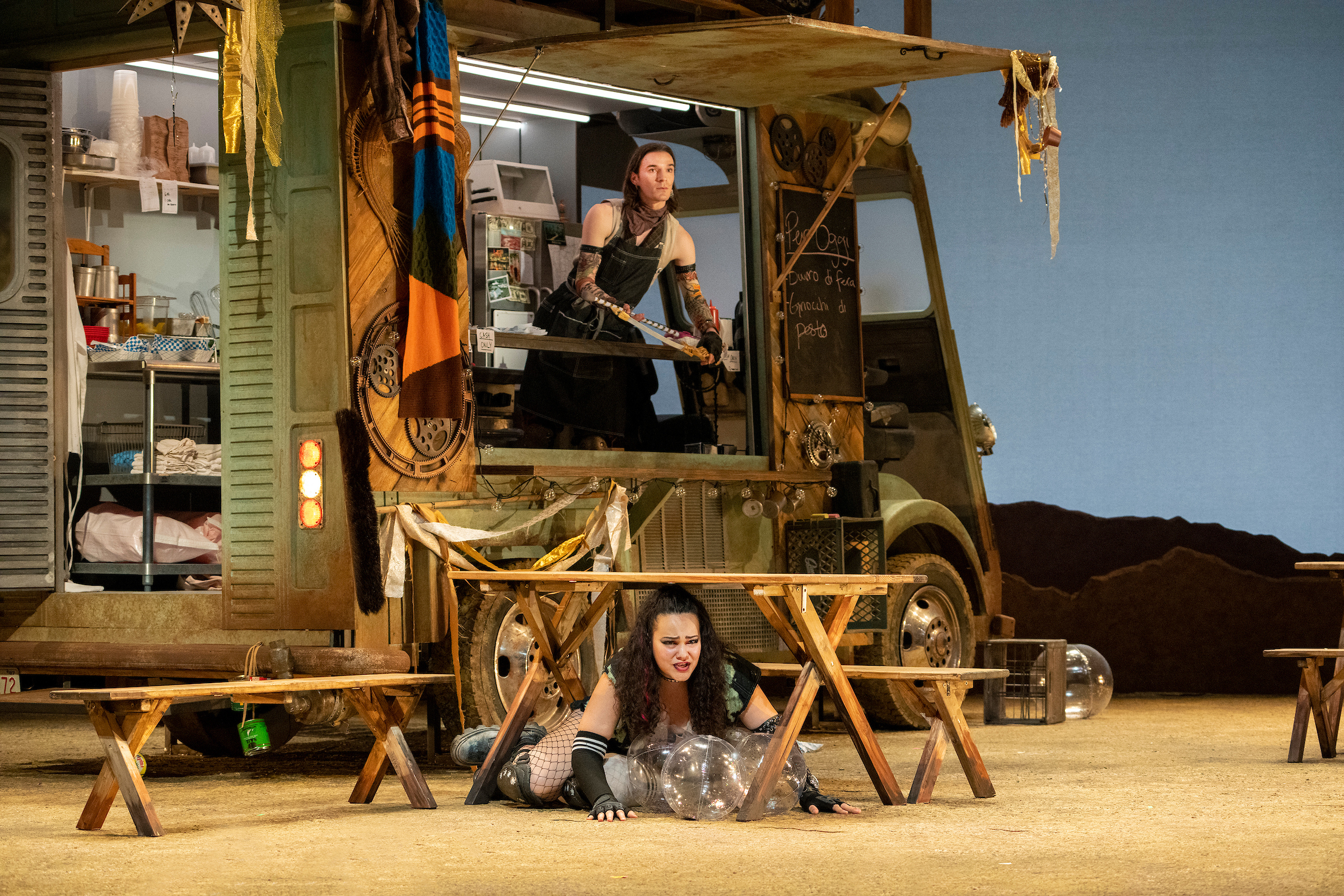
Richard Pittsinger and Maggie Renée (Photo by Richard Termine)
Now that masking is optional, we have happily returned to reviewing performances at The Juilliard School and last night we saw TWO performances. The first one was a musically authentic production of a Händel opera in which the stellar Maestro Gary Thor Wedow led Juilliard 415, the schools principal period instrument ensemble, in a musically authentic reading of Atalanta. Thanks to some recent exposures to Baroque performances, we were not surprised by the presence of musicians onstage with the singers from time to time. As a matter of fact, the overture put trumpeter John Thiessen onstage and some excellent duets were heard with the woodwinds and theoborist/lutenist Dušan Balarin. Harpsichords were played by Mo. Wedow himself and David Belkovski,
Not only did Mo. Wedow draw such admirable performances from his orchestra, but the vocal values were equally dazzling. Soprano Shelén Hughes, whom we wrote about when she was a student at Manhattan School of Music, made a powerful Atalanta who is supposed to be a Princess disguised as a shepherdess named Amarilli. Ms. Hughes has a voice of notable flexibility and a strong stage presence.
As her beloved "Tirsi" (actually King Meleagro in shepherd disguise) we had the remarkable mezzo-soprano Mary Beth Nelson (whom we heard recently at the National Arts Club as Cenerentola) utilizing the same dazzling technique as she used in the Rossini.
Another mezzo-soprano Maggie Renée immersed herself totally in the role of Irene, aggressively tormenting the man who loves her in spite of some better advice by her father Nicandro (bass-baritone Donghoon Kang). Richard Pittsinger made an excellent Aminta who had such stunning vocal moments that we found ourself holding our breath.
The hit of the evening was baritone Jared Werlein (whom we wrote about enthusiastically in a freshman recital) who brought the opera to a close as Mercutio, about which more later. Keep reading!
So, what was the second performance we attended at Juilliard? Well, it was simultaneous with the one we just described! It was a Broadway show with a lavish set (by Ryan Howell) and striking costumes (by Ryan Park) with a crazy story having nothing to do with the libretto Händel chose on which to drape his fluent arias, of which there were many.
We completely understand that audiences of three centuries ago were enchanted by pastoral stories which could be rather boring for contemporary audiences. We have observed an unending series of performances of Händel's operas tricked out with beach chairs and umbrellas and all kinds of nonsense meant to engage a 21st c. audience. It seems like a lack of trust in the music to stage it so.
The theme of the story is how young people play games on the court of love. Our association was that of middle school students who fake disinterest in those on whom they are crushing and who try to make their crushes jealous by flirting with others. So we appreciate that there is room here for a "concept". Much as we dislike updating, audiences must be attracted or opera will die.
In this production, director Omer Ben Seadia's concept was a group of young people at some kind of music/art festival in the desert. An overhead sign on stage read "Bacchanalia". On stage left was a performing stage with drums that didn't get played until the final postlude with the fantastically costumed cast trying to disco dance to Baroque music. You can imagine!
On stage right was a food truck in which Aminta seemed well supplied with ingredients and a chef's knife which he wielded whilst singing, making us a bit nervous. When he and Irene finally get their games straightened out at the end of the opera they can be seen through frosted glass, presumably fornicating.
Irene seemed to be the one admitting outlandishly costumed participants to the festival, checking ID's and cell phones. But the platform shoes seemed more suggestive of the 70's. Does it matter? No one seemed to care but rather enjoyed the eye candy. But the story seemed shoehorned into Ms. Ben Seadia's concept. After the opera we read her Director's Note and can see where she was coming from. However, the stage business was so overdone that it distracted from the music. It seemed as if every important aria was overshadowed by someone moving furniture or performing some kind of acrobatic activity. There were times when we had to shut our eyes to hear the beauty of the voices.
We did promise to tell you about Mr. Werlein's performance since one might say he stole the show. In extravagant white drag and platform boots, his Mercurio sang about the blessings of love, reminding us that this work was created to celebrate a royal marriage between Frederick (son of George II) and Augusta of Saxe-Gotha. The bridal couple did not deign to attend the premiere which was anything but modest and involved a great deal of spectacle. Well, this 21st c. audience did not suffer from want of spectacle!
© meche kroop
Friday, November 11, 2022
ACTION FOR ARTISTS
Saturday, November 5, 2022
THE THREE ''E"s of EXCELLENCE
Wednesday, November 2, 2022
A VISIT FROM OPERA LAFAYETTE
Wednesday, October 26, 2022
ERIC OWENS AND FRIENDS
Sarah Fleiss, Lucy Baker, Joseph Tancredi, and Eric Owens
What a magical evening we spent in the company of four artists from the Curtis Institute of Music in Philadelphia, on tour as part of Curtis on Tour. Led by esteemed bass-baritone Eric Owens, who graduated from the Curtis Institute a quarter century ago and who now serves on their faculty, three emerging artists dazzled us with their artistry. Mr. Owens' legendary gifts have been sufficiently recognized and treasured worldwide, so let us focus on the three young artists who seem to have profited enormously by his tutelage.
Let us begin by praising the program which contained not a single disappointment. There was something for every taste--art songs, folk songs, cabaret songs, musical theater songs, and of course a couple operatic scenes. The theme of the evening seemed to be love in all of its many manifestations--the longing, the satisfaction, the disappointments.
Who beside Brahms has brought so much artistry to the folk song! We never pass up an opportunity to hear his Liebeslieder Waltzer, Op. 52, but are far less familiar with his Neue Liebeslieder Walzer, Op. 65. We imagine that the first collection was so successful that Brahms was urged to set more of Georg Friedrich Daumer's text. (The final song of the group was written to text by Goethe but it was not included.)
Accompanied by 4-handed piano (Ting Ting Wong and Miloš Repicky) The soprano of Sarah Fleiss blended beautifully with Lucy Baker's mezzo-soprano, Joseph Tancredi's tenor, and Mr. Owens' bass-baritone. Each song offered a different combination of voices and therefore different textures.
The solos were particularly poignant, especially those given to Ms. Fleiss which seemed to emphasize the woes of a maiden unsuccessful at love--"An Jeder Hand die Finger" in which a maiden has bestowed all her rings on worthless men, and in "Rosen steckt mir an die Mutter", in which she sees herself wilting and stripped of leaves like a rose. This characterization would be repeated at the conclusion of the evening when she sang a most pathetic Gilda in the quartet from Verdi's Rigoletto.
Ms. Baker was very well suited to the role of temptress in "Wahre, wahre deine Sohn" in which she tells a neighbor that she is going to bewitch her son. Later, she would be similarly seductive as Maddalena. Hearing the two women bring Sophie and Octavian to life in "Mir ist die Ehre widefahren" from Richard Strauss' Der Rosenkavalier was all one could wish for and gave the two of them an opportunity to interact, which was not possible in the Brahms.
When a performance is that exquisite, the mind's eye supplies the costumes and settings and we were transported right into 19th c. Vienna. The two women sounded so harmonious together that we longed to hear them sing "Dôme épais le jasmin" from Delibes' Lakme. We are putting that on our wish list!
We were also happy to hear all voices together in a few of the songs and cannot think of any work written for four voices that we enjoy more . None of the songs were written for two male voices but we did get to hear Mr. Tancredi and Mr. Owens harmonize in double delight with "Au fond du temple saint" from Bizet's Les Pêcheurs de perles, our favorite duet for male voices.
We noticed a few things about Mr. Tancredi that augurs well for his future success. One is his vocal artistry; few tenors produce such round Italianate vowels, which we attribute to his consistent embouchure. There is no "spreading" and no forcing--rather, complete security of technique. We have reviewed Mr. Tancredi as an undergraduate at Manhattan School of Music where we noticed his promise. Again we observed his growth as a Santa Fe Apprentice in 2019. Nothing makes us happier than seeing growth in an artist. The other thing we appreciated was his total immersion in the character of Nadir. We saw the temple and the crowd through his eyes-- and that is the excitement of opera!
We have also heard Ms. Fliess a few years ago, singing a duet from Rossini's Tancredi, singing the title role as a mezzo-soprano. We were surprised to hear her as a soprano but happy to report that the high notes are crystalline and unforced. It will be interesting to see where she goes next. Her duet with Mr. Tancredi from Rodgers and Hammerstein's Carousel was a joy to hear.
Ms. Baker is new to us and we can hardly wait to hear her again. Aside from a lovely instrument she knows how to get a song across and we delighted in her delivery of "Langsamer Walzer" from Schoenberg's Brettl Lieder which is also known as "Den Spiegel von Arkadien" which we alway call "the Bum bum song". Her interpretation was highly dramatic and filled with humor, making every word count.
We have alluded to the closing number, the famous quartet from Rigoletto and it was the perfect way to end this varied program, leaving us with the impression that great voices and great music need not be categorized. Art song or folk song, aria or cabaret, just sing it with style and substance and we are happy.
© meche kroop


.jpeg)