MISSION

We are here to encourage the development of gifted young singers and to stimulate the growth of New York City's invaluable chamber opera companies. But we will not neglect the Metropolitan Opera either. Get ready for bouquets and brickbats.
Showing posts with label Joseph Tancredi. Show all posts

Wednesday, October 26, 2022

ERIC OWENS AND FRIENDS


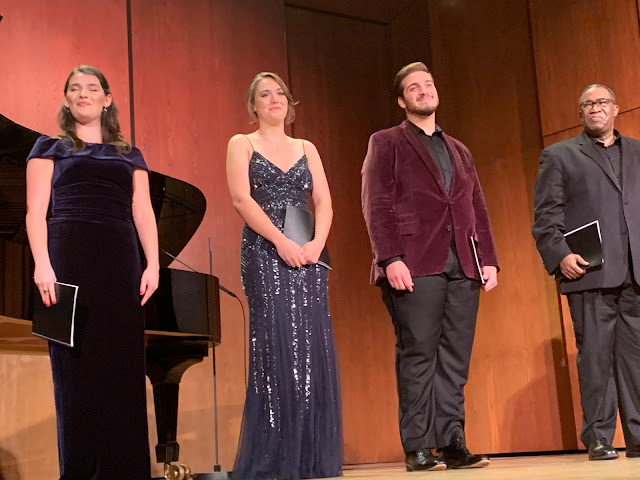
Sarah Fleiss, Lucy Baker, Joseph Tancredi, and Eric Owens

What a magical evening we spent in the company of four artists from the Curtis Institute of Music in Philadelphia, on tour as part of Curtis on Tour. Led by esteemed bass-baritone Eric Owens, who graduated from the Curtis Institute a quarter century ago and who now serves on their faculty, three emerging artists dazzled us with their artistry. Mr. Owens' legendary gifts have been sufficiently recognized and treasured worldwide, so let us focus on the three young artists who seem to have profited enormously by his tutelage.

Let us begin by praising the program which contained not a single disappointment. There was something for every taste--art songs, folk songs, cabaret songs, musical theater songs, and of course a couple operatic scenes. The theme of the evening seemed to be love in all of its many manifestations--the longing, the satisfaction, the disappointments.

Who beside Brahms has brought so much artistry to the folk song! We never pass up an opportunity to hear his Liebeslieder Waltzer, Op. 52, but are far less familiar with his Neue Liebeslieder Walzer, Op. 65. We imagine that the first collection was so successful that Brahms was urged to set more of Georg Friedrich Daumer's text. (The final song of the group was written to text by Goethe but it was not included.)

Accompanied by 4-handed piano (Ting Ting Wong and Miloš Repicky) The soprano of Sarah Fleiss blended beautifully with Lucy Baker's mezzo-soprano, Joseph Tancredi's tenor, and Mr. Owens' bass-baritone. Each song offered a different combination of voices and therefore different textures. 

The solos were particularly poignant, especially those given to Ms. Fleiss which seemed to emphasize the woes of a maiden unsuccessful at love--"An Jeder Hand die Finger" in which a maiden has bestowed all her rings on worthless men, and in "Rosen steckt mir an die Mutter", in which she sees herself wilting and stripped of leaves like a rose.  This characterization would be repeated at the conclusion of the evening when she sang a most pathetic Gilda in the quartet from Verdi's Rigoletto.

Ms. Baker was very well suited to the role of temptress in "Wahre, wahre deine Sohn" in which she tells a neighbor that she is going to bewitch her son. Later, she would be similarly seductive as Maddalena. Hearing the two women bring Sophie and Octavian to life in "Mir ist die Ehre widefahren" from Richard Strauss' Der Rosenkavalier was all one could wish for and gave the two of them an opportunity to interact, which was not possible in the Brahms. 

When a performance is that exquisite, the mind's eye supplies the costumes and settings and we were transported right into 19th c. Vienna. The two women sounded so harmonious together that we longed to hear them sing "Dôme épais le jasmin" from Delibes' Lakme. We are putting that on our wish list! 

We were also happy to hear all voices together in a few of the songs and cannot think of any work written for four voices that we enjoy more . None of the songs were written for two male voices but we did get to hear Mr. Tancredi and Mr. Owens harmonize in double delight with "Au fond du temple saint" from Bizet's Les Pêcheurs de perles, our favorite duet for male voices. 

We noticed a few things about Mr. Tancredi that augurs well for his future success. One is his vocal artistry; few tenors produce such round Italianate vowels, which we attribute to his consistent embouchure. There is no "spreading" and no forcing--rather, complete security of technique. We have reviewed Mr. Tancredi as an undergraduate at Manhattan School of Music where we noticed his promise. Again we observed his growth as a Santa Fe Apprentice in 2019. Nothing makes us happier than seeing growth in an artist. The other thing we appreciated was his total immersion in the character of Nadir. We saw the temple and the crowd through his eyes-- and that is the excitement of opera!

We have also heard Ms. Fliess  a few years ago, singing a duet from Rossini's Tancredi, singing the title role as a mezzo-soprano. We were surprised to hear her as a soprano but happy to report that the high notes are crystalline and unforced. It will be interesting to see where she goes next. Her duet with Mr. Tancredi from Rodgers and Hammerstein's Carousel was a joy to hear.

Ms. Baker is new to us and we can hardly wait to hear her again. Aside from a lovely instrument she knows how to get a song across and we delighted in her delivery of "Langsamer Walzer" from Schoenberg's Brettl Lieder which is also known as "Den Spiegel von Arkadien" which we alway call "the Bum bum song". Her interpretation was highly dramatic and filled with humor, making every word count.

We have alluded to the closing number, the famous quartet from Rigoletto and it was the perfect way to end this varied program, leaving us with the impression that great voices and great music need not be categorized. Art song or folk song, aria or cabaret, just sing it with style and substance and we are happy.

© meche kroop

Sunday, December 8, 2019

NOT JUST ANOTHER COMPETITION

Singers and Judges in Premiere Opera Foundation's International Vocal Competition Finals Concert


This was a great week for vocal competitions; we attended three of them! Truth to tell, there is nothing we enjoy more than these events. We get to hear a wide variety of material sung by some of the best vocal talent around. We get to watch the growth of young singers with whom we are familiar and we get to meet young singers from other cities that we don't usually get to hear.

Although all competitions share common features like excitement and cash prizes, each vocal competition has a different emphasis. Yesterday's competition inaugurated the union between the Premiere Opera Foundation and NYIOP, thus extending the concept of the competition beyond cash prizes by incorporating the function of auditioning. Instead of young artists traveling the world to audition, NYIOP brought casting directors to the event. If we were casting directors we would have felt like a gourmet at a banquet!

There was so much talent onstage to appreciate and such a distinguished panel of judges, including our own dear friend Ken Benson, Stefanos Koroneos and Maestro Israel Gursky from Teatro Grattacielo, Eric Margiore of Premiere Artists Management,and world famous soprano Erin Morley whose performances always thrill us.  

A field of 200 applicants was winnowed down to 91 semi-finalists; at the prior day's semi-finals, 20 young singers were chosen as finalists. It was interesting to us that in addition to the generous prizes awarded to the finalists, prizes were also given to some of the semi-finalists. No one walked away empty handed. Some prizes were cash and others were study grants abroad, vocal and career consultations, or coachings. Just imagine being able to coach with Ms. Morley!!!

We loved Nina Mutalifu's interpretation of Adriana Lecouvreur's famous aria "Io son l'umile ancella" in which her soaring soprano was used effectively to show both the character's diva stature but also her modesty. Ms. Mutalifu has sung in our Around the World in Song concerts, performing Uighur songs in her native language. What a treat to hear her sing a realismo role in Italian!

Tim Murray's pleasingly textured baritone was put in the service of limning the character of the clueless Count Almaviva. We watched and listened with glee as his ire grows. 

Mezzo-soprano Michaela Wolz performed "Parto, ma tu ben mio" from Mozart's La clemenza di Tito with variety of color in each verse, growing in ardency. There was something deeply affecting as she repeated "Guardami!"

Soprano Tatev Baroyan did justice to the "Snow Maiden's Aria" from the Rimsky-Korsakov opera. We recently saw this exquisite fairytale opera at Manhattan School of Music and Ms. Baroyan's ethereal interpretation was filled with the requisite innocence of the character.

Heldentenor Kevin Ray wisely chose the impassioned aria "Amfortas! Die Wunde!" from Wagner's Parsifal. His sizable instrument filled the sanctuary with overtones as his sincerity grew in power.

Mezzo-soprano Carolyn Sproule made a fine Adalgisa, beautifully shaping the long phrases of "Sgombra e la sacra selva" from Bellini's Norma. She has an admirable true mezzo sound and ended with a finely wrought decrescendo.

Joo Won Kang was one of several superb Verdi baritones on the program. His performance was well modulated and he brought considerable excitement to the cabaletta. We liked the resonance of his instrument as well.

Soprano Alexandra Razskazoff scored highly in that feature as well. She brought a lot of vocal excitement to "Come in quest'ora bruna" from Verdi's Simon Boccanegra. We liked the exquisite dynamic control and the fine vibrato of her instrument.

Baritone Denis Milo phrased "Onegin's Aria" beautifully and sang in fine Russian. We got more involved when he used dramatic emphasis and wished he would use his body more. We realize that Onegin is a somewhat pompous character and a bit stiff in his "Dutch Uncle advice" to Tatiana; but he is Russian after all and the performance would have been more affecting with a little more gesture.

Tenor Joseph Tancredi attracted our notice as an undergraduate at Manhattan School of Music and then as an Apprentice at Santa Fe Opera. We love witnessing his promise being fulfilled. His beautiful sweet tone was just right for the role of The Italian Tenor in Richard Strauss' Der Rosenkavalier.

Baritone Bryan Murray is winning prizes all over town. "Pierrot's Tanzlied" won him prizes from Opera Index and Talents of the World; let's consider it his very own showpiece! We were happy to hear it again as he gave each phrase a lovely shape and nostalgic perfume.

Victoria Davis has a big beautiful soprano sound and succeeded in creating a character in "Do Not Utter a Word" from Barber's Vanessa, one of the few operas in English that we enjoy. The problem is that words get lost in the upper register more readily in English than in other languages.

Baritone Jianan Huang sang "O Carlo ascolta" from Verdi's Don Carlo with Italianate legato phrasing and gorgeous tone. He gave us chills and won us over by being completely immersed in the prison cell scene. 

Soprano Quan Chen, stunningly gowned, added to our earlier impression of her as a perfect Puccini soprano. Recently we heard her "Chi il bel sogno di Doretta" from La Rondine, and last night she sang "Un bel di vedremo", allowing us to watch the harbor along with her. We always enjoy an aria more when the singer visualizes the scene and we can see it through her/his eyes.

Mezzo-soprano Polixeni Tziouvaras gave an hypnotic rendering of "Ô ma lyre immortelle" from Gounod's Sapho. She is a highly expressive singer and uses her entire body; she pulled us into the world of the aria so effectively that we forgot we were sitting in a church sanctuary. With gorgeous clearly enunciated French, of which every word was understood, she painted an aural picture filled with melancholy colors. Last April she sang in Greek for Around the World in Song, making a significant impression.

Soprano Amanda Palmeiro has a sizable voice with a bright sheen. She was convincing as the troubled Juliette in the Gounod opera, going through various moods with each verse of "Amour ranime mon courage". We enjoyed the very pretty trill and her fine French.

Monica Dewey used her sparkly soprano in Gilda's "Caro nome" from Verdi's Rigoletto. We admired the precision of her fioritura.

From the same opera we heard Rigoletto's aria "Cortigiani, vil razza dannata" performed perfectly by baritone Kidon Choi who seems destined to be a Verdi baritone. He didn't need a hump to convince us! His delivery grew in power and anger with superb modulation of color and dynamics. We felt his pain.

There was only one counter-tenor on the program and it was a welcome change to hear Gamaliel Reynoso Mejia convey the terror of the stowaway from Jonathan Dove's Flight. It was a moving performance and we could best appreciate the fine spin of his voice in the melismatic passages. The tessitura is so high that the words got lost. Thankfully, we had seen the opera before with titles and knew the story.

Soprano Elisabeth Rosenberg closed the program with "Einsam in trüben Tagen" from Wagner's Lohengrin, sung with power. It was a fine close to an excellent program.

Michael Fennelly did yeoman's work accompanying the entire lengthy program with the right support for each singer. He always does and we appreciate him from the bottom of our opera loving heart.

The evening concluded with a reception, enabling audience members, judges, and singers to mingle and network.  What a fine evening!

© meche kroop


Monday, August 12, 2019

THE STARS AT NIGHT ARE BIG AND BRIGHT

Sylvia d'Eramo, Cory McGee, Gina Perregrino, Alec Carlson, Elizabeth Sarian, and Santa Fe Apprentices

The stars this night were big and bright and dazzling, and we are not even in Texas! We are at the Santa Fe Opera and it is the night we have been waiting for, the night when the Santa Fe Apprentices get to take starring roles in eight scenes. Usually the eight scenes comprise seven winners and one dud, the dud  being related to a poor choice of scene. 

Last night there was no disappointment. Each scene was well cast and well directed and our fussy ears were gratified by some exemplary singing, some by singers we have reviewed and enjoyed before, and some by singers new to us whom we look forward to hearing in the future.

As far as the direction, we noticed that one of our favorite directors, Mary Birnbaum, is now directing a cast of singers we know and love in La Bohême, an event we are looking forward to and will be reviewing this week. We were happy to witness the directing artistry of David Paul (new to Santa Fe, we believe), Katherine M. Carter who is new to us, Paul Curran, and Kathleen Clawson, whose directing skills have always impressed us.

The scenes were well chosen to highlight the available talent as well as to delight the audience who, we are inclined to believe, love melody as much as we do. Certain operas thrill us no matter how many times we have seen them. Their melodies wind themselves around our brain in loving embrace.

Take, for example, the opening scene of Mozart's Le nozze di Figaro. Mr. Paul filled this prenuptial scene with warmth and joy, showing us a couple who can tease and bicker harmlessly as a prelude to a satisfying life together. We were reminded of the newly wed couple we saw in the Plaza yesterday and how touching is the promise of new beginnings. Bass Brent Michael Smith has the role of Figaro down pat and his Susanna, portrayed by soprano Cheyanne Coss, made a worthy counterpart, both vocally and dramatically. Their onstage chemistry was a delight to behold. 

Antonin Dvorák's Rusalka is best known for the title character's "Song to the Moon", a difficult aria which soprano Regina Ceragioli sang expressively. The Ježibaba of mezzo-soprano Kate Farrar was outstanding and we foresee a great future for her, given her textured instrument and stage presence. Significantly adding to the scene were Will Elphingstone's watery lighting and Hannah Schatzle's gorgeous costumes: a blue-green gown with a train trailing the width of the stage, used by Ms. Carter's direction to indicate the water from which this water nymph must free herself; and Ježibaba's costume with a huge cape which Ms. Farrar swirled around with malicious glee.

Everyone loves Rossini's Il barbiere di Siviglia and the Act II quintet is so brilliantly written that we never tire of hearing it. Along with Ms. Carter's astute direction, we had some excellent costuming by Maria Laura Sandoval and Harley Haberman's gorgeous wig for mezzo-soprano Katherine Beck who made a fine Rosina. Bass-baritone Alan Higgs, costumed in an elegant red robe, nearly stole the scene with some impressive acting and singing as Dr. Bartolo.
Baritone Jarrett Logan Porter made a splendid Figaro with tenor Angel Romero as the determined Almaviva and bass-baritone Seungyun Kim as the silly Don Basilio whom the others cannot seem to get rid of. "Buona sera mio signore" has been dancing around our brain all night!

In the Act I duet from Donizetti's La favorita, we were wowed by the vocal gifts of mezzo-soprano Katherine De Young in the title role and of tenor Anthony Ciaramitaro as her Fernando who, like Don Basilio just will not leave. Both artists impressed us with the size and color of their instruments and the artistry with which they employed them. Mr. Ciaramitaro sang with the most perfect Italian and we understood every single word. 

We confess to being dismayed by the huge disparity in their heights, making their embrace an awkward affair. But that is a minor quibble. The maid Inès had but few lines but we want to hear more of mezzo-soprano Ruby Dibble who sounded excellent. Naomi Beetlestone Detre's costumes were appropriate to the early 19th c.

On a simple set of boxes of graduated heights, mezzo-soprano Leia Lensing's Orfeo tried to lead a reluctant Euridice out of the underworld in Gluck's most famous opera. Who doesn't love "Che faro senza Euridice", known to every beginning vocal student! How wonderful to hear it sung by the excellent Ms. Lensing who gave each return of the verse a different set of ornamentation. It was all very tasteful in true Classical style, doing away with some of the excesses of the Baroque Era. Grace Kahl was convincing as the newly deceased Euridice who does not want to leave the peace of the Underworld. Becca Updyke's costumes were simple and right on the mark.

Of Wagner's entire Ring Cycle, our very favorite scene is the opening one of Die Walküre in which the woeful and weary warrior takes refuge in a hut in which he discovers a loveless woman who just so happens to be his beloved and long lost sister. Listening to Wagner's glorious music and poetic description of the discovery of a soulmate is unequalled in our book. 

As Sieglinde we were thrilled to hear the splendid soprano Mary-Hollis Hundley who seemed to have been made to sing Wagner. At this stage in her development, this is the perfect role for her; with her sizable instrument, we predict lots of heavier Wagnerian roles in her future. As her hapless brother/lover we were impressed by tenor Robert Stanley who not only sang with power and sensitivity but grew in stature and color as he discovered his identity. The sword Nothung was buried in an onstage tree, a sword which could only be extracted by himself. He blossomed as Sieglinde gave him the name of Siegmund. We felt a blossoming in our very own heart!

The final two scenes were exquisitely directed by Mr. Curran. Our only tiny quibble of the evening was that we wished the hilarious scene from Puccini's Gianni Schicchi had ended the evening so that the audience might have left in a great mood. The direction of this scene was so astute as to highlight Rinuccio's aria about the glories of Firenze; in this role we thrilled to the voice and stage presence of the very young tenor Joseph Tancredi about whom we have often written when he was an undergraduate at Manhattan School of Music. 

Mr. Curran had choreographed the unappealing members of the squabbling Busoni family to move in unison, all disparaging Rinuccio's attempt to bring his sweetheart's father Gianni Schicchi onboard to solve the inheritance dilemma. The more they unanimously scorned him and the unaristocratic Schicchi family, the more he stood out and we heard more in that aria than ever before.

As his sweetheart Lauretta, the versatile Ms. Coss gave a sweet rendition of "O mio babbino caro" with a marvelous messa di voce. In a clever directorial twist, she was complicit with the plot. Baritone Will Hughes was excellent in the title role, completely convincing as the wily manipulator. Ms. Lensing made a nicely nasty Zia; bass William Meinert made a very funny Dr. Spinelloccio, another character who just won't leave. There was a very funny bit with a bedpan. The remainder of the family comprised Elliot Paige, Andrew Moore, Ian Burns, Ms. Dibble, and Grace Kahl.

The evening ended with the final scene from Bizet's Carmen in which mezzo-soprano Gina Perregrino filled out the role as successfully as she filled out the shocking pink ruffled flamenco gown with which she was costumed by John Polles. Mr. Curran's direction emphasized the violence of the relationship which was almost too convincing. Ms. Perregrino's superb singing was matched by excellent stage presence and chemistry with her discarded and vengeful lover Don Jose, performed with notable artistry by tenor Alec Carlson. Both of them sang with fine French diction.

For some reason, the action of the characters did not always match up with the dialogue. When Carmen most forcefully demands to be let go, she should be blocked or restrained by Don Jose.

Baritone Cory McGee portrayed Escamillo; soprano Sylvia D'Eramo sang the role of Frasquita and mezzo-soprano Elizabeth Sarian joined in as Mercedes. Strangely, they were costumed as mid-20th c. sorority girls and Carmen's gown was open in the front revealing what looked like a black leotard. Only Escamillo seemed appropriately costumed.

It was an evening that could not be duplicated for sheer entertainment value. Those new to opera were offered the most tempting delicacies to tease their palate whereas experienced opera goers were given fresh looks at old standards and the opportunity to hear the stars of tomorrow.

There will be a new and different set of scenes next Sunday and if you are anywhere near Santa Fe we urge you to come on by, although we admit that this was a tough act to follow!

(c) meche kroop


Saturday, April 13, 2019

ALBERT HERRING/ ALBERT HERRING

Sung Shin, Gabriella Chea, Joseph Tancredi, Riley Bragg, Adam Goldstein, Erin Wagner, Edward Lim, Yvette Keong,
Christina Parsons, and Sam Krivda

By a strange quirk of scheduling, we found ourself at two different productions of Britten's Albert Herring two nights in a row. We could never consider ourself a big fan of Britten but we recalled a delightful production of the comedy seen in 2010 at the Santa Fe Opera and decided to explore the opera further. 

The work premiered in 1947 at Glyndebourne, using the same chamber orchestra used for Britten's 1946 tragedy The Rape of Lucretia. The work is perfect for presentation by a conservatory, offering juicy roles for 13 singers and not requiring massive orchestral forces.

For anyone who does not know the story, it is about a bumbling but virtuous (inhibited) youth who rebels against his mother's domination with the subversive help of a pair of friends. Because the selection committee is unable to find a sufficiently virtuous young woman to serve as Queen of the May, Albert is chosen to be King. His friends surreptitiously get him drunk and he goes out on a bender, driving his entire village into a state of anxiety and then mourning when they believe him to be dead. When he turns up alive and disheveled their grief turns to anger. But he has cut the apron strings!

At Manhattan School of Music Friday night, the MSM Senior Opera Theater brought the work to comic life with Dona D. Vaughn's detailed direction, offering many sly comic touches which, along with Britten's writing, gave each character his/her own particular character. Maestro Jorge Parodi's crisp conducting brought out the nuances of the score, particularly in the fugal sextet which closed the first scene. Act II brought a gorgeous duet in which an alto flute (Michelle Pokley) joined harmonics with a bassoon (Morgan Davison). We also enjoyed Sonia Bize's harp.

The singers were uniformly sensational and one could scarcely believe that they are all undergraduates! In the title role we had the sweet-voiced tenor Joseph Tancredi whose growth we have been watching for a couple of years. As agile of acting as he is of singing, we enjoyed watching his resentment grow until he liberated himself and got out from under his mother's thumb. His discomfort about being manipulated into his role as King of the May was a joy to observe.

As his naughty friends, Sam Krivda made a superb Sid, a young man with a carefree and wild side; as his sweetheart Nancy, Christina Parsons was especially likable when she sang of her remorse over tricking Albert with spiked lemonade.

The imperious and judgmental Lady Billows was given a fine realization by Riley Bragg; Gabriella Chea, as her equally judgmental housekeeper Florence Pike, sang well and also had the best and plummiest accent in the cast.

The selection committee comprised Vicar Gedge, whose arias were beautifully realized by Sung Shin; schoolteacher Miss Wordsworth, gorgeously sung and enacted by Yvette Keong; Mayor Upfold, finely etched by Adam Goldstein; and Superintendent Budd, sung by Edward Lim, whose rich bass could only have been tutored by James Morris. Their scene in Lady Billows' drawing room was filled with Britten's sendup of self importance.

Erin Wagner cut a fine figure as Albert's strict and controlling mother. Three children of the town were believably portrayed by Melissa Lubars, Hyejin Yoon, and Yunchan Zhou. They comprised a sort of Greek chorus, commenting on the action. The scene in which Miss Wordsworth tries to get them to sing for the May Festival was absolutely adorable.

Maureen Freedman's sets and costumes were just about perfect. In the opening scene, everyone was in grey monotones. In the Festival scene, ridiculous flowered hats added to the fun. The embarrassed Albert was made to wear a white suit with a crown of blossoms. Poor Albert!

The effective set for Mrs. Herring's greengrocer shop included a pot bellied stove, burlap sacks of potatoes and turnips, trays of herbs, bins of produce, and flowers. It was all deliciously realistic.

We have but minor quibbles. One is that the stage was elevated about three feet off the ground with seating on three sides, causing the audience to be always looking up and also obscuring the titles. It might have been better to have raised the audience!

The presence of titles was rendered almost unnecessary by the clarity of enunciation, thanks to Kathryn LaBouff. Perhaps this is too much to expect of undergraduates but we would have liked to hear different accents from the working class than we heard from the professional class. That's just how it is in England!

In spite of the charm of the "book" we found Eric Crozier's libretto to be somewhat leaden. Setting English is so challenging. W.S. Gilbert was long dead by then and Sondheim not yet born. It was obvious that Crozier could at times rhyme and scan but those moments were few and far between. As is usual in 20th c. opera, the interesting music is in the orchestra with not much melody going on in the vocal lines. It is to the credit of these young singers that their phrasing and tonal quality made music. We could scarcely believe that they are Seniors (and one Junior). What a wealth of talent!

Friday, December 7, 2018

DOUBLE FEATURE AT MANHATTAN SCHOOL OF MUSIC

Joseph Tancredi and Carolina Lopez Moreno
(Photo by Carol Rosegg)

In the best of all possible operatic worlds, one witnesses art and enjoys entertainment simultaneously. This was the case last night at Manhattan School of Music when a group of young singers, comprising mostly graduate students, presented a felicitous choice of two one act operas--one we have often heard and one we had never even heard of.

The first opera was Nino Rota's I due timidi, a work written for radio performance on RAI with libretto written by screenwriter Suso Cecchi D'Amico. The work was broadcast live in 1950 and later adapted for the stage in London and in Bari. This epoch seems as remote from today as the 19th c.

The work is set in a pensione run by the crabby Signora Guidotti (mezzo-soprano Polixeni Tziouvaras, as excellent vocally as she was dramatically) who has her hands full with plumbing problems and irate guests. The superb set by Lee Savage is the courtyard of the pensione which has three cameriere (soprano songbirds Heather O'Donovan, Kaitlin Turner, and Bridget Casey) gossiping whilst doing their chores. Flowers grow in window boxes and laundry hangs in the sun to dry.

Director Dona D. Vaughn (Artistic Director of the MSM Opera Theater) created a sense of time and place that hasn't been equalled since the Metropolitan Opera's late production of Mascagni's Cavalleria Rusticana.  People shout out of windows and lower baskets for groceries and payment. Very realistic.

The protagonists are the shy pianist Mariuccia (superb soprano Carolina Lopez Moreno, so fine of voice and so successful at creating empathy) and the equally shy suitor Raimondo (the promising tenor Joseph Tancredi who is still an undergraduate, singing with fine tone and phrasing). 

This is a comedy with a bittersweet ending which we will not divulge, but which seemed just right. Through a series of misunderstandings, Il dottore Sinisgalli (terrific tenor Zhiyu Shi) persuades Mariuccia's mother (marvelous mezzo-soprano Erin Reppenhagen) that the daughter needs his love, whilst La signora Guidotti mistakes Raimondo's intentions for love for herself.

In the playing out of this comedy of errors, the principals were each given a lovely aria so we could savor their vocal gifts. Acting as a one-man Greek chorus was the Narrator, bass Yi Yang whose rich voice convinced us that he was a worldly-wise observer.

Rounding out the cast were Laureano Quant as the porter and Sidhant Seth as another resident of the pensione.

Nino Rota would go on to compose film scores and had a particularly fruitful relationship with Federico Fellini.  But we doubt that his music was ever played as well as it was last night when the esteemed Maestro Giovanni Reggioli led the MSM Opera Orchestra in a lively reading of this colorful score.

Although Ms. Lopez Moreno was completely convincing as a pianist, the sound came from the beguiling offstage piano of Anna Smigelskaya.

Tracy Dorman's costumes looked just right for post-war Italy. Tyler Micoleau's lighting created a sunny Italy. Italian diction was excellent, thanks to Glenn Morton's coaching. Steven Jude Tietjen's supertitles were excellent for those who couldn't understand the very clear Italian.
Michelle Blauman and Xiaotong Cao (photo by Carol Rosegg)

Giacomo Puccini's Suor Angelica, celebrating its centennial, has been heard many times, mainly as part of an evening's production of Il Trittico, comprising Il tabarro, Suor Angelica, and Gianni Schicchi. There was something special about seeing this work up close and personal that resulted in our experiencing the work anew and being moved in ways that we had not been before.

Instead of a collection of nuns, we observed each one exhibiting a different personality behind the nearly identical ecclesiastical habits. We consider it a major triumph of director Dona D. Vaughn that we had different feelings for each one!

The eponymous Suor Angelica was portrayed by superb soprano Xiaotong Cao. She seemed on a different level from the others.  Apparently she had adjusted to the cloistered life although her admission to the convent had probably been not exactly elective. Culture at that time was not kind to girls who got pregnant out of wedlock, especially if they came from aristocratic families. Hiding the "sinners" away in convents was considered the only solution to deal with the family's shame.

This in itself seems tragic but tearing a mother away from her infant seems even more tragic. Poor Angelica has harbored secret wishes for a visit from her family but when the visit finally comes it is her aunt, La zia principessa who arrives with no love or forgiveness, just disdain and some documents through which Angelica must sign away her inheritance.

The role of the aunt was played by Michelle Bauman with rigid posture, icy demeanor and wonderful mezzo-soprano tone. We tried to figure out why she was costumed in the Italian version of Dior's post-war "New Look" with a silly hat. It was probably done to provide some chronological resonance with the first opera on the program but it served to undercut her critical authoritarian stance and gave the lie to her arrival in a coach with a family crest.  We far prefer the character wearing a long black dress and veil!

Another mezzo, Erin Reppenhagen, shone in the role of the Monitor, doling out corrective punishment to the nuns for their minor infractions. Yet another mezzo, Gabriella Chea, excelled as the Abbess.

Among the nuns, our favorite character was Suor Genovieffa, sung by the sweet voiced soprano Hannah Friesen. When she sung of her longing to hold a lamb, we were quite moved.

But the most moving moment was toward the end when Angelica rips off her wimple and collapses on the floor in tears, lamenting the death of her son. Having poisoned herself she believes herself to be damned and thereby separated eternally from the boy. We confess to a bit of water in the eyes.

We enjoyed the two Lay Sisters played by Michelle Capano and Cambrey Willhelm. The Mistress of the Novices was sung by mezzo Mengran Jia and her charges comprised Amanda Larkin, Lauren Curet, Duqingna, and Nicole Rowe.

Xiao Xiao and Sophie Blatt portrayed the Begging Sisters who brought provisions via bicycle. Corinne DeJong was Suor Osmina and Bridget Casey was Suor Dolcina.

The set was repurposed from the first work, this time with the second story shutters tightly closed and a fountain in the center of the courtyard. Mr. Micoleau's lighting was effective but we would have loved to see the golden light which purportedly illuminates the fountain only three days a year!

This is such a great opera with so many female roles, giving opportunities to so many female singers. Each one was wonderful in her own way.

There are three more opportunities for you, dear reader, to share in this outstanding experience--tonight, Saturday night, and Sunday afternoon. The newly redecorated Neidorff-Karpati Hall has excellent acoustics and is just the right size.  Don't miss out!

(c) meche kroop

Sunday, June 10, 2018

OPERA FOR THE PEOPLE

Sung Shin at Opera Under the Arch of Washington Square Park (photo by Ken Benson)


The ever-expanding crowd did not give up when Opera Under the Arch was delayed due to a prior event occupying their space.  New Yorkers know a good thing when they hear it, and the audience has been growing in this, the second year of Opera Under the Arch, a public festival organized by baritone Sung Shin.

Perhaps there were some tourists in the audience as well, and apparently everyone left satisfied by the exceptional performances, when the festival was obliged to move along at 10:00 by some complaining neighbors. Who could possibly object to such gorgeous music on a warm summer night!

The musical values were of the highest order and the audience was unusually attentive.  Yes, cell phones were out but only to take photographs. No one was texting or talking. The selections were wisely chosen from among the most popular opera standards, reminding us that in the 19th c. opera was a popular art form, not "highbrow culture". How good it felt to see people having a good time!

Baritone Sung Shin chooses his singers and collaborative pianists wisely. At the keyboard we had composer/ pianist Hohyeon Kyung and Andrew King. Sopranos included Show Yang, Yvette Keong, Natalie Eccleston, Sara Jayne Blackmore, and Isabel Vigliotti; mezzo-sopranos included Jordyn Goldstein and Lu Liu; the two tenors were Joseph Tancredi and Omar Bowey; baritone roles were performed by Sung Shin himself; our notable bass was Hidenori Inoue. We have reviewed them all and have only good things to say about them.

The program opened with "Dôme épais" from Léo Délibes' Lakme, an audience pleaser if ever there was one. Ms. Yang's crystalline soprano was joined by Ms. Goldstein's well-matched mezzo in that soaring melody we so love.

The aptly named Mr. Tancredi did a swell job as the Duke in "Questa o quella" from Verdi's Rigoletto, showing us everything we needed to know about the fickle Duke. Mr. Tancredi has a fine set of pipes and Italianate phrasing. His voice is perfumed with garlic!  Later in the evening we got another look at the licentious Duke when Mr. Bowey performed "La donna e mobile".

Ms. Yang returned for Blondchen's aria "Durch Zärtlichkeit und Schmeilchen" from Mozart's Die Entführung aus dem Serail, showing as much facility with German as she exhibited in the French.

Ms. Keong wowed us with her bel canto technique in Norina's aria "Quel guardo il cavaliere" from Donizetti's Don Pasquale. Later we heard Mr. Shin and Mr. Inoue exhibiting wonderful comedic chops in the very funny "Cheti cheti immantinente" in which neither one was daunted by the rapid-fire patter. 

From Mozart's La Clemenza di Tito, we enjoyed the duet "Ah perdona al primo affetto", performed by Ms. Vigliotti as Servilia and Ms. Goldstein as Annio.

Sara Jayne Blackmore captured all the excitement of the innocent Juliet in "Je veux vivre" from Gounod's Roméo et Juliette and the audience responded with wild applause.

Response was similarly enthusiastic for Ms. Eccleston's winsome performance of Adele's Laughing Song "Mein Herr Marquis" from Johann Strauss' Die Fledermaus. Her voice was bright and the trill delicious.

Mr. Sung delighted us with "The Impossible Dream" from the 1965 Broadway musical Man of La Mancha composed by Mitch Leigh with lyrics by Joe Darion. This sounded more operatic than some of the contemporary operas we've heard in the past few years, especially the way Mr. Sung sang it.

The audience went wild for Mr. Inoue's performance of "Le veau d'or" from Gounod's Faust. A small dog in the audience joined in for some canine tenor input and Mr. Inoue broke the surrounding fourth wall and interacted with the audience. He certainly made Lucifer fun and accessible!

Délibes showed up again in an aria from Les Filles de Cadix that we have never heard before. Ms. Vigliotti's sensational performance made us want to hear the entire opera with its Spanish inflected score. She ended with a crystal-breaking high note.

We have heard "Una voce poco fa" from Rossini's Il Barbiere di Siviglia many times this month and always enjoy seeing what a different singer can do with it. Ms. Liu's marvelous mezzo, personal charm, and artistry with embellishments brought something new to the aria, as we had hoped it would.

What a win-win situation! Greenwich Villagers had another evening of priceless entertainment and the talented young singers got to do what they love doing. There was so much enthusiasm and responsiveness on both sides, especially toward the end when the audience was encouraged to close in around the piano. We were all moved by the spirit of community and that is one of the great features of good music!

Watch our page on Facebook (Voce di Meche) for information on the next installment of Opera Under the Arch--most likely in July.

(c) meche kroop