MISSION

We are here to encourage the development of gifted young singers and to stimulate the growth of New York City's invaluable chamber opera companies. But we will not neglect the Metropolitan Opera either. Get ready for bouquets and brickbats.
Showing posts with label Opera Lafayette. Show all posts

Monday, May 4, 2026


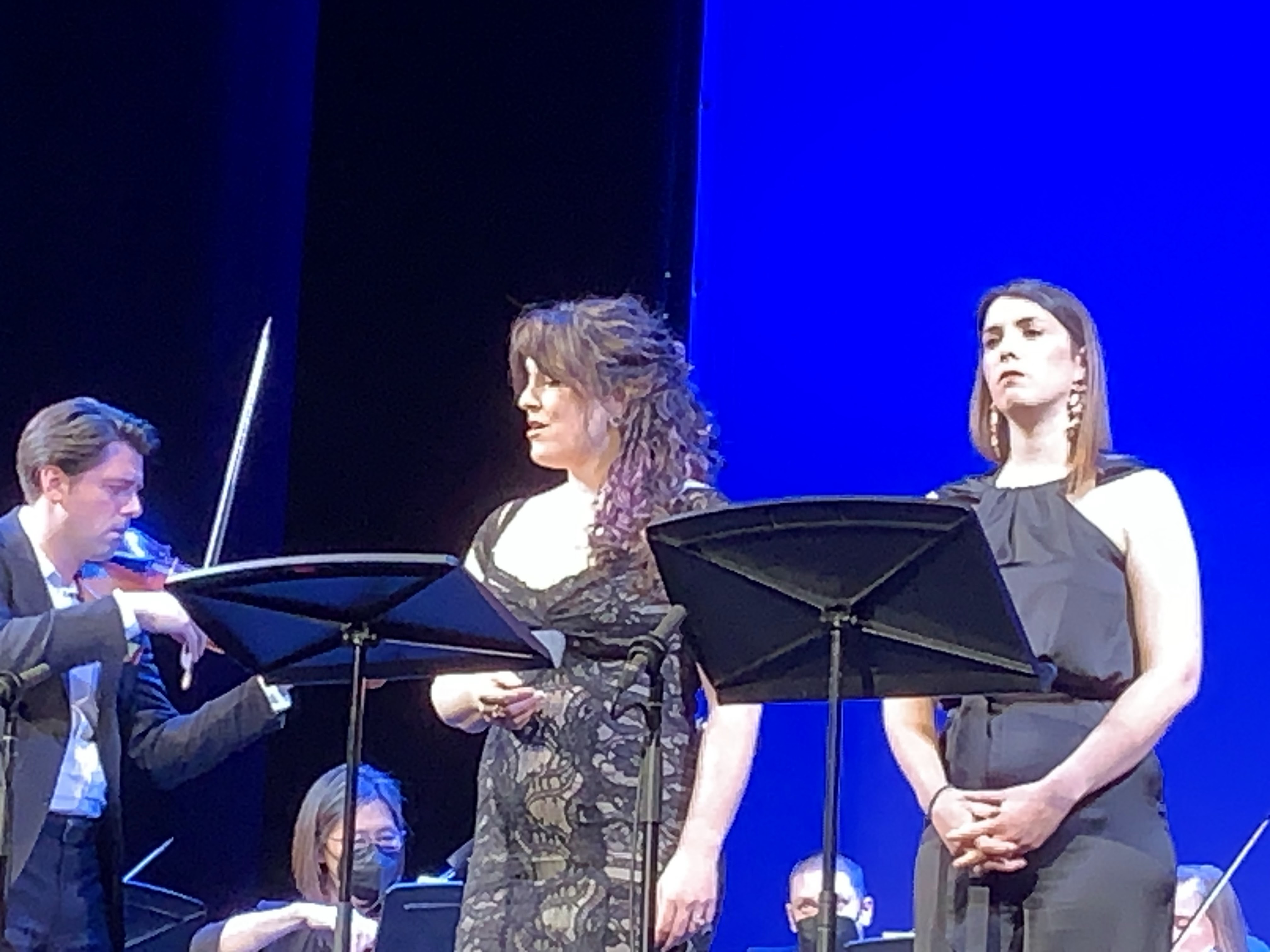
 Maestro Patrick Quigley and Lauren Snouffer
(photo by Jennifer Packard)

It is always an exciting event when the D.C. based Opera Lafayette comes to town. They always introduce us to music with which we are unfamiliar, concentrating as they do on the 18th century. Furthermore, the scholarship is impressive since it puts the music into historical perspective and offers a new way of appreciating it. What a compelling idea it was to compare music written by men for castrati with music written by women for female voices. We confess that we had never heard of any 18th century female composers! What a discovery!

The first half of the program opened with Gluck's "Se mai senti spirarti sul volto" from La clemenza di Tito, based on the same tale which Mozart would later put to good use. Soprano Lauren Snouffer sang with bright clear tone and lovely phrasing, but we yearned for her to step away from the music stand. Although other audience members may not mind, we find it disconcerting when a singer keeps looking down and turning pages.

We remember Ms. Snouffer from small roles in years gone by. Exactly eight years ago we wrote favorably about her role as Amor in another Gluck opera--Orfeo ed Euridice. Even before that we found her charming as a winsome pig (!) in a contemporary opera for children presented at The Metropolitan Museum of Art. But we have vague memories from when we first began writing of her standing out in a gorgeous duet in Strauss' Dafne, perhaps at a summer music festival. So, it comes as no surprise that her career has flourished abroad and at venues outside of New York. It is sad that New York City has no mid-sized opera company or suitable theater to keep emerging artists right here.

Her fine vocal instrument competed with a solo oboe in J.C. Bach's concert aria "Ebben si vada...Io ti lascio". We loved the way they alternated on the same melodic pattern and then "sang" in duet.

The second half of the program introduced us to two female composers who impressed us with their unique voices. Maria Antonia Walpurgis (what interesting associations we have for that name!) was a princess, composer, patron of the arts, and a singer as well. She wrote an opera Talestri, regina delle Amazzoni from which we heard the overture and an aria "Vado, ma il core, o Dio!". In spite of the loathed music stand, the passion of the aria, especially the brief fury of the middle section, brought Ms. Snouffer's involvement with the audience to its peak. 

Maria Martines was a celebrated intellectual in Viennese society, famed for her composition and keyboard skills. Ms. Snouffer performed her concert aria "Berenice, a che fai?" which offered many opportunities for coloration, embellishment of the vocal line, and strength in the lower register.

We should mention how much we appreciated the projected titles which were consistently visible and made linguistic sense. We would love to hear more of the compositions by Walpurgis and Martines and we would love to hear Ms. Snouffer again  without a music stand.

The program also included some fine orchestral writing by (Franz) Joseph Haydn. Maestro Patrick Quigley took firm command of his orchestral forces, comprising mainly strings but also the aforementioned oboe played by Dan Bates, a flute and bassoon doubling on recorder, a pair or horns, a fortepiano, and a harpsichord.

As is true of every visit from Opera Lafayette, we felt educated as well as entertained. There is so much worthy music that the public never gets to hear.

© meche kroop

Wednesday, October 22, 2025

PERFECTLY PURCELL


 Chelsea Helm and Mary ElizabethWilliams

A most welcome visit from Washington, D.C.- based Opera Lafayette provided the usual banquet of aural and visual delights for which they are known. Departing from their customary emphasis on opera of the 18th century, we took a step into the distant past to the Baroque era work Dido and Aeneas by Henry Purcell. At least our ears were transported thereto. Our eyes however confronted a rather contemporary setting looking very much like a library or common room in an educational institution. Identically costumed young women confirmed our speculation.

Having missed the pre-performance lecture, we were left to our own devices to figure out the disjunction. It only took a few minutes to realize that the taller women were either teachers or proctors and that they would be rehearsing Purcell's masterpiece, which (a fact dredged from our memory) was written for a girls' school in England in the last quarter of the 17th century. 

This concept by Stage Director Corinne Hayes was brought to realization by Set Designer Lisa Schlenker and Costume Designer Lynly Saunders. Having two tall women as the "teachers" and a clutch of shorter youthful women/girls as students (playing the choral roles) facilitated the illusion. Our vision is not the best but the acting convinced us that they were unruly schoolgirls, not the obedient schoolgirls of the 17th century but perhaps more like Dalton girls, sporting uniforms with plaid skirts, well directed to tease each other and assume children's postures and gestures.

Purcell's instrumental prelude tuned our ears, however, to a different time and place and it took several minutes to integrate what we were hearing with what we were seeing. Once the singing began however, and we realized they were putting on a show, we were able to settle in and enjoy the music. Furniture was repurposed as props and makeshift costumes for the two "teachers" were devised. Purcell's gorgeous duet for Dido (Mary Elizabeth Williams) and Belinda (Chelsea Helm) reminded us how skillfully Purcell set the English language (and what a rare and forgotten skill that is!), tailoring his elaborate vocal line to emphasize the words of Nahum Tate who wrote the libretto. Most music lovers are familiar with "Dido's Lament" which closes the opera, but not many would recognize the gorgeous duet in which two sopranos, with voices of different weight, wove their vocal lines into a tapestry with the glorious music.

For those of you who don't know the story, it is a simple one of two lovers parted by fate, leading to a suicide. It's an old story but just think how times have changed. Fate, in the 17th century, meant angry gods or witches and thus we had bass-baritone Hans Tashhjian who's made quite a name for himself in the dozen years since the first time we reviewed his performance as Wurm in Luisa Miller. Why this sorceress has it in for Aeneas we never learn but he employs deceit to lure Aeneas to Rome and to thus abandon Dido, Queen of Carthage.

In succeeding centuries, lovers were separated by political rivalries, vengeful paramours, and unequal social standing. Today, it is more likely personal whim or ghosting. Suicide over romantic disappointment is rare. By 21st century psychology, Dido seems petulant and histrionic. Our thoughts ran along the lines of  "So, dear girl, your lover gets called out of town. Move on. Find yourself a new one." Presenting the story as Virgil intended gives us perspective into the changing meaning of love and the relationship between men and women.

Musical values were excellent all around with Patrick Quigley serving as Music Director and the superb Opera Lafayette Orchestra comprising mainly strings with a couple of winds. Oftentimes the theorbo  seems indistinguishable to our ears but at this performance Dušan Balarin took  the part and made himself heard. Perhaps it's the way Purcell scored it but we heard it distinctly and we loved it.

We have yet to mention the third soprano. We hardly know what to make of a male soprano and how that fach differs from a counter-tenor, but the role of Aeneas was played by Elijah McCormack. Perhaps it was just a height issue but Ms. Williams, with her strong dramatic soprano and imposing height, seemed to overshadow him.  Another soprano  Kayleigh Sprouse made an impression with her convincing acting. The deep contralto of Cecilia McKinley made her a believable  witch.

It was a fine evening with the tragic tale leavened by some rowdy sailors' chorus, Purcell's gorgeous music, Tate's concise libretto, and all around excellent musical values.

© meche kroop

Thursday, February 6, 2025

A WORTHY DISCOVERY


Maestro Patrick Quigley conducting Opera Lafayette Orchestra's world premiere performance of 
Edmond Dédé's Morgiane, ou, Le Sultan d'Ispahan
Singers L to R: Joshua Conyers, Mary Elizabeth Williams, Chauncey Packer, Nicole Cabell, 
Kenneth Kellogg, and Jonathan Woody 
(photo by Jennifer Packard, Courtesy of Opera Lafayette)

After such a satisfying evening, we scarcely know where to begin. In an era when the field of opera is getting bogged down in prosy unmusical polemics, a few companies stand out by mining the past for undiscovered treasures. Teatro Nuovo brings to life forgotten gems from the Bel Canto period, whereas Opera Lafayette brings to the table a scholarly approach to rarely heard operas of the 17th, 18th and 19th c. The D.C. company's annual visits to New York City bring us education with our entertainment. Both companies achieve sold out status, proving that opera is not a dying art form.

There is room for contemporary opera just as there is for modern art. They just fail to provide nourishment to our classical eyes and ears. We would happily attend Nozze di Figaro, La Traviata, and La Bohême several times a year (and we have). Just the same, to be introduced to a work from the past that has lain forgotten gives us a thrill like no other.

A great deal of scholarship went into the recreation of Morgiane, ou, Le Sultan d'Ispahan and Opera Lafayette partnered with OperaCréole to bring this work to the stage, just in time for Black History Month. The composer Edmond Dédé was a Free Man of Color whose lifespan occupied the greater part of the 19th century. The opera is probably the first four-act opera by a United States born composer of African descent. Born in New Orleans, he established his reputation in France in the second half of the 19th century and his rich melodies reveal an exposure to various forms of music from café-concerts to high opera. We hope to hear some of his songs on recital programs!

The libretto he set was an exotic tale by Louis Brunet and probably was inspired by Europe's 19th century fascination with Asian exotica. The Islamization of Persia began in the 7th century and we can assume that the opera takes place after that time since the ruler in the opera is the tyrannical Sultan Kourouschah. Prior to the time of the opera, his mistreated wife had fled with their infant daughter in her arms and had been rescued by Hagi Hassan, a good man who raised the child with love and care. At the time of the opera, the girl, named Amine has just wed a worthy young man named Ali when Beher, a henchman of the Sultan, abducts her to be the consort of the Sultan. Yikes!!!!

We are sorry to have given away the secret surprise reveal of the 4th act. Actually, as is our wont, we did not read about the opera in advance, hoping that the work would speak for itself, which it surely did. Nonetheless, we were probably not the only member of the audience to have anticipated the surprise!

The work was exceptionally well cast. Although the production was given as a concert version with music stands, exotic atmosphere was provided by the gorgeous "Arabian Night" costuming, even for the chorus. Yes, we know that Iran (the country formerly known as Persia) is not Arabic but you, Dear Reader, know what we mean. This colorful costuming was designed by Amy Amos, Givonna Joseph, and Aria Mason. In spite of the music stands, the singers, especially the women, managed to inject their characters with dramatic intention, looking at the character they were addressing.

The role of Morgiane was played by Mary Elizabeth Williams whose spinto instrument filled out the emotion of the lines in a way that created a character of depth and determination. Her way with the vocal line was exemplary and the tonal quality admirable. Although she is the eponymous heroine, her best music and dramatic performance was saved for Act IV when she performed a stunning aria replete with arpeggios. She created a character that was forceful and spunky, proving that women can change their fates, and we are on board with that! 

Nicole Cabell is an entirely different type of soprano, a coloratura possessing an instrument of great agility. The ease with which she handled the fioritura whilst maintaining a warm coloration delighted our ears. Like Ms. Williams she always gazed upon whichever character she was addressing. She was completely believable as Morgiane's daughter Amine. Dédé gave her the most interesting music with a number of excellent arias and also duets.

As her new husband Ali, tenor Chauncey Packer sang sweetly with a lovely legato vocal line and a warm coloration, making his character most likable. One could really feel his anguish at losing his bride and his determination to recover her. In the duets, his voice blended beautifully with Ms. Cabell's, notably in Act I, in which the pair set the tone for the story by means of their mutual affection and deep devotion.

Joshua Conyers has a warm baritone that was just right for the role of Hagi Hassan. He conveyed all the warmth of a pater familias, protector of his family, a man who will go to any lengths to ensure their safety. And yet, one could imagine him as a shining knight on a white horse some two decades earlier, rescuing the poor Morgiane as she fled from her abusive husband--just the kind of hero who will raise another man's child as his own.

There was something very touching about a family banding together to try to save one of their own at a risk to their own lives. This is operatic in a way that contemporary stories cannot manage. We heard a stunning trio in which the parents and new husband vow vengeance for the abducted Amine. The composer's quartets showed his skill at weaving vocal lines into a multi-textured fabric.

The role of Beher, the Sultan's henchman, was well portrayed by bass-baritone Jonathan Woody who sat stony-faced but managed to sing with a snarl.

And finally, the role of the arrogant Sultan was sung by bass Kenneth Kellogg whom we didn't get to hear until Act III. Of all the singers, his French was the most comprehensible; of course, that is partly due to the low register, but also due to his crisp enunciation. He undergoes an Act IV transformation that was made believable by his skill at altering vocal coloration.

Just imagine!  An opera with a happy ending!  We left smiling because of the successful resolution, but also because of the marvelous music. Maestro Patrick Quigley was in full command of his resources and drew many colors from the orchestra. The music was varied with many contrasts of orchestration and rhythm.  In the opening chorus, members of the OperaCreole Ensemble, sang about nature in lilting waltz time. Later, we heard martial music in 4/4 time. 

Orchestral colors rivaled those of the rainbow. We even had the opportunity to hear the rarely heard ophicleide, an unusual brass instrument with a wide register, played by keys. We were so curious, we looked it up and learned that it was used mainly in the 19th century. and was featured in works by Mendelssohn and Berlioz. This was surely a night of discovery! We realize we have mentioned colors and coloration a great deal and perhaps this is one of the reasons we enjoyed the evening so much.

Let us finally mention that smaller roles were played by members of OperaCréole, including Valencia Pleasant, Taylor White, and Antonio Domino, Jr.

We believe a recording is forthcoming, in which case, Dear Reader, we urge you to have a listen. How impressive it is when two companies join forces to resuscitate a forgotten work. We in the audience only get to see and hear the end result. One can only imagine the happy accidents and diligent labor that went into creating such a memorable event.

© meche kroop

Saturday, May 11, 2024

TWO ESTHERS


 Curtain Call at Opera Lafayette's Presentation
"From Saint-Cyr to Cannons: Moreau and Handel's Esther"

In two days we have gone from comedy to oratorio and changed location from El Museo del Barrio to the modern sanctuary of St. Peter's Church (in Manhattan, not Rome). With their customary scholarship, Opera Lafayette presented two versions of the biblical Story of Esther. This heathen reviewer was obliged to read about it, to understand the text of the two oratorios which were presented on the same program. If you do not know the story, we will share it with you, directly from Wikipedia.

"Esther,[a] originally Hadassah, is the eponymous heroine of the Book of Esther in the Hebrew Bible. According to the biblical narrative, which is set in the Achaemenid Empire, the Persian king Ahasuerus falls in love with Esther and marries her.[1] His grand vizier Haman is offended by Esther's cousin and guardian Mordecai because of his refusal to bow before him; bowing in front of another person was a prominent gesture of respect in Persian society, but deemed unacceptable by Mordecai, who believes that a Jew should only express submissiveness to God. Consequently, Haman plots to have all of Persia's Jews killed, and eventually convinces Ahasuerus to permit him to do so. However, Esther foils the plan by revealing and decrying Haman's plans to Ahasuerus, who then has Haman executed and grants permission to the Jews to take up arms against their enemies;[2] Esther is hailed for her courage and for working to save the Jewish nation from eradication."

How appropriate we find this story, whether fact or, more likely, fiction--a story of a woman who overcomes her fear and acts with courage and fortitude, risking her life to save her people. The Story of Esther has inspired many beautiful paintings and some mighty fine music; Opera Lafayette brought us two exemplars. The 1689 work by Jean-Baptiste Moreau (libretto by the famous French playwright Jean Racine) was presented by Madame de Maintenon, second wife of Louis XIV, at her chateau/spiritual retreat at St. Cyr where she instituted a school for young women of the lesser nobility; they received moral instruction as well as theatrical.

Extracts of the works were conducted from the harpsichord by Justin Taylor with contributions toward the musical direction by singer Jonathan Woody who gave a dramatically scary performance as the evil Haman, one of the world's earliest would-be racial cleansers. The Persian King Ahasuerus was portrayed by Jesse Darden. The female roles were taken by soprano Paulina Francisco (reviewed earlier this week in the comic work La Fête de Thalie), soprano Elisse Albian, and alto Kristen Dubenion-Smith. Jacob Perry sang the tenor parts. 

It was barely two decades later that Handel created his own setting of the story to text by Samuel Humphreys, which was sung in English. Let credit be given to the singers for clarity of diction as well as uniformly beautiful vocalism and musicianship. It was interesting to witness how compositional style evolved within that brief period.

The Moreau work, sung in fine French, had many interesting moments. With "O mortelles alarmes!" we appreciated the melding of two voices and in the second iteration of that phrase, a moving cello solo by Serafin Smigelskiy, who also carried the stirring "Entracte". Later in "Que le peuple est heureux", we loved the expressive vocal trio. The nature of that particular section seemed written to glorify King Louis in subtle allegorical fashion. Ms. Dubenion-Smith lent her fine mezzo instrument to some authoritative declamation that filled the sanctuary. 

There was a lively and rousing "Marche" followed by another vocal trio and the sopranos took turns in praising God. But the best part was the cheerful "Que son nom soit béni" which was delivered with overlapping voices, bringing this half of the evening to a stunning conclusion.

After a brief pause, we entered a more sophisticated world in which Händel made generous use of the decoration of the vocal line which we so admire in his operas. We also noted the addition of instruments providing a more textured sound. Mr. Woody made a detestable Haman, just as called for. (Love the voice, hate the rôle!) In "Praise the Lord with cheerful noise" there were some bravura flourishes from Mr. Taylor's harpsichord, and some fine coloratura singing from Ms.Francisco.

A somber sextet in "Tears assist me" was marked by a prominent descending motif. When Ahashuerus is awakened by the courageous Esther, Mr. Darden allowed the king a moment of anger that softens when he recognizes his beloved wife. It was a powerful moment. The dialogue between the two singers that follows was lovely and moving.  Mr. Woody had a fine moment as Haman pleads for his life and mourns his fallen state.

The final number "The Lord our enemy has slain" is an exultant canon for the six voices and Händel's command of the musical language is impressive, ending the work on a high note, so to speak.

It was a worthwhile evening, even for a heathen. "Si, non e vero e ben trovato"! How stimulating it was to hear the two works together. As is everything done by Opera Lafayette, it was original in creation and flawless in execution. Mr. Taylor is a true artist at the harpsichord, the singers were superb, and the orchestra magnificent. A special shout out to Concertmaster Jacob Ashworth for his artistry on the violin.

As is our custom, we invited someone unfamiliar with the world of classical voice. He enjoyed the performance without any prior knowledge, thus proving our belief that opera and classical singing can be appreciated on its own merits. The unamplified human voice goes straight to the heart.

© meche kroop

Wednesday, May 8, 2024

COMEDY TONIGHT!


 Opera Lafayette performance of Mouret's Les Fêtes de Thalie

It is always an occasion when Opera Lafayette comes to New York City. They are unique in combining scholarship with entertainment and doing a superb job on both counts. We attended the pre-performance lecture and learned a great deal about the historical and musical context of Les Fêtes de Thalie; our companion arrived in time for the performance; both of us enjoyed the performance.  So, although scholarly knowledge added something, it wasn't necessary for the "pleasure principle" to take hold.

It is on this aspect that we choose to focus. The structure of this light-hearted early 18th c. romp by Jean-Joseph Mouret involved a Prologue, in which two Muses duke it out.  Dramatic soprano Angel Azzarra lent her full-throated voice to the role of Melpomene, Muse of Tragedy and the charming lighter-voiced soprano Paulina Francisco appeared as Thalie, Muse of Comedy. 

We were reminded of Richard Strauss' comedy Ariadne auf Naxos in which the down to earth Zerbinetta is in contest with the haughty diva who was to perform a tragedy. But in this opera, a compromise is reached by Apollo (Jonathan Woody) who makes the decision that tragedy would be performed in the winter and comedy in the summer.  Just like today, when we seek lighter entertainment in the summertime. 

After the three acts, all based on the same theme of how women deal with love, there is "La Critique" in which the Muses representing all the arts involved in the production vie for importance. Polyhymnia, Muse of Music (Ariana Wehr, dressed as a conductor) joins Thalie and Terpsichore, Muse of Dance (Pascale Beaudin) and get a rather mediocre review from Momus, God of Mockery (Patrick Kilbride). You will get no such mediocre review here, Dear Reader. We found the entire evening delightful.  This scene brought to mind another Strauss opera Capriccio in which the relative merits of libretto and music are compared.

Sandwiched in-between "Prologue" and "Critique" were three scenes in which cast members took various parts.  In "La Fille", a ship's captain (Jean-Bernard  Cerin) arrives in Marseille bringing with him Cléon (whom he rescued from pirates, played by Mr. Woody.  The captain is unsuccessful at wooing Cléon's daughter (Ms. Francisco) until he flirts with Cléonte's wife (Mr. Kilbride in a frock).

In "La Veuve Coquette", a happy widow (Ms. Beaudin) refuses to give up her single status in spite of the heroic efforts of the wealthy Chrisogon (a very funny John Taylor Ward) and the earnest military man Léandre (Scott Brunscheen) and the urging of her friend (Ms. Azzarra). Do we see a theme here? Yes, we do! We had no idea that 18th c. women were so disinclined to wed!

In the third scene "La Femme" Ms. Beaudin portrays a clever wife who outwits her philandering spouse (Mr. Cerin). She pretends to go away and arrives in disguise at a masked ball her husband is throwing and fools him into believing she is his latest potential conquest. She delays the unmasking as long as possible and when she finally does they both take the joke well. Now she knows he really loves her!  Does this remind you of an operetta? Since this work has lain undiscovered for centuries, it is unlikely to have influenced subsequent composers; but it does remind us that such tropes are common in opera.

Each of the three scenes involved spectacular dancing (Thanks, Terpsichore!) In "La Fille" we had sailors dancing the Hornpipe, choreographed by Julian. Donahue and Julia Bengtsson with dancers from the New York Baroque Dance Company. In "La Veuve Coquette" the dance choreographed by Anuradha Nehru and Pragnya Thamire was a village wedding party and the dancers from Kalanidhi Dance made a fine showing. Perhaps the most exciting dances were those at the masked ball in "La Femme". Particularly exciting was a bullfighter. Those dancers were choreographed by Caroline Copeland.

The colorful costumes were designed by Marie Anne Chiment. Melpomene was dressed in a floor length dramatic caftan of royal purple whilst Thalie was costumed in a motley jacket and mini-skirt with punk look combat boots. The best costumes, however were in  "La Femme" in which we noted some commedia dell'arte characters as well as the aforementioned bullfighter.

We have devoted most of our space to the libretto (by Joseph de La Font) and the colorful costuming and dancing but let us not neglect Polyhymnia. The excellent conductor for the evening was Maestro Christophe Rousset whose effective conducting of Mouret's music was the necessary underpinning for the action, singing, and dancing. 

The Stage Director, Catherine Turocy, kept the action moving briskly and managed to make the work seem not only historically intact but also contemporary and relevant.

The amount of labor it must have taken over a period of several years to bring this lost work to vivid life is astonishing. Musical preparation, coordination of different choreographers, assigning several roles to each artist, getting the entire project onstage--who but Opera Lafayette would have the interest and the means to have achieved all this, a major feather in their already multi-feathered cap.  
We do hope the work was recorded on video since so few people got to experience it. The theater at Museo del Barrio was packed and we assume the theater in Washington D.C. was as well, but it surely deserves a wider audience.

© meche kroop

Friday, October 27, 2023

A VISIT FROM OPERA LAFAYETTE


 Jacob Ashworth, Christophe Rousset, Joshua Keller, and Jonathan Woody

Visits from the Washington D.C. based Opera Lafayette are always greeted with enthusiasm;  to the musical scene of New York City they bring value both entertaining and educational by means of their approach to 17th and 18th c. music.  Last night's concert at the Kosciuszko Foundation, entitled Couperin le Grand, brought many delights, both instrumental and vocal.

The elegant room provided not only intimacy but also an appropriate baroque feeling by virtue of its gilded ceiling, recreating the court environment that originally saw (heard) the same material.  The generous program introduced us to three myth-based cantatas and a pair of instrumental works. 

Of chief interest to us was the recently discovered Couperin cantata Ariane consolée par Bacchus ;  for this discovery we must thank Musical Director and harpsichordist Christophe Rousset. The story parallels that portrayed by Richard Strauss in his opera Ariadne auf Naxos--minus the satirical element.

What made this, and the other two cantatas, so riveting was the passionate performance of bass-baritone Jonathan Woody. We were gritting our teeth, waiting for the appearance of the loathed music stand, but lo and behold there was none. That Mr. Woody invested the time and effort to commit to memory not just the Couperin, but also the other two, was sufficiently impressive;  it enabled him to share his consummate skill as storyteller. His artistry was rewarded by the well-deserved rapt attention of the audience. His dramatic delivery never missed an opportunity to heighten the drama by means of gesture and facial expression. The proverbial lily was gilded by his French diction.

The cantata La Mort d'Hercule Louis by Nicolas Clérambault and the cantata L'Enlévement d'Orithie by Michel Pignolet de Montéclair shared a number of characteristics with the Couperin but not the immediacy of the Ariadne story. This was not the boring dry performances we associated with the Baroque period before our ears were opened by Opera Lafayette. 

These are works filled with passion with each verse illumined differentially with its own tempo, texture, and mood. There is sufficient repetition of motifs to make the melodies memorable. The ornamentation of the vocal line captures the ear with roulades, trills, and appogiature. The harmonies are complex and often dense. 

The concerts by Couperin featured a succession of dance rhythms and provided enough variety to keep the ear constantly engaged; we found our body swaying and our toes tapping. Were it not for a sense of decorum, we might have gotten up and danced!

The musicians were impressive all around. The violin of Jacob Ashworth (whom we first heard some years ago with Heartbeat Opera) was spirited with excellent singing tone. The mellow transverse flute, played by the masterful Immanuel Davis, often echoed the melody introduced by the violin. The six-stringed viol, in the hands of Joshua Keller, created the bass line, whilst the harpsichord of Mr. Rousset provided a carpet of sound upon which danced the melodies of the violin and flute.

Opera Lafayette returns to New York City in May with two exciting programs. A little bird told us that the future holds more excursions to New York City, which will make us happy, along with a lot of other grateful fans.

© meche kroop


Tuesday, May 16, 2023

EDUCATION, ENLIGHTENMENT, AND ENTERTAINMENT


 Patrick Kilbride, Hannah De Priest, and Jonathan Woody 
Pergolesi's La servante maïtresse

Opera Lafayette's annual visit from Washington D.C. is always cause for celebration and the thunderous applause at the end of this week's visit manifested the high esteem in which they are held by their New York audience. This year's theme focused on Madame Pompadour, mistress of King Louis XV, radical, and patroness of the arts. Three events explored her influence upon and appreciation of mid-18th c. music. Sadly, prior commitments prevented us from attending the first two evenings but we made up for it in our own appreciation of the final evening.

We know of no other company that puts such a premium on scholarship, presenting artistic works in a socio-political context. The 120-page program book, fronted by a beautiful portrait of Mme. Pompadour, was thoroughly researched and highly educational. The pre-opera lecture, given by Dr. Julia Doe from Columbia University's Department of Music, was as engaging as it was instructive. The composer of the evening, Giovanni Battista Pergolesi, lived only a quarter of a century but his contributions altered the course of musical evolution. A precocious musical genius, he studied in Naples and brought his fresh direct simplicity to Paris. He died of tuberculosis but achieved posthumous fame. Many compositions claimed to be of his authorship but in fact he composed only thirty.

One of these was a one-act comic opera called La Serva Padrona, meant to be a "palate cleanser" in between the acts of an opera seria. However, it achieved fame outside of Europe and was translated into French and known as La servante maîtresse. This is what we saw and heard last night as a stand alone work followed by a tragedy-- about which more later.

In this comedic bonbon, the wealthy bourgeois Pandolfe (bass-baritone Jonathan Woody) is manipulated by his servant Zerbine (Hannah De Priest) into marrying her. The backstory is that he had procured her from her family and raised her to serve him; she was strong-willed and bossy toward his manservant Scapin (Patrick Kilbride) and resistant to serving Pandolfe. She finally succeeds in getting his "proposal" by enlisting the services of Scapin who impersonated a most unsuitable suitor, making Pandolfe feel jealous but also protective of her. It is a silly trifle with echoes of commedia dell'arte but the music is gorgeous. Maestro Ryan Brown, the Artistic Director of Opera Lafayette, conducted with fine attention to detail and the balance of instrumentation among the strings, a pair of French horns, a bassoon, and a harpsichord.

Much credit goes to Director Nick Olcott who kept the action moving and who provided translation of the text with spoken dialect in clever rhyming couplets. This struck us as a genius move which contributed to the fine French singing and on point acting. Marsha LeBoeuf's costume design was perfectly a propos and inventive to the point that when Zerbine gets "promoted" from servant to wife, she removes her serving apron to reveal an elegant dress. There are more photos of the production to be found on our Facebook page Voce di Meche. Lest you think that simplicity eliminated vocal decoration, let us reassure you that we relished every bit of fioritura It was thoroughly enjoyable.


Jacob Ashworth, Sarah Mesko, and Gwendoline Blondeel

Tragedy followed comedy after intermision. Pergolesi's  Stabat Mater comprises a dozen sections dealing with the effects of the crucifixion on Jesus' mother Mary. That Pergolesi managed to give each section a different mood and color is testament to his genius. The work was sensitively sung by soprano Gwendoline Blondeel and mezzo-soprano Sarah Mesko. Ms. Mesko, unlike so many mezzo-sopranos who are barely distinguishable from sopranos, has a richly textured mezzo sound that had us mentally casting her as Carmen and Dalilah. We were not at all surprised, when we got around to reading the program notes, to learn that Carmen is one of her signature roles. The gorgous voices of these two women were blended together in a few duet sections adding even more interest. The work was successfully conducted by Concertmaster Jacob Ashworth, known to us from his work with Heartbeat Opera. 

It was a very special evening in both conceptionn and execution. Were we to have a flute of champagne at hand, we would raise it to toast Opera Lafayette!

© meche kroop

Tuesday, December 6, 2022

GO FOR BAROQUE


 Emmanuelle de Negri

Every time Opera Lafayette makes their way north from our nation's capitol to The Big Apple, they have something unique to offer; it is always educational as well as entertaining. On this occasion, they brought Emmanuel de Negri to coach some young singers in the art of singing Baroque arias. The coaching was meticulous, worthwhile, and offered with humor and warm support. If anyone knows more about this art form than Ms. de Negri, we would be astonished to hear it. 

At the end of the masterclass we felt in a position to appreciate music that has seemed to us heretofore as pleasant but uninvolving.  Au contraire, dear reader! When properly performed it is as exciting as bel canto. It seems as if the more techniques singers have in their toolbox, the greater variety and interest they will be able to bring to their selections. We learned that in the Baroque period, singers improvised their own decorations of the vocal line, which was, in the Bel Canto period, written down by the composer. We believe that the cadenze of arias are, to this day, devised by the singers, an interesting holdover.

Many performers of Baroque music hew to a dry style of singing which sounds boring to our ears. Who's to say what it sounded like several centuries ago? We prefer to agree with those who achieve a dramatic and involving style of singing, as we heard the other night.

The first singer to be coached Grégorio Tanaguchi chose an aria from a cantata by Monteverdi in which Amor and Bacchus have an argument. (Somehow, this made us think of the singing competition in Mahler's lied "Lob des hohen Verstands".) There is plenty of back and forth and opportunities for dramatic voicing. It sounded quite good at first, but with some of the finer points shared by Ms. de Negri, it became dramatically valid and vocally more interesting.

Soprano Rachel di Blasio was coached in "Di misera regina" from Monteverdi's Il Ritorno d'Ulisse in Patria and we observed how some finer points could express Penelope's complex emotions more effectively.

Mezzo-soprano Naomi Steele received coaching for "Iris, hence away!" from Händel's Semele. We appreciated her crisp diction and enjoyed hearing how variations in the decorations could be used playfully to make the performance more interesting.

All three singers were superb in their initial run through; and yet we were impressed with Ms. de Negri's coaching that took these excellent performances to an entirely new level. What a feel this artist has for Baroque.  We don't think we will ever hear this music the same way as we did before!

© meche kroop


Wednesday, November 2, 2022

A VISIT FROM OPERA LAFAYETTE


 Christa Patton and Markéta Cukrová

It is always a special event when Opera Lafayette comes to New York City from their home in Washington D.C.  The company makes an annual visit in the Spring, bringing neglected masterpieces, mostly from the 18th c. Opera Lafayette can be counted on to provide not only entertainment but education, by means of lectures which illuminate the operas that are presented.

Artistic Director Ryan Brown came to town for a short visit to pique our curiosity about this season's works and we will only give you a hint--they relate to Madame Pompadour--and we urge you to watch our FB page for advance notice. And if you cannot wait, go directly to their website (operalafayette.org).

Guests at this private event were treated to a delightful performance of Baroque music at a lovely space in Chelsea, not to mention a generously provided spread of delicacies and wine. But we are not here to talk about food (our other passion) but to tell you a bit about the music.  

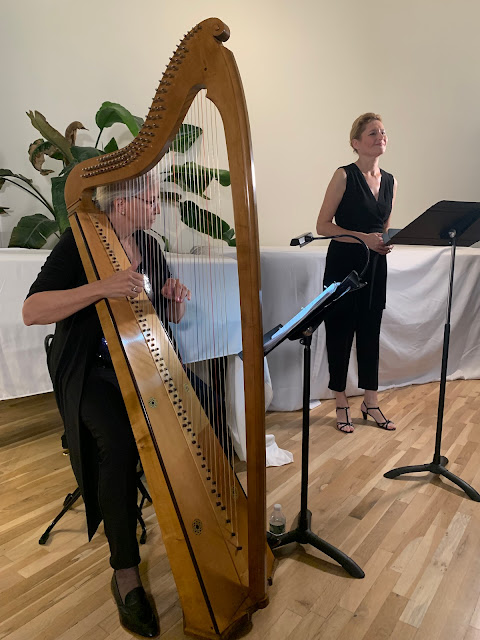
Czechoslovakian mezzo-soprano Markéta Cukrová was accompanied by Christa Patton on a Baroque harp. True to Opera Lafayette form, we were not only entertained but also enlightened by Ms. Patton who demonstrated the unusual features of her harp.  Not only does it lack pedals but it has a third row of strings. Something that was entirely new to us is that the flats and sharps are played on different strings.  As an amateur pianist, we know that G# for example is played on the same key as A-flat. Not on this harp! We had to listen very closely to discern the difference in color and tonality.

Ms. Patton also introduced the gorgeous songs to which Ms. Cukrová lent her magnificent instrument. We had never enjoyed Baroque singing until our friend soprano Jessica Gould introduced us to her opinion that Baroque songs should not be sung dry, without overtones. And so we grew to love the early Italian canon when so performed.

Ms. Patton told us some interesting facts about the Caccini family. Father Giulio is the composer of "Amarilli", a song that has enchanted us since our first hearing. However we were a bit disappointed to hear that it might have been meant to be ironic. We have always taken it seriously when the poet says "Open my chest and see my love written on my heart".

We heard a number of songs and learned about his daughters and why women chose to be courtesans.

We were completely enraptured by the superlative artistry of both women. The singing was beautifully phrased and the dynamics astonishing. There were some delicate diminuendi that tapered off to a thin thread of sound hanging in the air. The fioritura was cleanly rendered. Although one song was of a religious nature, most were about love.  All were sung with consummate expressivity. We so enjoyed this trip back in time.

© meche kroop

Friday, June 10, 2022

SPIRITUAL OR SECULAR


 Sichel Claverie, Victor Sicard, Jehú Otero, and Samantha Louis-Jean

It is no small matter to come to enjoy that which one previously avoided. Like kale. Baroque music has generally sounded to us like a sewing machine going on and on, lacking in climax and resolution. Thus we were thrilled to be so royally entertained by Opera Lafayette's program last night--Concert Spiritual aux Caraïbes. We found this "Religious Music in the French Caribbean 1760-1790" to be absorbing, entertaining, and thoroughly delightful.

We are not sure how "spiritual" can be defined. The program began and ended with the 1716 Messe en cantiques by Domenico Zippoli,  performed by soprano Samantha Louis-Jean, mezzo-soprano Sichel Claverie, tenor Jehú Otero, baritone Victor Sicard, and bass Jonathan Woody, accompanied by a pair of violins, cello,  and theorbo. We found the weaving of vocal lines and instrumental lines to be exquisite and replete with pleasing harmonies Listening and not reading the program produced feelings of absorption, peace, and aspiration, similar to what we felt during Faure's Requiem and Verdi's Requiem. If religious observance produces such elevated feelings in its believers, we are all for it. Yet, it puzzles us.

Bookended by this Messe was a succession of works by various 18th c. composers both known to us (Pergolesi) and unknown. There were two that we wanted to hear more of: Johann Paul Aegidius Martini, whose opera Le marriage yielded some most enjoyable excerpts, and Duni, whose opera La fée Urgèle seemed to be a comedy about a statue much loved by women that comes to life. This was given a semi staged performance by the four glorious voices of Ms. Claverie, Mr. Sicard (heard two days ago as a farmer in Grétry's Silvain), Ms. Louis-Jean (as his about-to-be-married daughter in the same opera), and Mr. Otero (as her intended, also in Silvain). In this charming scene he portrayed the statue which came to life.
 
The program was conceived and conducted by Maestro Pedro Memelsdorff whose conducting style was marked by precision and lively gestures, qualities we truly admire and take pleasure in watching. As constructed, the program worked extremely well. There were no pauses for applause and one work led seamlessly to another. This was a wise decision since applause would have interrupted the mood.

All the works were written in the 18th c. but seemed to our ears to owe more to the Baroque period that the Classical. We love the sound of instruments used in "Early Music", particularly the theorbo, the playing of which is fascinating to observe. There were major contributions from the harp, performed by Sandrine Chatron and some dazzling work by Concert Master Théotime Langlois de Swarte. The sweetest sounds came from Charles Brink's baroque flute. The entire orchestra responded to Mo. Memelsdorff's lively conducting. We loved the surprising percussion effects, mainly chimes and snare drum.

It mattered not a bit to us that movements from different works were interspersed. Obviously, the intention was to produce seamless enjoyment and total auditory immersion.  This goal was achieved.  We left with joy and gratitude in our heart, and perhaps that is what is meant by spiritual!

Let us also praise the scholarship of the essays in the program book which we read after the performance. It is interesting to note that the unfortunate and impoverished island known today as Haiti was once the French colony Saint-
Domingue where African slaves were exploited by French planters. Apparently these planters loved culture and theater going was a popular pastime.  This was interesting reading but, unlike one's understanding of Silvain two nights earlier,  not necessary to appreciate the music.


We are already anticipating next year's visit by Opera Lafayette, exploring "The 
Era of Madame de Pompadour" which will include ballet as well as opera and chamber music.


© meche kroop

Wednesday, June 8, 2022

AGRARIAN REFORM


 Maestro Ryan Brown conducting Grétry's Silvain

We have missed Opera Lafayette's annual visit to New York and were delighted to welcome them back. It's always an event to see operas from a neglected period of operatic history that we may never have an opportunity to see again. This year's visit was the first of a three-season exploration of French music of the 18th c.  Each season's festival explores music centering around a famous woman in French history.  This year's festival centers around Marie-Antoinette, and so we are given an opera that she enjoyed during France's period of admiration for the pastorale.

The scholarship involved in this festival seems thorough with examination of history, politics, social movements, and culture of that epoch. Probably, those who were able to attend the pre-performance lecture or to read the program book's 100 pages, had a very different experience than we did.

We are the type of person who learns by reading. For us, opera is entertainment. We entered the lovely theater of the Museo del Barrio completely unprepared and naive. It is our opinion that a work of art should stand on its own merits and not require explanation. It was only upon returning home and reading some of those 100 pages that we realized what director Tania Hernández Velasco was going for and what point she was trying to make.  We will discuss that after we discuss the music, which is why we go to the opera instead of reading a book.

The young Belgian composer André-Ernest-Modeste Grétry who had studied in Rome, composed Silvain in 1770 and it premiered at the Comédie-Italienne. It was the first opera performed in New Orleans in 1796. The music is lush and Maestro Ryan Brown (who is also Artistic Director of Lafayette Opera) elicited every nuance from the score. The cast was uniformly excellent with three notable sopranos lighting up the stage. Camille Ortiz, looking way to young to be the mother of a marriageable daughter, used excellent acting skills to overcome her youthful appearance. One of the highlights of the performance was her scena in which she expresses self doubts and ultimately courageous resolve. 

Paulina, the daughter about to get married was convincingly portrayed by Samantha Louis-Jean and the role of the enchanting little sister was excellently performed by Teresa Castillo. That the three women with the same vocal range were able to achieve musical harmony as well as familial harmony was impressive. 

The male singers were no less excellent. Tenor Jehú Otero has a lovely warm tone and was convincing as the prospective husband of Paulina and baritone Victor Sicard did well with the role of the paterfamilias who was threatened by a new landowner with the loss of his hunting privileges. In the role of the father from whom he is estranged we heard bass Nathan Berg who employed his resonant instrument in the final scene to restore order and harmony to a distressed family. His trio with his two newly discovered granddaughters was emotionally touching. 

But perhaps the most compelling moment of the opera was the intricately composed septet  pitting the family against a trio of thugs threatening with pitchforks (a pitched battle?). Here Mo. Brown distinguished himself by making each line distinct with all woven expertly together.

Musically, it was a most worthwhile 90 minutes in spite of a rather prosaic libretto by Jean-François Marmontel. The spoken dialogue was delivered in English and Spanish which puzzled us, since we were ignorant that the directorial decision had been made to change the century and the location! We were also puzzled by the colorful costumes (Patricia Michaels) which didn't look at all the way we imagined pre-Revolution France to look like.

Apparently we weren't the only puzzled audience members. The lively post performance conversations in the Ladies Room speculated without resolution. It was only after reading a lot of information in the program book that we found the solution to the puzzle. The director was drawing a parallel between the pre-revolutionary feudal agrarian system in France with the situation in 19th c. Colorado in the United States where the director's family had lost land. We consider ourselves newly educated since we never knew that French aristocrats owned land in the American Southwest. We do know that the Mexican people threw out the French in the 1860's.  (Think Cinco de Mayo and the battle of Puebla.)

We have been reviewing Santa Fe Opera for many years and have been aware of the strong Hispanic presence from Santa Fe north to Taos (where, incidentally, or maybe not, is located the Helene Wurlitzer Foundation at which Opera Lafayette was in residence to create this festival)! Perhaps the Hispanic natives of that region also had problems with land use. Perhaps there were similar issues with aristocratic sons falling in love with Hispanic peasant women and getting disowned by their fathers, which was the backstory of SilvainWell, there is reconciliation at the end with acknowledgement that rustic virtue is more important than noble birth. A happy ending.

Even with this new understanding of the resonance between the need for land reform in pre-revolutionary France and the American Southwest, we still would have preferred seeing the piece the way it was written. To us it appeared that the work was forced into a Procrustean Bed.

A further quibble would be the overuse of video projections. They seemed fine during the overture, to set the stage as a rural environment, but later they became annoying as they distracted from the music. At one point we saw confusing loops of strings and fingers, only to learn it was a woman's hands doing embroidery. Like food fads (kiwis, sun-dried tomatoes, and avocado toast) we hope this trend will pass.

© meche kroop