MISSION

We are here to encourage the development of gifted young singers and to stimulate the growth of New York City's invaluable chamber opera companies. But we will not neglect the Metropolitan Opera either. Get ready for bouquets and brickbats.
Showing posts with label Morena Galan. Show all posts

Monday, December 15, 2025

HOLIDAY CONCERT AT THE GUGGENHEIM MUSEUM


 Artists of The Metropolitan Opera Chorus

New Yorkers are an intrepid bunch. Neither snow nor ice nor frigid temperatures will keep them from their appointed cultural rounds. Last night's cultural event was not to be missed. The rotunda of The Guggenheim Museum was lined with music lovers standing on the ascending ramp at every level with a significant portion sitting in chairs at ground level, all of us eager to hear Christmas music, some familiar, some less well known.

Regulars at The Metropolitan Opera are probably aware of the enormous contribution of The Metropolitan Opera Chorus comprising 75 full time singers; but not many know that The Metropolitan Opera is the only opera company in The United States that has a full time chorus. A couple dozen of them have formed a subsidiary entity called The Metropolitan Opera Chorus Artists and artists they are indeed.

We recognized several up and coming young singers that we have written about like mezzo-soprano Morena Galan and bass Eric Lindsey. In any other city they would be starring in an opera and in fact, many of them have done so, like big fish in a small pond. Maestro Jeremy Little conducted them and Lee Steiner accompanied them on the piano.

A special treat was the presence of soloist Jasmine Rice LaBeija, a Juilliard trained singer who has forged quite a career for her gorgeous flamboyant self performing in drag shows around the country and abroad. Please, Dear Reader, take a look at a photo we took of her and posted on our Facebook pages and on Instagram. We have a particular admiration for people with an unusual combination of talents who depart from the traditional path. 

She is the essence of fabulosity, beside having a sensational voice which she shared in Stephen Schwartz' "Through Heaven's Eyes" and the most affecting "O Holy Night", an English translation by John Sullivan Dwight of Adolphe Adam's "Cantique de Noël". The arrangement was attributed to Dan Goeller. It was lovely but we still prefer the French version. Do you?

"Carol of the Bells" struck a familiar chord, so to speak.  Rachmaninoff's "Vespers Bogoroditse" was particularly lovely. The audience responded with enthusiasm to Irving Berlin's familiar "White Christmas".

We loved the gospel inflected final number, Moses Hogan's arrangement of "Glory, Glory, Glory to the Newborn King" which had us moving to the beat. We could tell from the smiling faces of the audience as they filed out into the cold that they had been warmed by the concert. And this is exactly what "culture" should do for us.

© meche kroop

Saturday, July 20, 2024

THE USES OF ENCHANTMENT


Emma Ritto, RJ Flud, Noelle Carlson, Maestro Keith Chambers, Director Sarah Beckham Turner, Morena Galan, Jessica DeGennaro, Brooklynn King, and Elizabeth Barsalou

People go to the opera for all kinds of reasons: some consider it an elegant social event, some go to hear famous stars, some go because they love the music.  Having come to opera from the world of theater, we find ourselves happiest when we see a good story amplified by music and brought to life by skilled artists. We love melody and feel alienated by prosy dialogue and non-melodic music. We find ourself favoring operas from the baroque period through the period of realismo with a special affection for bel canto.

Last night, thanks to Manhattan Opera Studio, we got to enjoy one of our favorite operas, Hänsel und Gretel composed by Engelbert Humperdinck and premiered in 1893, conducted by none other than Richard Strauss. Aside from a student production at Manhattan School of Music (with piano accompaniment) which we enjoyed and an overblown production at the Metropolitan Opera which we did not enjoy, Manhattan Opera Studio has been the major presenter of this charming and ultimately satisfying opera.

This is their third mounting of the opera and, in our opinion, the most successful.  For once, all the roles were well cast and the astute direction by Sarah Beckham Turner confirmed our opinion that opera singers make the best directors.. As usual, the conducting of the chamber orchestra by Maestro Keith Chambers was right on point and (perhaps because of the necessarily odd arrangement of the orchestra on the side of this long narrow hall at the National Opera Center) seemed to favor the winds.  We have no complaints on that situation. As a matter of fact, our only complaint of the evening was the projection of titles in an awkward rhyming translation that added nothing, since the story is well known and the singers' German was universally quite good.

We admit that our two prior reviews (available by entering Manhattan Opera Studio in the search bar of this website) were rather detailed on the story of this opera's composition and quite eloquent on the subject of fairytales and Bruno Bettelheim's psychological analysis thereof. We eschew self-plagiarizing and hope, Dear Reader, that you will take advantage of the search bar!

Let us instead focus on the very special performances of the young artists, all of whom we heard in recital recently. It was particularly revealing to see how well they handled their characterizations, abetted by costuming, cosmetics, and fine direction. Performing in a theatrical piece draws on many more talents than singing arias and duets in concert.

The lead roles were taken by mezzo-soprano Morena Galan as Hänsel and soprano Jessica DeGennaro as Gretel. Their voices harmonized beautifully and their interaction reflected an abiding affection as well as sibling rivalry and endearing gender based differences. Not every mezzo soprano is as convincing in a pants role as Ms. Galan and we found ourself touched by the brother-sister interaction.

Brooklynn King was equally convincing as their mother Getrud, portrayed as a basically decent person who was so concerned about the lack of food that she took it out on the children as anger at their laziness. Who hasn't seen a mother punishing her children for her own failures and guilt!

RJ Flud's Father Peter did an excellent job portraying a man drunk with success selling brooms-- and also by a  celebratory stop at the local tavern. Gertrud's hostility melts when she realizes that he has fulfilled his role as provider.

The Gingerbread Witch was brought to vividly wicked life by Noelle Carlson whose facial expressions and body movements went almost over the top. Riding a broom (one perhaps made by Peter?) brought to mind the origins of the myth of the broom-riding witches used to burn witches in the darker ages of Europe.

As the Sandman we saw Elizabeth Barsalou disguised beyond recognition with shaggy white beard and hair.  Emma Ritto made a fine Dew Fairy and injected some sly humor as she tried and tried to wake the sleeping children from their forest slumber. 

The chorus of angels dressed in white did double duty as the children who had been baked into gingerbread cookies by the witch. They comprised Abigail Hite, Tang Li, Lauren D'Ottavio, Andrea Sandor, Erin Hinds, and Abbey Engelmann. In a fine directorial touch, their blank stares melted when they received the human touch of Hänsel and Gretel.

Maestro Chamber's conducting elicited every melodic theme of the score and never neglected the Wagnerian harmonic touches.

In place of sets, there were a few storybook projections above the stage that helped to orient the setting without interfering with the action or storytelling.

Bettelheim's thesis in his book The Uses of Enchantment, posited that fairytales help children to work through their psychological struggles and fears.  Here we have a happy ending to the fear of parental abandonment. Perhaps our adult satisfaction with the opera suggests that adults may still be working through the same fear!

© meche kroop


Wednesday, April 10, 2024

A PARABLE FOR OUR TIME


The cast of Viktor Ullman's Der Kaiser Von Atlantis

Citizens of the United States are prone to taking much for granted. Among the many rights and privileges we possess, one of the most important is that of freedom of artistic expression. With a few exceptions, like desecrating the flag or saying scurrilous things about minorities, artists are free to hold a mirror up to society and to show us what we tend to avoid or deny. Fascist dictators (is that redundant?) exert total control over music, art, and theater to present an idealized and dishonest view of society. Those that expose the lies are silenced, imprisoned, or killed.

 Viktor Ullman's opera Der Kaiser von Atlantis, was composed in 1943 in the Nazi showcase concentration camp Terezin, with libretto by Peter Kien.  The opera was seen in rehearsal after which both men were hustled off to Auschwitz and tragically exterminated.  The opera has been produced in Europe but has been rather neglected in New York with the exception of a production by Opera Moderne in 2012 and one in 2015 by Juilliard Opera Theater.

The tragic circumstances of two talented lives cut short lends import to a work that easily stands on its own.  For this, we thank Ullman's fellow prisoners who managed to rescue the work when Terezin was liberated as well as the spiritualist who purportedly communicated with Ullman's ghost in finishing the instrumentation!  For bringing the work to life this week  we thank Manhattan School of Music Graduate Opera Theatre.

Now, what about the work itself?   Ullman's music is at times rather jazzy, referencing composers of many periods. Although we have heard it scored for and played by 13 instrumentalists, including a saxophone, a banjo and a harmonium, we heard it performed last night by two pianists (Eric Sedgwick and Anya Gershtein) and a percussionist (Tarun Bellur).  Under the musical direction of Djordje Nesic, it never sounded 
boring or "academic".   

It's a one act piece of great cynicism which makes one think of Brecht and Weill.
The story is an ironic one in which the Kaiser (a stand-in for Hitler) tries to co-opt Death which results in Death taking a holiday.  No one dies.  The world is filled with the walking dead.  A better image for prisoners in a concentration camp could not be imagined!  In the middle of this, a soldier and a girl find love.  At the end, Death takes the life of the Kaiser.

With great appreciation for the direction of John de los Santos assisted by Daniel Isengart, we were not forced to make the obvious connection with the threat of a would-be dictator in our own midst, nor was the point driven home by having the Kaiser sport a Hitlerian mustache. Nor were the subjects wearing striped pajamas.  The audience was wisely left to make their own connections. This always draws us into the work whereas overly explicit references or attempts to make a work "relevant" tend to push us away.

The cast was uniformly excellent. Kaiser Overall was played by Gregory Gropper whilst the role of Death was performed by Donghoon Kang who recently received a well-deserved major award from Opera Index. The role of Der Lautsprecher, the Kaiser's mouthpiece, was well performed by Brian Linares and the part of Der Trommler was taken by Morena Galán, whose undergraduate work at Mannes College of Music we followed with great interest. 

There was a moving scene with more lyrical music  performed by Samantha Noonan and Scott Rubén La Marca (recently seen as the fickle Count Belfiore when the MSM Graduate Opera Theater produced Mozart's La Finta Giardiniera).  Both begin as enemy soldiers trying to kill each other; but since Death was taking a holiday, they wind up loving each other--an optimistic note in a dark story.

Also remembered from La Finta Giardiniera was Victoria Magnusson who excelled as Harlequin, much as she won us over in the role of Serpetta in the Mozart. Rounding out the production was Margaux Frohlich who did an independent study project (with Benjamin Sokol) on the artists, actors, and musicians who were interred at Terezin. We believe it was she who gave a short speech at the conclusion of the opera about her ancestors who were victims of Nazi brutality.  As if the work was not sufficiently powerful!

What word could we use to describe our experience? "Entertained" is far too light-hearted. It might be more accurate to say that we were shaken and driven to think about the many places in the world today, some in our very own hemisphere, where dictators manage to enslave a populace. It doesn't matter whether we call their regimes "Fascist" or "Communist" or "Religious Fundamentalist"; they all have the same goal of concentration of power in the person of a sociopath with the result that the people suffer. Let us not think that we are immune. Democracy must be fought for to be won and vigorously supported to be maintained.

Should you be fortunate enough to find a ticket for tonight's performance, do not fail to read the historical background provided by Heather O'Donovan's essay.

© meche kroop


Monday, May 15, 2023

MORENA GALÁN


Malena Galán (photo by meche kroop)


Graduation recitals are usually pretty exciting, especially if you have watched the graduating singer develop over a period of time. The singer develops the program and gets the stage with whomever she chooses to share with. It is an opportunity to show off what one has learned over the past four years and to exhibit as much variety as one chooses. 

At this concert given by mezzo-soprano Malena Galán, graduating from Manne School of Music, we heard accompaniment on the piano by Youngmo Na and Aleksandar Hadžieski, Helen Wyrick on the guitar, Elias Ludlam on flute, Carlos Pino on string bass, as well as by a string quartet comprising Salome Lamidze, Zoe Lo, Sofia Machuca, and Beatriz Sardón Martin, 

The recital was a most audience-pleasing survey of her multiple areas of artistry, covering not only art songs in English, German, French, Spanish, and what we think was Ladino-- but also some musical theater and tango. All were enjoyable.

There is one thing that differentiates Ms. Galán's stage presentation and that is a complete comfort with the audience, manifested by a welcoming and engaging manner. We felt as if she were a guest in our home introducing each song.

English may not be our favorite language for singing but Purcell's "Music for a While" was a great opener, showing an artist who isn't afraid of emoting. As a matter of fact, that quality was present in every selection, making each song into a mini-aria. That is the gift of "story-telling". The imagery comes alive in a most engaging fashion.

In the German section, "Wer hat dies Liedlein erdacht" from Mahler's Des Knaben Wunderhorn, we felt like a child listening to a folk tale. In contrast, Schubert's "Ständchen" was filled with ardent mature longing.

In the French section we particularly enjoyed a most convincing "Maman, dîtes-moi" a cute ditty about a girl experiencing the pangs of first love.

Ou favorite in the Italian section was the familiar "Voi che sapete",  sung by the very hormonal Cherubino to the Countess in Mozart' Nozze di Figaro. We could just see the youth with all his diffident gestures and bravado.

The hit of the musical theater section was Jerome Kern's "All the Things You Are", thankfully sung with simplicity and sincerity. (We never cared for the jazzed up version). We liked the sad song of a disappointed lover from Manuel Valls' Canciones Sefarditas.

Unfortunately, we had to leave before the concluding songs from Argentina, Ms. Galán's homeland. It was not such a great loss because we have a persistent memory of our introduction to the artist at a concert at the Argentinian Consulate organized by fellow Argentinian Maestro Jorge Parodi in which we acquired a great appreciation for those songs.

Between then and last night we had the pleasure of seeing this young artist in a Mannes production of Cavalli's La Calisto. It will be interesting to see where she goes next. A mezzo-soprano with a smoky lower register and firmly supported tone could occupy the world of opera, cabaret, or musical theater.  We eagerly await further developments.

We can never end a review without a quibble and here it comes. The German needs work.  Like so many American singers, there is so much fear of mispronouncing the final consonants that they get left off to the point where the word makes no sense.  Let's get friendly, singers, with "ich" and "ig" and other endings!

© meche kroop


Sunday, November 20, 2022

MORE BAROQUE FROM MANNES OPERA


 Curtain Call from La Calisto presented by Mannes Opera


Last night we attended a performance of Francesco Cavalli's l651 opera La Calisto, presented by Mannes Opera and directed most imaginatively by Emma Griffin. We don't know why all three opera conservatories in New York City chose to present a Baroque opera during the same time period; we thought we had had our fill and had no intention of writing another review. We only went to see the performance of a couple singers we admire. However, we were so taken with the production and the artistry of the singers and musicians that we feel compelled to share it with you, dear reader. If you read this too late to see it in person, we urge you to watch the livestream on December 2.

 We were amazed by the endurance of so many aspects of love that have remained unchanged for  four centuries. The stage was filled with nymphs and satyrs, gods and goddesses--strange figures to be sure; and yet their concerns are our concerns today.  The social media generation did not invent unfulfilled romantic longing, sexual dalliances overcoming chaste intentions, rejection, cross-dressing, lesbian love, romantic deception, cheating husbands, nor vengeful wives. There was something particularly thrilling about seeing ourselves onstage in a work dating back four centuries.  Not just thrilling but moving as well. Love and sex will always be with us until the robots take over!

It is difficult to believe that this marvelous work lay dormant until 1970.  How fortunate we are that it was discovered and revived.  It lets us in on what the mid 17th c. Venetians expected from a rather new and popular art form. Cavalli was there at the birth of opera!

Impresario/librettist Giovanni Faustini had created many operas with Cavalli; this one was their penultimate production. The story was derived from Ovid's Metamorphosis and recounts the myth of Giove pretending to be the goddess Diana in order to seduce the beautiful chaste Calisto. The tale is padded out with the love story between the real Diana and the shepherd Endimione. In every case, chastity falls under the weight of sexual desire. 

The wily Mercurio (fine and funny tenor Daniel Rosenberg) convinces Giove (authoritative baritone Christopher Lau) that persuasion is no match for deception when trying to seduce a woman. Their duet was musically gorgeous and also quite humorous. 

In the title role, lovely soprano Anna Aistova sang about wanting to lead a chaste life, devoted to the goddess Diana.  Giove transforms himself into Diana (beautifully sung by soprano Lindsey Kanaga) and successfully seduces her. The two women had a tender duet before entering a cave to exchange chaste kisses (which led to much more).

When the real Diana appears (Jihye Seo) her voice and gestures are very different and there is no doubt that she is the real thing. When Calisto refers to their makeout session, Diana is outraged by the inference and tosses Calisto out of the virginal sisterhood. 

Diana, on her part, is secretly in love with the shepherd Endimione (Elisse Albian) who expresses his longing for her in the most exquisite aria.

In a scene offering comic relief, Maia Sumanaweera portrayed Linfea, one of Diana's followers, who longs for romance. In spite of her desperation, there is no way Linfea is going to settle for the importuning of Satirino (Emmet Solomon), even though he tells her that while young, his tail is still growing!  He is a member of a clutch of satyrs, of which the leader is the god Pane, portrayed by Joohyun Kim. As Silvano, one of the satyrs, we enjoyed hearing Yuan Lai.

We were met with new delights as Giunone, the jealous wife of Giove, appeared to expose her husband's infidelity.  The stunning soprano Marieke de Koker just about stole the show as she gave her all to the revenge aria, in which she instructs women not to put up with philandering husbands but rather to take revenge.  Her particular revenge is to transform Calisto into a bear. Giove cannot undo this curse but finds his beloved Calisto a place in the firmament as the constellation Ursa Major, a condition foretold in the Prologue.

The Prologue was outstanding with soprano Yixuan Li taking the role of L'Eternita, soprano Jillian Agona appearing as Il Destino, and mezzo-soprano Morena Galan taking the role of La Natura. In a stunning opening scene the three women decide that Calisto deserves her place in the heavens. 

Taking the roles of The Furies were Olivia Gray and Anna Ruhland.

Emma Griffin, Managing Artistic Director of Mannes Opera, pulled exemplary performances from these gifted young singers and told the tale in a way that resonated with contemporary listeners, without robbing the work of its authenticity. Cavalli's music is very singable and  a small chamber orchestra, such as was heard in its own time, did full justice to Cavalli's writing, led by the rising star conductor Kamna Gupta.

We do not know who was responsible for the costuming and makeup but both contributed enormously to the effectiveness of the storytelling. What impressed us the most was how these wonderful singers are also terrific actors, especially in the comic roles.  We could see both the mythic characters and ourselves simultaneously!

© meche kroop

Friday, October 14, 2022

ARGENTINIAN SOUL


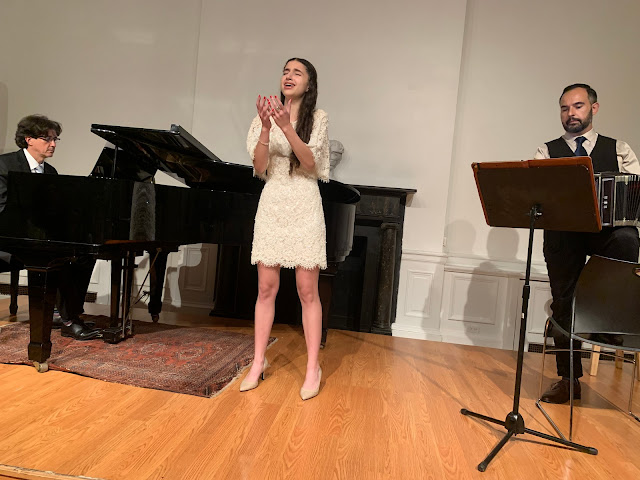
Maestro Jorge Parodi, Mezzo-soprano Morena Galán, and Bandeónista Rodolfo Zanetti


If New Yorkers are ignorant of Argentinian music, we are sure that will not last long since Maestro Jorge Parodi has assumed the helm of Opera Hispánica; he will see to it that these treasures will be mined. The most interesting feature of Latin American music, in our opinion, is that their composers were not seduced by the destructive tendencies of the world of music academia which gave the old heave-ho to melody and key signatures.; Latin American music remained melodic and relatable all through the 20th c. and on into our own epoch.

Last night, hosted by The Consulate General of Argentina in New York, a full house was gifted with a program of Argentinian music, including art song, folkloric song, piano compositions, and, of course, tango. There was no shortage of melody and rhythm, joined in celebration of a wide range of human emotion.

Included among the artists were Maestro Parodi himself, appearing as collaborative pianist, solo pianist Pablo Lavandera, Metropolitan Opera star baritone Fabián Veloz, baritone Gustavo Ahualli, two lovely young mezzo-sopranos Morena Galán and Malena Dayén, guitarist Andrés Guerra, and bandoneónista Rodolfo Zanetti.

The above photo captures an intense moment in which Ms. Galán offered a passionate rendition of a tango from the 1920's entitled "Romance de Barrio" by Anibal Troilo. Aside from possessing an appealing and well-supported instrument, this young artist has a formidable ability to connect with the audience, an ability than can only come from a deep connection with the music. We enjoyed equally Carlos Gardel's "Por una cabeza" which allowed her the opportunity to show off a smoky lower register. The more modern "El clavel del aire blanco" by Carlos Guastavino was also given the same heartfelt treatment.

From the same song cycle, the familiar. "La rosa y el sauce" was beautifully performed by Ms. Dayén whose rich mezzo was put to good use in her phrasing of the gorgeous melody and in the fine use of dynamic variation.  In the livelier dance-like "Pampamapa", also by Guastavino, we had trouble staying still. Splendidly accompanied by Mr. Guerra, she introduced us to Daniel Toro's "Samba para olvidarte". Unfortunately, the audience broke into applause before we could hear the conclusion of Mr. Guerra's tender postlude.

Mr. Veloz' generous textured baritone filled the room with resonance in a stunning rendition of Guastavino's "Cita", making ample use of phrasing and dynamics. The dancy rhythm of Jorge Cafrune's "Cuando llegue el alba" was delightful. He wisely matched his large voice to the size of the room.

Mr. Ahaulli's powerful baritone fit well with Guastavino's "Abismo de sed" which was preceded by a complex introduction in the piano part which was stunningly performed by Maestro Parodi. We also enjoyed Carlos Gardel's familiar "El dia que me quieres" which just oozed romance.

Mr. Lavandera performed Tres Danzas Argentinas Op. 2  by Ginastera, composed early in his life. The rapid fire "Danza del viejo boyero" was followed by the lilting adagio "Danza de la moza donosa" (our favorite), and finally  "Danza del gaucho matrero"  the complex rhythm of which the artist was thoughtful enough to explain to the audience.

He also performed a gentle work by the recently deceased Claudia Montero entitled "Junio", given its New York premiere. He shared with the audience the fact that what sounded like improvisation was written down note by note. The work was marked by. thrilling runs and lilting arpeggi.

There were many more delights in the generous program, including tangos by the famous Astor Piazzolla. One could not fail to appreciate the wide variety found in this program which was entitled An Argentinian Affair. For us it was a golden opportunity to get a taste of many different styles of composition and to hear some new voices.  A big bravissimo to all concerned!

© meche kroop