MISSION

We are here to encourage the development of gifted young singers and to stimulate the growth of New York City's invaluable chamber opera companies. But we will not neglect the Metropolitan Opera either. Get ready for bouquets and brickbats.
Showing posts with label Donghoon Kang. Show all posts

Wednesday, April 10, 2024

A PARABLE FOR OUR TIME


The cast of Viktor Ullman's Der Kaiser Von Atlantis

Citizens of the United States are prone to taking much for granted. Among the many rights and privileges we possess, one of the most important is that of freedom of artistic expression. With a few exceptions, like desecrating the flag or saying scurrilous things about minorities, artists are free to hold a mirror up to society and to show us what we tend to avoid or deny. Fascist dictators (is that redundant?) exert total control over music, art, and theater to present an idealized and dishonest view of society. Those that expose the lies are silenced, imprisoned, or killed.

 Viktor Ullman's opera Der Kaiser von Atlantis, was composed in 1943 in the Nazi showcase concentration camp Terezin, with libretto by Peter Kien.  The opera was seen in rehearsal after which both men were hustled off to Auschwitz and tragically exterminated.  The opera has been produced in Europe but has been rather neglected in New York with the exception of a production by Opera Moderne in 2012 and one in 2015 by Juilliard Opera Theater.

The tragic circumstances of two talented lives cut short lends import to a work that easily stands on its own.  For this, we thank Ullman's fellow prisoners who managed to rescue the work when Terezin was liberated as well as the spiritualist who purportedly communicated with Ullman's ghost in finishing the instrumentation!  For bringing the work to life this week  we thank Manhattan School of Music Graduate Opera Theatre.

Now, what about the work itself?   Ullman's music is at times rather jazzy, referencing composers of many periods. Although we have heard it scored for and played by 13 instrumentalists, including a saxophone, a banjo and a harmonium, we heard it performed last night by two pianists (Eric Sedgwick and Anya Gershtein) and a percussionist (Tarun Bellur).  Under the musical direction of Djordje Nesic, it never sounded 
boring or "academic".   

It's a one act piece of great cynicism which makes one think of Brecht and Weill.
The story is an ironic one in which the Kaiser (a stand-in for Hitler) tries to co-opt Death which results in Death taking a holiday.  No one dies.  The world is filled with the walking dead.  A better image for prisoners in a concentration camp could not be imagined!  In the middle of this, a soldier and a girl find love.  At the end, Death takes the life of the Kaiser.

With great appreciation for the direction of John de los Santos assisted by Daniel Isengart, we were not forced to make the obvious connection with the threat of a would-be dictator in our own midst, nor was the point driven home by having the Kaiser sport a Hitlerian mustache. Nor were the subjects wearing striped pajamas.  The audience was wisely left to make their own connections. This always draws us into the work whereas overly explicit references or attempts to make a work "relevant" tend to push us away.

The cast was uniformly excellent. Kaiser Overall was played by Gregory Gropper whilst the role of Death was performed by Donghoon Kang who recently received a well-deserved major award from Opera Index. The role of Der Lautsprecher, the Kaiser's mouthpiece, was well performed by Brian Linares and the part of Der Trommler was taken by Morena Galán, whose undergraduate work at Mannes College of Music we followed with great interest. 

There was a moving scene with more lyrical music  performed by Samantha Noonan and Scott Rubén La Marca (recently seen as the fickle Count Belfiore when the MSM Graduate Opera Theater produced Mozart's La Finta Giardiniera).  Both begin as enemy soldiers trying to kill each other; but since Death was taking a holiday, they wind up loving each other--an optimistic note in a dark story.

Also remembered from La Finta Giardiniera was Victoria Magnusson who excelled as Harlequin, much as she won us over in the role of Serpetta in the Mozart. Rounding out the production was Margaux Frohlich who did an independent study project (with Benjamin Sokol) on the artists, actors, and musicians who were interred at Terezin. We believe it was she who gave a short speech at the conclusion of the opera about her ancestors who were victims of Nazi brutality.  As if the work was not sufficiently powerful!

What word could we use to describe our experience? "Entertained" is far too light-hearted. It might be more accurate to say that we were shaken and driven to think about the many places in the world today, some in our very own hemisphere, where dictators manage to enslave a populace. It doesn't matter whether we call their regimes "Fascist" or "Communist" or "Religious Fundamentalist"; they all have the same goal of concentration of power in the person of a sociopath with the result that the people suffer. Let us not think that we are immune. Democracy must be fought for to be won and vigorously supported to be maintained.

Should you be fortunate enough to find a ticket for tonight's performance, do not fail to read the historical background provided by Heather O'Donovan's essay.

© meche kroop


Friday, November 17, 2023

BRITTEN AND THE BARD


 Curtain call at Manhattan School of Music for Benjamin Britten's "A Midsummer Night's Dream"

We lost count of the number of times we have seen the Shakespeare play but the production we saw last night of Benjamin Britten's operatic adaptation of A Midsummer Night's Dream  best captured the spirit of the work. Shakespeare's text in iambic pentameter has its own music and, in our opinion, does not inspire memorable vocal lines. However, Britten's instrumental music creates a soundscape that evokes a world of fantasy and magic. The opening scene gave the chamber orchestra, so well conducted by esteemed Maestro George Manahan, frequent glissandi that tickled the ear.

The success of the production rests firmly on the professional level performances of the Manhattan School of Music Graduate Opera Theater and the Director John de los Santos who has a long list of professional successes but is known to us mainly through his work at MSM and New Camerata Opera. His work on this piece is marked by originality, creativity, and imagination. It is also marked by some ribaldry and naughtiness of which Shakespeare would have surely approved.  (Ask us about the toilet plunger and the ass' ass.)

We did not miss the opening scene of the play which takes place in an Athenian courtroom. The opera begins in the forest, the land where fairies lead their magical lives and play tricks on mortals. The gods in Wagner's Ring Cycle display as many characterological defects as the humans; similarly the fairies in Britten's opera are beset by romantic problems just like the mortals.

Titania, played by the tiny powerhouse soprano Sofia Gotch-Caruana, does not want to relinquish the changeling infant to her demanding husband Oberon, played with appropriate majesty by Haolun Zhang whose ethereal counter-tenor, effectively accompanied by the celeste, fulfilled the role with excellence.

The lovely Hermia (mezzo-soprano Ya Gao) has fled Athens with her beloved Lysander (tenor Isaiah Traylor) because of parental disapproval. The couple are so adorable together that we are cheering for them right from the start.

In contrast, poor Helena (soprano Madison Marie Fitzpatrick, well remembered from last year's Caccini opera) is pursuing Demetrius (baritone Ross Macatangay) who rejects her because he is in love with Hermia and wants nothing more than to take Hermia away from Lysander.

That Shakespeare created this romantic mess five centuries ago gives us pause. His work endures because of his keen insight into human behavior which seems not to have changed in half a millenium!  How do you think this romantic situation can be resolved? By the help of the fairies of course!

Oberon enlists the help of the sprite Puck, a non-singing role that was well spoken and extremely well-danced by Johannes Linneballe who made use of the entire stage as his playground. We saw no choreographer listed in the program; shall we assume that this gifted member of the graduate vocal program self-choreographed?

Shakespeare himself said "The course of true love never did run smooth"; so, of course, Puck's performance of Oberon's instructions is mistaken and the bewildered Helena winds up fighting off two lovers and poor Hermia is abandoned. Of course, things are set aright but the complications, emphasized by the music, keep us involved.

Thinking about Wagner's Ring Cycle and the gods interfering with the lives of mortals, we notice also a setting apart of a less genteel and less educated working class, i.e. the "rustics" who win a competition to provide entertainment for the wedding of Theseus Duke of Athens (the smooth-voiced baritone Donghoon Kang) and Hippolyta Queen of the Amazons (the regal Xiaowei Fang).

The six "rustics" provided comic relief and a welcome break from the romantic struggles of the Athenian upper classes. Outstanding among them is Benjamin R. Sokol as Bottom the Weaver who wants to play every part in the play within the play, another grand insight of the Bard.  Don't we all know someone like that? Mr. Sokol garnered plenty of laughs during the process of casting Pyramus and Thisbe but even more when he is transformed into an ass and becomes the love object of Titania who has been tricked by her manipulative husband. Did we mention how well he sang?

The other rustics were also excellent: William Velasco de Jesús as Flute, reluctantly playing Thisbe in drag, Xingxiang Liu as Snout, Gregory Gropper as Starveling, Jon Carr as Snug, and Liyuan Liu as Quince, trying to direct the project. Each performer evinced a different personality.

In contrast, the fairies comprised a unified chorus and worked more as an ensemble. We heard Suzana Ikeda, Margaux Frohlich, Nadine Nagyeong Li, Abigail Williams, Zixuan Zhang, and Morena Galan.

In the final scene, order is restored and Britten has his fun lampooning the golden age of opera with the performance by the rustics of "Pyramus and Thisbe" including murder and suicide. The bored Athenians gently decline to see the Epilogue. "All's well that ends well", as they say. All are successfully matched and we have been royally entertained by this superlative cast. We are left hoping that they enjoyed themselves as much as we did.

Let us not fail to credit the excellent costume design of Ashley Soliman. The fairies were fantastical with extravagant attire whilst the Athenians were costumed in contemporary streetwear with the rustics in contemporary workmen's attire. The Duke and his bride were appropriately elegant. Abbey Wiker's scenic design was simple but effective with multi-leveled playing areas and vertical sliding elements that altered perspective.

We are also left reflecting upon how often Shakespeare's works have inspired operas. The ones that came to mind first are Verdi's use of Macbeth, Othello, and The Merry Wives of Windsor. We also thought of Thomas' Hamlet. We will think upon this more and invite you Dear Reader to make any additions in the comments below. Obviously Italian opera of the 19th c. had far more interesting vocal lines which we attribute to the musicality of the language, as opposed to Shakespeare's iambic pentameter.

© meche kroop


Sunday, October 22, 2023

CLA OFFERS FRENCH OPERA AND MÉLODIE


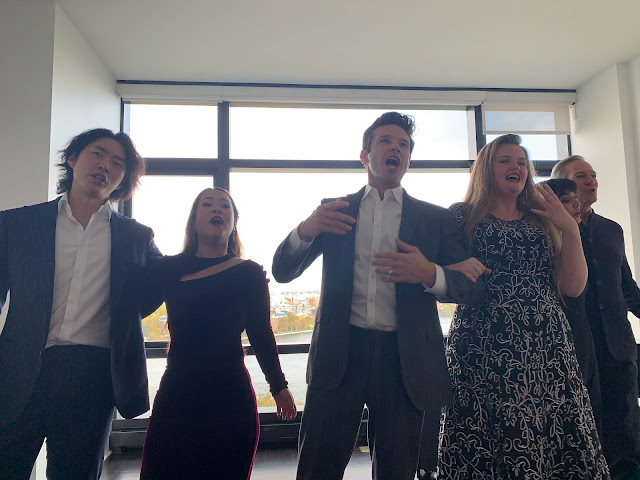
 Donghoon Kang, Yohji Daquio, John Viscardi, Sara Stevens, and Glenn Morton

Not even the stunning view across the East River could distract us from the fabulous French program presented by Classic Lyric Arts. CLA has, at present, summer programs of incomparable value in France, Italy, and The Berkshires, the latter focusing on the operas of Mozart. Graduates of these programs are showing off their acquired skills in theaters all over the world. One thinks of these programs as polishing the gems.

Yesterday's concert shed luminous light on the success of CLA's French program which provides an immersive experience for young singers who wish to up their game in French opera and mélodie. If this concert is accepted as evidence, the summer program in France has accomplished its objective beyond what one might hope for. The French language is notoriously difficult to master, largely due to the vowels, especially the nasal ones, and the necessity for long lines, almost free of the stresses one finds in English.

The program opened with CLA Artistic Director Glenn Morton accompanying Executive Director John Vicardi (a graduate of the programs from some years ago) in a moving performance of Henri Duparc's "Chanson triste". As staged by renowned director Daniel Isengart, the mood was fragrant with tristesse. This was no ordinary concert since each piece was lent dramatic impact and intent which augmented the very fine voices.

The gifted young pianist Xu Cheng accompanied the other singers in a program that seemed all too short. Most memorable were the following:  soprano Yohji Daquio singing Juliette's sparkling aria "Je veux vivre"  (from Gounod's Romeo et Juliette) with every ounce of impassioned young womanhood; baritone Donghoon Kang's  strutting demeanor as he created a formidable Escamillo, from Bizet's Carmen, capturing the hearts of the imaginary Spanish ladies (and perhaps those of the women in the audience as well); soprano Sara Stevens' performance of "Robert, toi que j'aime" from the rarely seen Meyerbeer opera Robert le diable.

We are glad that the collapse of Thaïs (Ms. Daquio) into the arms of Athanaël (Mr. Kang) from Massenet's Thaïs  was followed by the frisky "C'est l'amour" from Louis Ganne's Les Saltimbanques. The first brought us to tears and the second left us grinning from ear to ear.  And who doesn't love a happy ending!

© meche kroop

Monday, January 23, 2023

OPERA INDEX HONORS JAMES MORRIS

Last night at the Metropolitan Club, Opera Index honored legendary bass-baritone James Morris with a Lifetime Achievement Award--and who would deserve this more than the only Wotan in our memory who showed us the complexities of this character as we needed to see them. Of course, Mr. Morris' biography is an impressive and lengthy one but that is how we wish to remember him. Mr. Morris' "third act" is coaching young artists and we can tell you, Dear Reader, how many young artists have shared with us the incredible value received from his tutelage.

The evening was led by Opera Index President Jane Shaulis who herself had a legendary career and who now does so much to benefit young artists. Speeches were given, toasts were raised, and the room rang with applause. After the lengthy Covid related "intermission" this was a golden opportunity for a gathering of the tribe and we were overjoyed to see so many familiar faces. But let's get to the stellar entertainment!


Donghoon Kang, Moises Salazar, Chuanyuan Liu, Vladyslav Buialskyi, Siphokazi Molteno, and Le Bu

From among 350 applicants for the Opera Index awards, 29 finalists were chosen, and 19 winners received $74,500. in prize money provided by foundations and individually sponsored awards. We can only imagine the tough job tackled by the judges to narrow down such a wealth of talent. Guests at the gala were privileged to hear eight of the winners and thankfully, dinner was not served until after the performances. To tell the truth, we felt so satisfied by the entertainment we experienced no need for food. Maybe we should share this information with those who are trying to lose weight. Feed the ears!  Feed the soul!  Not the belly.

Opening the program was magnificent mezzo Maggie Renée who moved around the audience seducing us with a spirited  "Seguidilla" from Bizet's Carmen. It is quite a special gift to combine a rich mezzo tone with technical aplomb and firm dramatic instincts! 

Ms. Renée was not the only artist to use the entire space of the room. Ukrainian bass-baritone Vladyslav Buialskyi achieved dramatic realism in his valid portrayal of Figaro in Mozart's Nozze di Figaro, as he opens the fourth wall and addresses the audience in "Aprite un po' quegli occhi". With superb vocalism he created a character in such a sure manner that the entire scene came to mind.

It was surely a night for the bass-baritone and it came as no surprise to learn that Le Bu studies with Mr. Morris. Winner of countless awards, Mr. Bu is firmly stage ready and can look forward to inheriting Mr. Morris' roles. Tackling the moving expression of Procido's patriotism in "O tu Palermo" from Verdi's I vespri siciliani, he got everything right--a stellar performance in every respect. 

Since we are now in the midst of celebrating the Lunar New Year, it gave us pleasure to have three Asian artists on the program--and all from different fachs. Chinese countertenor Chuanyuan Liu brought out every subtlety of the fioritura in "Si, la voglio e la ottero" from Händel's Serse. The plot is as elaborate as the fioritura but, truth to tell, we appreciate the latter more than the former, especially when delivered with pinpoint accuracy and fine flexibility as it was by Mr. Liu. What would countertenors do, were it not for Händel and his crazy plots!

We heard more French from South Korean baritone Donghoon Kang who performed "Riez! Allez! Riez du pauvre ideologue" in which Sancho Panza defends his poor confused master in Massenet's Don Quichotte. Mr. Kang effectively employed variation in dynamics and expansive expression to achieve emotional impact--another fine performance. 

Yet another admirable actor took the stage in the "Chanson de Kleinzach" from Offenbach's Les Contes d'Hoffman.  Mexican tenor Moises Salazar is quite the storyteller and held us as spellbound as the character does to his audience in the opera. He colored every phrase with such dramatic interest that we almost missed noting the superb vocal qualities of his artistry.

The beautifully textured vocal quality of South African mezzo-soprano Siphokazi Molteno was also accompanied by firm dramatic intent as she portrayed the seductive Dalila in Camille Saint-Saëns'  Samson et Dalila. We have often heard "Mon coeur s'ouvre à ta voix" and indeed, it was our introduction to the Metropolitan Opera with Marilyn Horne as the doomed gypsy. It would be fair to say that in between that performance and Ms. Molteno's we have not enjoyed it as much.

We hear less French opera than we do Italian and were delighted to hear tenor Philippe L'Esperance perform Faust's serenade to Marguerite from Gounod's eponymous opera. Between Ms. Renée, Ms. Molteno, and Mr. L'Esperance we heard a lot of seduction in one night. Mr. L'Esperance's sweet tenor was well employed with some fine phrasing and Gallic style.

We did not get to hear all of the Opera Index winners but we are quite sure that the quality was equivalent. Young talent deserves our backing as well as our appreciation.  We hail the stars of tomorrow!

© meche kroop