MISSION

We are here to encourage the development of gifted young singers and to stimulate the growth of New York City's invaluable chamber opera companies. But we will not neglect the Metropolitan Opera either. Get ready for bouquets and brickbats.
Showing posts with label Stephen Sondheim. Show all posts

Thursday, April 9, 2026

STRANGE BEDFELLOWS?


Theo Hoffman, Christine Taylor Price, Steven Blier, and Bénédicte Jourdois

(Photo by Cherylynn Tsushima)

What do Francis Poulenc and Stephen Sondheim have in common?  That is the question that Steven Blier, Artistic Director of New York Festival of Song, proposed to answer in a rewarding program of art song presented at Merkin Hall Tuesday evening. The well thought out concept may have been more interesting to other members of the packed house; for us, it was more than enough to hear two superb singers bring to vivid life a lot of songs that were new to us.

A decade ago at Juilliard was a magical time, a time when the young singers of the Vocal Arts Department made a lasting impression on us. We have lost track of the number of times we wrote about the vocal and dramatic triumphs of soprano Christine Taylor Price and baritone Theo Hoffman. As the decade passed by, we were fortunate enough to update ourself on their growing artistry from time to time, but what remains predominantly in our memory are the earliest stages of their respective careers. We do love recognizing future stardom!

The program was an interesting one in that we heard some of Sondheim's less well-known works, works that predate our arrival in New York City and our interest in music theater.  We were quick to love Sondheim from our early experiences with Sunday in the Park with George, Into the Woods, A Little Night Music, Pacific Overtures, and Sweeney Todd. Among the lesser known works of his introduced to us by Mr. Blier were excerpts from Saturday Night, Anyone Can Whistle, Dick Tracy, The Frogs, A Funny Thing Happened on the Way to the Forum, and a song that was cut from A Little Night Music--"Silly People".

Poulenc, on the other hand, was not on our radar until we got interested in opera and art song. Unlike our immediate affection for Sondheim, our appreciation of Poulenc has grown slowly. Most of the works on this program were new to us. It seems that there are a few of his works that have become common in recital and only Mr. Blier has dug deeply enough to find some lesser known true gems.

What always strikes us about a NYFOS concert are the singers that Mr. Blier chooses.  Not only do they have great voices but they are also impressive interpreters. They give the same value to art songs, Broadway songs, cabaret songs, and popular songs. Such was the case at Poulenc/Sondheim. Each and every song was a miniature gem. We would have to name as our favorite the final number on the program featuring both singers-- "No One is Alone" from Sondheim's Into the Woods, a show we attend every chance we get, most recently at Manhattan School of Music when their Music Theater Department gave it an outstanding production. There wasn't a bit of "Sondheim snark"--just an inspiring wrap-up to a show that exploded all our fairytales.

The encore number "Old Friends" from Merrily We Roll Along was similarly delightful. "Finishing the Hat" from Sunday in the Park with George gave our two singers an opportunity to interact, bringing back memories of a long ago time when we saw the show on Broadway. Ms. Taylor Price's delivery of "Ladies Who Lunch" made us wish we had seen Sondheim's Company.  Mr. Hoffman's performance of  "Fear No More" from The Frogs had us experiencing the Shakespeare text in a new way. We were fortunate enough to have seen The Frogs recently, thanks to Master Voices.

As far as the Poulenc work on the program, the song we liked best was "Fancy" sung by Ms. Taylor Price, showing a great respect for the melodic line which seemed more melodic than Poulenc's usual songs. We enjoyed Mr. Hoffman's soulful delivery of "Montparnasse", with text by Apollinaire, and, almost as much, the bibulous delivery of "Chanson a boire". 

As is customary, Mr. Blier narrated the program with wit and humor, garnering giggles from the audience. He took turns with Bénédicte Jourdois accompanying the singers. It was a stellar evening start to finish and was no less than what we have come to expect from a NYFOS evening. This is their 38th season and are still going strong!


© meche kroop


Sunday, September 14, 2025

A TRIBUTE TO STEPHEN SONDHEIM


Curtain Call for SAS Performing Arts Company's Sondheim Tribute Revue

When we think of opera of the 19th century, a number of giants come to mind--Rossini, Bellini, Donizetti, and Verdi. When we think of the 20th century we think of Puccini, Richard Strauss, and Stephen Sondheim.  How does Sondheim fit into this illustrious group? We haven't even mentioned Rorem or Britten. 

We take full responsibility for our opinion that no one has spoken to us as Sondheim did.  No one entertained us as Sondheim did. No one had us leave the theater humming his tunes with such pleasure. An evening tribute to his vast repertory, presented by SAS Performing Arts, left us completely satisfied.

What is unique about SAS Performing Arts is their embrace of three cornerstones of performing arts: opera, musical theater, and drama. Beginning a company at the time of Covid, as Stephen Scovasso did, was a brave act and is likely the reason that we were unaware of their (mostly virtual) productions until recently. We are happy to report that this season promises to be an exciting one, with productions of Grecian's Dracula, Menotti's The Medium, Dickens' A Christmas Carol, Oscar Wilde's The Importance of Being Earnest, Thornton Wilder's Our Town, and a night of Rodgers and Hammerstein. Sounds ambitious!

We avoid drawing a line between opera and music theater when neither is amplified. It's all about telling a story with music. Hopefully, the story resonates with us and the music stays in our ear, giving us pleasure long after the performance ends.

What is unique about Sondheim is the fact that he wrote both lyrics and music, allowing an uncommon fit between clever rhymes and melodies that captured the emotional intent and rhythms of the phrases. Of course we are aware that he was a successful collaborator, writing music for other lyricists and providing lyrics for other composers' music, most notably for Bernstein's West Side Story. But what we heard last night comprised works that were totally his.

The revue was produced and directed in a most satisfying manner by Mr. Scovasso (we see that there are lots of S's in both names), an experienced musicologist, conductor, director, and author. The cast of ten artists were seated onstage at café tables so that the artists performing a particular song could rise and join one another as called for. They worked well as an ensemble and we will name them all before ending our review.

Sondheim's greatest hits were each given a few songs and we particularly enjoyed renewing our acquaintance with Sweeney Todd, which, we insist, is an opera by virtue of its serious consideration of morality and fate, along with a most arresting score. Who but Sondheim could tell such a dark tale with flashes of humor as in "Try a Little Priest"--reminding us of Shakespeare's tendency to leaven some of his tragedies with humor.

Another favorite of ours is A Little Night Music with its sharply drawn characters and romantic entanglements that a 21st century audience can relate to. The poignancy of missed connections in "Send in the Clowns" is so intense that the work has become a favorite of cabaret artists. As a matter of fact, most of the selections chosen for the evening's entertainment were stand alone favorites.

Of course, knowing the entire work always makes the individual numbers more deeply felt; "Into the Woods" from the work of the same name, took us back a few months when we saw the work performed by students of Manhattan School of Music. We enjoyed it so much we saw it twice and if you, Dear Reader, care to know more, enter the title of the show in the search bar.

Participating artists, in alphabetical order, were Brian Alvarado, Tyler Ayala-Van Tassel,  Jorge Blakely,  Janice Hall, Dan Drew, Daryl Glenn, Elisabeth Ritscher, Emily Samuelson, Veronica Shea, and Deborah Surdi.  Accompanying on the piano was Nick Stamatakis.

And now, Dear Reader, since nothing is perfect, we have come up with a few quibbles. An unnecessary microphone made a couple unwelcome appearances, as did the loathed music stands. The acting was, on the whole, a major contribution to the success of the performances which were most relatable when the music stands disqppeared. Sondheim's clever text would have benefitted from some clearer enunciation. Surprisingly, it was in the ensembles that the words came across most clearly. (We have noticed in the opera world that enunciation of English is best by artists from other cultures who work hard to get the words across clearly.)

We were overjoyed to make the acquaintance of Sondheim's works that were less familiar to us than Sweeney Todd and A Little Night Music. We were delighted that our foreign born companion enjoyed the evening almost as much as we did. There is something about Sondheim's melodies and the cadence of his  rhymes that delight the ear; and there is something quintessentially New York about his storytelling, even when the stories take place in London, Sweden, Rome or Paris. Sondheim was indeed an American treasure whose music will endure in the same way as Verdi's.

© meche kroop

Monday, April 7, 2025

BACK INTO THE WOODS


Curtain Call at Manhattan School of Music's production of Into the Woods

Broadway shows are not our fach, so to speak, but to be so impressed by a production of Into the Woods that we saw it twice, it would seem thoughtless to not write about it. We give credit to the Manhattan School of Music's Musical Theatre Department for outperforming any show we have seen on The Great White Way. That is indeed impressive.

We have nothing against American Musical Theater and we would love to attend, were it not for the amplification. We adore the sound of the human voice and cannot tell anything about vocal quality that has been electronically altered. So, we have nothing to say about the voices of these young artists but we have a lot to say about their performances.  Each and every one in both casts managed to create a unique character by means of gesture and body movement.

We are sure than Evan Pappas' direction was responsible for shaping the work as a whole and shaping each performance as well. Lorna Ventura's choreography served the piece well, as did Debbi Hobson's colorful and apt costuming. James Rotondo created a simple set with movable elements that well served the work. David Loud coaxed a well-shaped performance of Stephen Sondheim's glorious music from the young instrumentalists.

Beyond all those accolades, we would like to make a few observations on the work itself, its source material, and its effect on the audience. The lectures, the polemics, and the dense prose of contemporary opera rarely change one's feelings in a significant way. One might praise the performances (especially if the star is famous) and one might tell one's friends to go see something, but the work rarely stays with you. One is unlikely to return for a second viewing.

However, we have seen Sondheim's Into the Woods at every opportunity and even changed plans to see it twice in one week at Manhattan School of Music. Let's take a look at the reasons. As a psychoanalyst we can point out that the work addresses serious issues in a humorous way, making them more acceptable and accessible. James Lapine's book, weaving together a number of fairy tales, is beyond clever and Sondheim's lyrics rhyme and scan in the quirkiest of ways. The music is tuneful and sticks in the mind. We confess we have been singing and humming all week!

We have no idea which of the artists conceived the idea of utilizing fairy tales. The first time we read Bruno Bettelheim's 1976 book The Uses of Enchantment we were completely astonished by his theories of how small children process these ancient tales which were recorded by the brothers Grimm. We learned how these tales help the child deal with sibling rivalry, separation anxiety, oedipal conflict, and fears of the unknown. (For our purposes it is not terribly important but Bettelheim's authorship has been questioned; but the man who he purportedly plagiarized had no problem with it. )

So, we wonder whether an adult, seeing these fairytale characters onstage might help said grown person on an unconscious level. The characters in the show undergo sexual maturation (Little Red Riding Hood), fear of barrenness (The Baker's Wife), parental disdain (Jack), parental over possessiveness (Rapunzel), romantic dissatisfaction (the two Princes), and marriage for material reasons (Cinderella). The Baker suffers from his father's misdeeds. Everyone is blinded by their own selfish desires and lack of community. Everyone experiences the ground shaking under their feet. (Hello 2025!) Things go wrong just when you think you have solved your problems. Ultimately, it is community that helps people deal with grief and loss. No wonder we love this show. Art holds a mirror up to us and shows us who we are.

Major props to everyone concerned with this memorable production and a big dose of admiration and career encouragement to the huge cast that brought it to life. Bravissimi tutti!

© meche kroop


Sunday, November 5, 2023

RIBBIT!


Douglas Sills and Kevin Chamberlin in Stephen Sondheim's The Frogs by Master Voices

(photo by Erin Baiano)


In 405 B.C.  the playwright Aristophanes won first prize for his play Frogs in which his hero Dionysos and the slave Xanthius travel to the Underworld to bring back Euripides to fix the problems of Athens, suffering under a lengthy war with Sparta. A debate (agon) between Euripides and Aeschylus persuades Dionysos to bring back the latter instead of the former. The topic is a serious one but handled with a lot of humor, much of it sexual. The frogs would seem to represent the "sheeple" who resist using art to effect political change.

In 1941, Burt Shevelove, a graduate student at Yale University, adapted the play, directed it, and staged it in the university gymnasium. It took three decades for the work to be revised with music by Stephen Sondheim and again be produced by The Yale Repertory Company. Nathan Lane uncovered the script shortly thereafter and began revising and sketching fresh ideas. Sondheim wrote some new songs. The work has had a checkered production history and mixed critical responses. It was last seen at the Vivian Beaumont Theater in 2004.

We personally would go to Hades to bring back Mr. Sondheim whose grasp of character and artistry at setting the English language have not been matched. We are grateful to Ted Sperling, Conductor and Director of Master Voices for presenting a concert version at the Rose Theater. Although there were no sets, Tracy Christensen's costumes went a long way toward creating each character. Nathan Lane took on the role of narrator, bridging gaps between scenes; the actors were universally superb in spite of using scripts in hand. Thank goodness they were not standing at podiums!

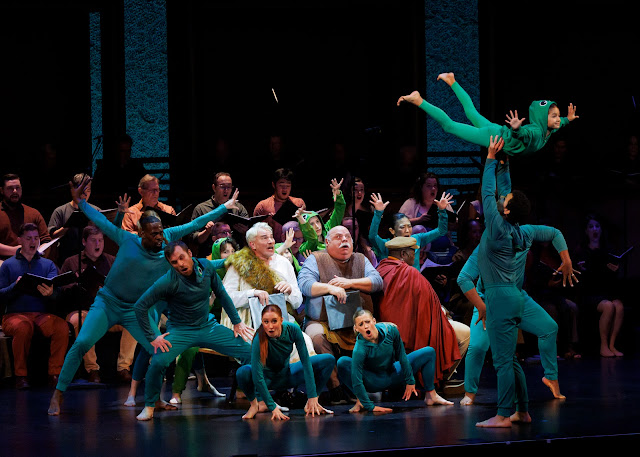
As in the original, the bitter pill of political despair is sugar-coated with humor, much of it bawdy. The musical numbers were always engaging and the choreography by Lainie Sakakura was brilliant. Dancers clad in green body suits tumbled and leapt around the stage. All the parts were astutely cast. Of course the massive chorus of voices was superb.

We knew we were in for a treat right from the start with an hilarious scene advising audience members how to behave. True to the original, Dionysos (Douglas Sills) and his slave Xanthias (Kevin Chamberlin)  plan to go to Hades to bring back a playwright whose work could possibly help "Athens" in troubled times. They establish some rather negative opinions of frogs and then consult with Heracles (Marc Kudisch) in a very funny song "Dress Big" in which the god known for his prowess instructs the somewhat effeminate Dionysos how to walk with a swagger and talk tough.

Then there is a very funny scene with Choron (Chuck Cooper) who will take them across the river Styx for a price. There is some THC-fueled humor about cruise lines and their responsibilities, or lack thereof.

Upon arrival, the pair of travelers get to meet the extremely swishy god of the Underworld --Pluto (Peter Bartlett). There is a great deal of humor about how wonderful life is in Hades where no one has to worry about dying because they are already dead. 

Once the pair meet up with George Bernard Shaw (Dylan Baker), the tone gets a bit more serious. Says Dionysos " I want to take him back to earth with me. You see, the world is in such a mess. Everyone lives in fear now. Our leaders have filled us with fear. And that's the way they like us. Frightened and vulnerable. So, they can do as they please. And I just think if Shaw were to write again, he could show us the truth about ourselves and how we live." 

It certainly does appear that Shaw has all the answers embedded in his scathing wit. "Basically, we have two kinds of leaders--ineffectual and corrupt". What will shake up the complacent "frogs" of the world? Says Dionysos about his trip, "Look, I'm no hero. I made my way here through a river of frogs. It wasn't easy. They tried to stop me. The frogs like things the way they are. 'Earth is well enough', they say. 'Let well enough alone.' And I'm afraid more and more people are starting to think the same way."

And then comes the twist.  Shakespeare (Jordan Donica) appears on the scene and the agon begins. Shaw denigrates Shakespeare but Dionysos decides to take The Bard up to earth instead of Shaw. "In order to change things, we need to touch people's hearts as well as their minds. Remind people what's right with them as well as what's wrong with them. If we really want to be heard, the words should be poetic. Bernard... I have decided that you shall stay here in Hades."

What a perfect summation of the role of art in our lives! We personally have been touched by Shaw and Shakespeare, but, above all, by Sondheim.


© meche kroop

Saturday, March 10, 2018

PASSION

Elizabeth Bouk and Jonathan Fox Powers in Sondheim's PASSION at Utopia Opera

Most people enjoy having their opinions validated and we are no exception.  In the Director's Notes for Sondheim's Passion, presented by the reliably adventuresome Utopia Opera, Benjamin Spierman eloquently addresses the issue of opera vs. musical theater. We are in complete agreement that any division is unnecessary and only results in contentious discussion. Drama with music, when sung by classically trained singers without amplification qualifies a work as "opera" in our opinion.

One of the distinguishing features of "opera" is that it is passionate.  People die for love, kill for love, and live on the edge.  That is why opera is the perfect antidote for our "whatever" age, marked by indifference and irony.

The very title of Sondheim's work tells us so.  The story was adapted from Ettore Scola's film Passione d'Amore, itself adapted from the 19th c. novel Fosca by Iginio Ugo Tarchetti. The renowned James Lapine wrote the book. 

The story concerns a young military officer whose pity for his Colonel's sickly cousin ends up becoming love. Fosca is a disagreeable and demanding woman with a sad past and she stalks Captain Giorgio Bachetti obsessively until she wins him over.

That he has a romantic and sexual relationship with Clara, a woman he adores, does not stop Fosca from throwing herself at Giorgio without reservation or reason, sacrificing all dignity in the process.

Elizabeth Bouk was convincing as Fosca, somehow hiding her natural beauty to portray a woman who believes herself to be homely. It was satisfying to watch her blossom when she succeeded in winning Giorgio's love.

Giorgio was well enacted and sung by Jonathan Fox Powers who showed us his character's inner kindness but also his attempts to firmly reject Fosca's initial advances. His fine voice suited the part well.

We particularly enjoyed Dennis Wees' portrayal of Colonel Ricci, so protective of his unfortunate cousin and so angry when he believes that Giorgio has taken advantage of her. He also has a fine voice and employs it well.  

Actually, the encounters between Giorgio and Fosca were set up and encouraged by Doctor Tambourri, played rather woodenly by Jack Anderson White.

As Clara, Giorgio's married lover who loves with the necessary restrictions of a married woman who stands to lose her child in 19th c. Italy, Paige Cutrona was barely audible except when she employed the upper end of her register where she had an attractive sound. The spoken dialogue and lower notes could not be heard.

Mr. Spierman himself appeared as Fosca's father, in flashback, with Hannah Spierman portraying her mother with a fine sizable sound. Also seen in flashback was the "Count" Ludovic (Jonathan Price) who took advantage of Fosca which probably led to the decline in her health.

Comic relief was provided by the military men who gathered over meals and billiards, commenting on the action like a Greek chorus. Performers were Ray Calderon, Benjamin Herman, Platon Vavylis, Nick Miller, and Ross Schwaber.  It was in these scenes that Sondheim's familiar wordplay was most in evidence.

The music is through-composed with several impactful duets. Most of the arias involve the reading of letters written by Giorgio to Clara and by Clara to Giorgio. We hear Sondheim reaching for something grander in this work, arguably his most operatic creation. Under the baton of Artistic and Music Director William Remmers, the orchestra played well.  On the audience level we had a string quartet plus bass and two keyboards. On stage and off to the side, as usual, we had a pair of horns, a trumpet, percussion, and four wind players who alternated among oboe, English horn, clarinet, and flute. 

Originally Jonathan Tunick composed the lush orchestration and we have no evidence that this was changed for Utopia Opera's production. The score is definitely worth a repeat hearing.

Speaking of repeats, you will have a couple opportunities to catch this chamber opera. There is a matinee today and another on Sunday and an evening performance tonight at 8:00.  The work is seldom produced and we encourage you to seize the opportunity.

(c) meche kroop

Thursday, April 20, 2017

NYFOS HONORS SONDHEIM


Steven Blier, Theo Hoffman, Greer Grimsley, Luretta Bybee, Meredith Lustig, Ron Raines, and Pamela Myers


It was just one wonderful treat after another at the NYFOS Gala at Weill Recital Hall last night. The packed house was the right audience for the generous selection of songs by Stephen Sondheim with the illustrious Steven Blier at the piano, charming the audience with tidbits about each song and the show from which it was drawn.

As is customary with NYFOS events, there is no boundary drawn between types of songs and who gets to sing them. The best part about these evenings, beside Mr. Blier's delightfully witty narration, is that the music is sung by superb singers in their natural unamplified voices. This strengthens the assertion that there are only two types of songs--the good and the bad. Mr. Blier chooses the good ones; they tell us stories.

Stephen Sondheim is inarguably the best composer of musicals of our time. The astuteness of his lyrics and the complexity of his music never ceases to amaze. There is no subject he has been afraid to tackle--not even assassinations and cannibalism.

It is hard to say which is our favorite show but A Little Night Music and Sweeney Todd are both right up there at the top and were well represented last night. The program opened with "Two Fairy Tales" which was written for the former show but somehow never made it. Performed by Meredith Lustig and Theo Hoffman (of the Los Angeles Opera). it involved a kind of "she said-he said" situation with ironically contrasting and alternating lines. The two artists were completely delightful.

Ron Raines and Pamela Myers were similarly delightful in the waltz "You Must Meet My Wife" with Ron as Fredrik, waxing rhapsodic over his (surprise!) virginal bride and Pamela as Desiree cracking wise.

Sweeney Todd was well represented with the too-clever-by-half "Have a Little Priest", with Greer Grimsley as the eponymous Sweeney Todd matching rhymes with Luretta Bybee's Mrs. Lovett. What incredibly adroit wordplay!  Ms. Bybee got to sings Mrs. Lovett's romantic fantasy "By the Sea", and the forceful "Epiphany" was given a powerful and dramatic delivery by Mr. Grimsley.

The show also had a tender ballad in which Tobias sings "Not While I'm Around" in which he expresses his protective caring for Mrs. Lovett. Mr. Hoffman sang it with appropriate depth of feeling. And yet another duet "Pretty Women" sung by Mr. Raines and Mr. Grimsley. 

Follies was represented by Ron Raines singing Ben's song "The Road You Didn't Take". It made us wish to see a revival of the show which we have never seen. We never saw Evening Primrose either but "Take Me to the World" was quite moving as performed by Ms. Lustig and Mr. Hoffman.

A song from Company was performed by Pamela Myers who originated the role of Marta, a woman who is in love with New York City. "Another Hundred People" captured all the energy and vitality of our city.

And there was a song about the beach as well--"The Girls of Summer" from Marry Me a Little, winningly performed by Ms. Lustig.

Not every Sondheim show was a smash hit and Road Show was re-written a number of times, never achieving great success; but it did contain a wonderful song called "Talent" in which the character Hollis Bessemer expresses his dream of creating an artist's colony in Palm Beach. Mr. Hoffman's performance was superb.

The evening ended with the entire cast joining Ms. Myers for Hattie's song "Broadway Baby" from Follies.  It was a superfine evening that we wished would never end.  We could have listened to Sondheim songs all night!

(c) meche kroop

Monday, March 6, 2017

APPLE OF OUR EYE (and ear)

Ken Noda, Sarah Mesko, and Paul Appleby


What gives us the greatest pleasure in life is witnessing the growth of young artists. We have thrilled to the performances of tenor Paul Appleby since we started writing--no, even before--from Juilliard to leading roles on the stages of the world's greatest opera houses. We have been there when he was showered with awards from all the leading foundations. And yesterday he appeared as the "senior" member of a duo at the George London Foundation recital series, having been awarded a half dozen years ago. His rapid ascent can be attributed to his impressive expressive qualities and commitment to whatever he sings.  Besides all that, he has a tonal quality that goes straight to the heart.

The final piece on yesterday's program at The Morgan Library (a very special series for those of us who adore the human voice) was a duet with the "junior" member of the team mezzo-soprano Sarah Mesko, who was honored by the foundation just two years ago. The duet was the final scene from Georges Bizet's Carmen, a scene which has always seemed to go on a bit too long for our taste causing us to inwardly mutter "Stab her already".  But not yesterday!  The performance was so intense that we had to restrain ourselves from leaping onstage to prevent Don Jose from stabbing Carmen.

This frightening reality was created without set or costumes. We have never seen/heard it performed better. When Don Jose cradled the dying Carmen in his arms we could not hold back the tears. Ms. Mesko has experience with the role and Mr. Appleby absolutely must add this to his already substantial repertoire. Don Jose is a complex character and Mr. Appleby's artistry captured all of it. Interestingly, the two artists appeared together at the Santa Fe Opera a few years back in Offenbach's La Grand Duchesse de Gerolstein, which we reviewed so enthusiastically.

With that bedazzlement out of the way, let us consider the remainder of the program. Ms. Mesko's voice has the quality of liquid caramel and felt so totally perfect for Brahms whose "Die Mainacht" was the standout of her first set. Accompanied by the fine violist Andrew Gonzalez, she also gave a beautiful interpretation of Brahms' Zwei Gesange, op.91. The artist filled "Gestillte Sehnsucht" with restless longing. "Geistliches Wiegenlied" is a lullaby to the Christ child that we have often heard. Mr. Gonzalez' line echoed the vocal line and the repetition of the phrase "stillet die Wipfel" will not quit our ear.

We might add that Ms. Mesko's German diction was superb and she filled Hugo Wolf's "Der Mond hat eine schwere Klag erhoben" with wonder. She also accomplished a rare feat by singing English with superb enunciation. As far as the French, we found Gabriel Faure's "Clair de lune" to be wanting more fluidity of line to bring out the sensuality achieved by Ken Noda's superb accompaniment.  We even had the curious thought that the English song preceding the "Clair de Lune" had set her up for a choppier delivery.

We liked the way Ms. Mesko addressed the audience and told about her choices. She related how Hector Berlioz added something to Virgil's account of Dido's death when he wrote the libretto for Les Troyens. When she sang "Ah! Je vais mourir" we got Dido's anger at the abandoning Aeneas...followed by Berlioz' addition of an adagio section in which she expresses her gratitude for the good things in her life. In this part, we heard the longer legato line that we wanted to hear in the earlier "Clair de lune".

Mr. Appleby, so passionately convincing in opera, revealed a different side of his artistry in a set of songs by Britten. He is a thinking man's artist and can only be admired for choosing material that resonates with him. That it doesn't resonate with us does not take away anything. His attention to text is impressive and he mines every song for meaning. When we read the title of the song cycle On This Island, all we could think about was Mr. Appleby's thrilling performance at the Met in Enchanted Island! But this set of songs, settings of text by W.H.Auden, although they did not enchant us, held our interest.

We enjoyed the embellishments in "Let the florid music praise!" and the Brecht/Weill flavor of "Now the leaves are falling fast". The dirge-like "Nocturne" appealed to us because the text rhymed and scanned. But the most affecting was the sardonic and bitter "As it is, plenty" which Mr. Appleby invested with great dramatic import.

We cannot say that the set of Poulenc songs held our attention. Tel jour, telle nuit was set to text by Paul Eluard which struck us as surreal and not worthy of setting.

We would have been happy to have left the recital all shook up by the Carmen but the generous artists supplied encores. Ms. Mesko gave a delightful delivery of "Everybody Says Don't" from Sondheim's 1864 Broadway show Anyone Can Whistle. The show did not do well but the song is a winner.

Mr. Appleby's encore was Ned Rorem's paean to "The Lordly Hudson". Well performed as one would expect, but we would prefer to see the river through the eyes of a painter of the Hudson River School!

The talented pair closed the program with Ralph Vaughan Williams' "Dirge for Fidele" also known as "Fear no more the heat o' the sun", text from Shakespeare's Cymbeline. The overlapping voices and peaceful harmonies were perfect.

But the most perfect performance of all was that of collaborative pianist Ken Noda who is as supportive of the artist as he is brilliant on the keys.

(c) meche kroop


Wednesday, November 2, 2016

NYFOS GIVE US THE FAMILY RODGERS

Hal Cazalet, Lauren Worsham, Mary Testa, and John Brancy

Count on Steven Blier to assemble a gifted group of singers who are comfortable with genres from classical art song to Broadway to the Beatles.  Count on Steven Blier to dream up a thrilling theme.  Count on Steven Blier to curate enough songs to fill out the theme.  Count on Steven Blier to titillate the audience with tidbits about the composers. Count on Steven Blier to tickle the ivories and your ears with his arranging and playing. And count on Steven Blier to write a fascinating essay about the program, instead of the customary boring program notes.

The theme of last night's concert at Merkin Concert Hall was "Rodgers, Rogers & Guettel"; three generations of America's own musical dynasty. The first set of songs illustrated Richard Rodgers partnership with Lorenz Hart as lyricist and were composed in the 1920's and 1930's. Our personal favorite of this group was "Maybe It's Me" from the 1926 musical Peggy-Ann.  We loved soprano Lauren Worsham's charming style and were delighted by  Mr. Hart's clever rhymes (i.e. senator/progenitor).

In the 1940's, Mr. Rodgers produced some of his finest music in collaboration with lyricist Oscar Hammerstein II.  Mezzo-soprano Mary Testa sang the insightful "The Gentleman Is a Dope" which reminded us of how we tend to disparage what we cannot achieve. 

Baritone John Brancy performed "Some Enchanted Evening" in a highly personal fashion that enchanted us, pouring that old wine into some new flavorful oak barrels, adding nuance upon nuance.

Mr. Rodgers collaborated with Stephen Sondheim in the 60's and "Bargaining" from Do I Hear a Waltz? with it's humorous and clever lyrics was well performed by tenor Hal Cazalet.

Mary Rodgers, Richard's daughter, wrote some fine music in the 60's and last night's program included a number of them that had gone unpublished for one reason or another. She is better known today as a writer of children's books but it was a real gift from NYFOS to share these songs with us. She died just two years ago.

One of the songs was familiar to us--"The Boy From...." with hilarious lyrics by Mr. Sondheim; it was part of a revue called The Mad Show and may have been a send-up of a song "The Girl from Ipanema".  Ms. Testa is at her best in comedy and everything about her delivery was on point.

Ms. Rogers also worked with lyricist Marshall Barer on a musical called Once Upon a Mattress. "Happily Ever After" was delightfully performed by Ms. Testa, Mr. Cazalet, and Mr. Brancy. This satire of fairy tales made us think of Sondheim's Into the Woods which appeared in 1986.

The third member of the family to be honored by NYFOS was Ms. Rogers' son Adam Guettel, whose music is very much of our time, melding influences from several genres and time periods. 

Ms. Worsham was absolutely charming as Clara from Light in the Piazza singing the title song of Mr. Guettels's 2003 musical.

An earlier work from his 1998 Myths and Hymns, entitled "Awaiting You" was sung by Mr. Brancy who employed all manner of vocal colors and dynamic variety. The writing for piano was particularly complex and turbulent.

Mr. Blier's essay about the Rodgers clan touched upon the many problems of this musical dynasty but we prefer to focus on the musical gifts they have given to us. We understand that Mr. Guettel married just two years ago so it's a bit too soon to know if the family gift will be perpetuated!

(c) meche kroop


Saturday, September 10, 2016

IT WOULD BE A CRIME TO MISS!

Sarah Marvel Bleasdale, Joshua Miller, Duncan Harman, and David Pasteelnick in Utopia Opera's production of Sondheim's Assassins

Stephen Sondheim's 1990 musical Assassins was originally presented Off-Broadway by Playwrights Horizons (we were there) and remounted on Broadway in 2004, garnering 5 Tony awards. It is just as relevant today, if not more so, largely due to the intransigence of the NRA and the vehemence of their followers.

Utopia Opera's decision to present it as their season opener was based, as these decisions are, on votes from the audience. This show got more votes than any other show that was nominated. 

Although some of Sondheim's oeuvre seem quite kin to opera, this one is more like a revue. Although the topic of presidential assassination is a highly serious one, the show gives it a gloss of black humor and Sondheim's music is unmatchable. His dialogue is twice as clever as it needs to be.

With slim biographical data to go on, the characters in the show are fully realized by John Weidman's excellent book: paranoid schizophrenics, disaffected immigrants, woefully misguided idealists, pathetic victims of an exploitative society, and all-around loonies.

The parts were brilliantly cast, effectively enacted, and well sung by a cast that seemed to bring serious vocal training from both the operatic camp and the Broadway camp. Happily, the voices were not amplified.

The versatile William Remmers stepped down from the podium to assume the role of The Proprietor in vaudeville guise, ready to provide guns to the would-be killers. It was a knock-out characterization.

The Balladeer who tells the story of the American Dream and narrates the proceedings was portrayed by Chazmond J. Peacock, in fine voice.

Joshua Miller made a strong impression as John Wilkes Booth--not only in the scene in which he is wounded and tries to justify his murder of President Lincoln, but later when he "inspires" and goads the others to attempt their heinous acts. Of all the performers, his English diction stood out.  We missed not a single word.

Lauren Gismondi made a marvelous Emma Goldman, both looking and sounding exactly right. Her scene with Leon Czolgosz (a fine Duncan Hartman), the killer of William McKinley, was one of our favorites.

For humor we had Lynette "Squeaky" Fromme (Kayla Ryan Walsh) carrying on about her "love affair" with Charles Manson, and Sara Jane Moore (Sarah Marvel Bleasdale gleefully interacting, then hilariously messing up their intended assassination of President Gerald Ford.

Matthew Hughes portrayed the pathetic Giuseppe Zangara who tried to kill FDR, and David Pasteelnick enacted the manic Charles Guiteau who did away with James Garfield. He laughed all the way to the hangman's noose.

Michael Matthias excelled as the patently delusional Sam Byck who failed to rid us of Richard Nixon. Zachary Barnes was fine as John Hinckley, Jr. who tried to kill President Ronald Reagan to make an impression on Jodie Foster!  Jeff Goble was excellent as the weak-willed and suicidal Lee Harvey Oswald, falling under the influence of John Wilkes Booth's spirit.

The 13-piece orchestra, heavy on the brass, was conducted by Benjamin Weiss. Sondheim made good use of the American idiom and at one point quoted Leonard Bernstein. Although the instrumental balance was fine, we felt the volume frequently overpowered the voices, including Mr. Remmers' introduction.

It is also fair to point out that the enunciation was not always as clear as it might have been, particularly on the part of The Balladeer. Sondheim's lyrics are so important that we wanted to hear every word. It occurs to us that surtitles are just as important for English as they are for foreign languages.

Utopia Opera is a perfect example of substituting creativity and imagination for a big budget; they have done so much with paltry resources. There was no scenery to speak of but the costuming (Eric Lamp and Angel Betancourt) seemed quite apropos to the periods. It was quite a challenge to mount a show like this and much credit goes to the company for doing such a fine job. Mr. Remmers himself directed.

It is arguably the job of the artist to hold a mirror up to society and reflect us back to ourselves.  At this performance we felt entertained, enlightened, squeamish, and a bit ashamed of our violent history.  We need to experience our dark side before we can change it. The show has been produced overseas and we can only imagine how Europeans must judge our outmoded infatuation with firearms and revenge.

There will be two shows today, matinée and evening--similarly on Sunday. Can you allow yourself to be entertained and changed at the same time?

(c) meche kroop


Wednesday, May 13, 2015

A Little Night Music at Manhattan School of Music (photo by Brian Hatton)

There was much to enjoy last night in Manhattan School of Music's American Musical Theater Ensemble's production of Stephen Sondheim's A Little Night Music. Although it premiered in 1973 it has aged well with a plethora of melodic arias underscored by beautiful music, orchestrated by Jonathon Tunick. Music director Shane Schag was at the piano and there were some lovely contributions by Caroline Cox on violin, Duane Fields on cello, Connor Schultze on bass and particularly by Melanie Genin on harp and Brian Krock whose lovely clarinet intro to "Send in the Clowns" was a highlight of the evening.

The story (book by Hugh Wheeler) was suggested by the Ingmar Bergman film and takes place in the early 20th c. in Sweden at the time of year when the sun doesn't set. Six mismatched people get their love lives sorted out under the observing eye of grande dame Madame Armfeldt who has a lifetime of experience, and her precocious granddaughter Fredrika. 

The former was portrayed by veteran star of opera and theater Catherine Malfitano who was made up to look elderly. Her voice is undeniably better than Hermione Gingold and she put her own take on the role. Her song "Liaisons" was a show-stopper.

She had a lovely bond with granddaughter Fredrika, portrayed by petite Julia Suriano who was able to express all the ambivalence of the child of a too-busy mother of whom she is quite proud but by whom she feels somewhat neglected.

The middle generation of the Armfeldt family is the actress Desirée who would like to renew her old relationship with Fredrik Egerman, a lawyer now married to his childlike virgin bride Anne. Desirée was portrayed by mezzo-soprano Agness Nyama, whose song "Send in the Clowns" was far better sung than it was by Glynis Johns. She has a fine mezzo instrument and sang with great feeling.  Unfortunately, her acting was not up to par with her singing.  There was no chemistry with anyone else in the cast and it was difficult to believe that she belonged in that family or circle of frenemies.

As Fredrik, baritone Clayton Brown was quite believable and sang well. His Act II duet with Count Carl-Magnus Malcolm was splendid. Nickolas Miller was quite good as the arrogant Count, especially as he terrorized his poor wife Charlotte, excellently sung and believably acted by Addie Hamilton. Ms. Hamilton's conspiring with young Anne was quite fine and Samantha Williams made a fine shallow Anne with her bright clear soprano and ditzy body language.

Fredrik's son Henrik was performed by Luke Sikora who did an excellent job portraying a young man in love with his step-mother and burying his feelings in theology. As immoral as the story is, we couldn't help cheering when the two of them ran away together leaving Fredrik free to get back together with Desirée.

We loved the other show-stopping song performed by Viktoria Falcone as the servant Petra--"The Miller's Son".  Her pizazz is something to see and to watch develop.

Further, we loved the chorus.  All were fine: Evan Henke, Stephanie Christian, Sara Ptachik and Hannah Dishman with Christopher S. Lilley a standout for his impressive tenor. All were choreographed by Colleen Durham in a colorful waltz.

The gorgeous period-appropriate costuming was credited to Summer Lee Jack. The simple but effective set and its lighting were credited to Shawn Kaufman.

The Direction by Carolyn Marlow fell short of her customary good work. The main flaws in the production had to do with the overall tone of the piece. Accents were all over the map and some performers had lazy diction, causing us to miss the wonderful sung dialogue. Characters occasionally seemed to belong to  different productions, different countries and different epochs. We longed for more unity of tone.

We were also troubled by the obvious amplification which lent an unnatural sound.  In a rather small auditorium with trained voices, perhaps that could have been eliminated. 

Nonetheless, it was a gift to be able to see and hear this show again, in spite of some minor shortcomings. This is the first time we have seen and heard shortcomings of any kind at an MSM production. We realize it is a student production but we generally don't have to make such allowances.

(c) meche kroop

Saturday, March 28, 2015

MILES TO GO

Dan K. Kurland and Miles Mykkanen


Tenor Miles Mykkanen is mature beyond his years and versatile beyond belief. We have had the pleasure of hearing him sing and witnessing his compelling performances for several years now and are always astonished.  Yesterday he presented a recital at Juilliard as partial fulfillment of the requirements for his M.M. degree.  Importantly, it fulfilled all the requirements of audience engagement.

Our favorite parts of the program were the beginning and the end although there were delights aplenty in between. Ever since Lachlan Glen's perusal of all 600+ of Schubert's lieder output we have been more than usually excited when we see the name of this liedermeister on a program.

Mr. Mykkanen's three choices were perfect for his unique voice and style.  The lilting "Ganymed" is filled with rapture and left us with rapturous feelings. The tender "Der Vater mit dem Kind" was no less wonderful.  But it was the well-known "Erlkönig" that knocked our socks off.  The young artists at Juilliard have spoiled us for other performances with the intensity of their dramatic involvement but Mr. Mykkanen's performance was beyond.

He employed his impressive instrument with different colors for the narrator, the frightened child, the reassuring father and the deceitful Erlkönig. But he somehow managed to alter the colors from one verse to the next as the child becomes more terrified, the father in greater denial, and the Erlkönig nastier. This was the work of a true artist of the stage and Mr. Kurland's piano kept up with him every step of the way. We confess to being overwhelmed. We give credit to Goethe's poetry and Schubert's music, of course.

The following set, which Mr. Mykkanen thoughtfully introduced, comprised three selections from Benjamin Britten's Seven Sonnets of Michelangelo. These were written for Michelangelo's young male lover and Britten set them for his male partner, tenor Peter Pears. They were so passionately sung that one would think they were written for Mr. Mykkanen.

Having sung in such perfect German and Italian, Mr. Mykkanen moved on to French, also perfectly sung.  We heard Albert Roussel's "Sarabande", Gabriel Fauré's "Clair de lune" and Claude Debussy's "Le jet d'eau". French songs can sometimes sound a bit effete but not here!  Mr. Kurland's piano added to the magic with pictorializations of fountains and moonlight.

Mr. Mykkanen is one of the few singers whose English diction is likewise perfect. "Ain't it a pretty night" from Carlisle Floyd's Susannah was an unusual choice but made perfect sense as the longing Mr. Mykkanen experienced to move to New York City.

It was the closing set of Sondheim songs that best illustrated Mr. Mykkanen's versatility and the influence of Steven Blier and the New York Festival of Song. When sung without amplification, we accept Mr. Sondheim as composer of 20th c. operas and his songs can stand next to those of the old masters of the 19th c. (Mr. Sondheim may see things differently).

We were treated to a few songs from Sunday in the Park with George--"Putting it Together" was a bit revised to indicate that the art of which Mr. Mykkanen sang was the art of making music, not painting. No harm was done!  "Finishing the Hat" and "Move On" were equally excellent.

We particularly enjoyed songs from Company--"The Little Things You Do Together" and Mr. Mykkanen's encore "Being Alive".

But there were two songs about children that captured our heart--"The Glamorous Life" from A Little Night Music in which Mr. Mykkanen was able to illustrate both the pride a child has in a famous mother and also the loneliness.  And then the cautionary "Children Will Listen" from Into the Woods.

Mr. Mykkanen, as versatile as he is, can look forward to a major career whether he chooses opera, recital or Broadway.  Everything he sings is golden and he knows how to get a song across.  Once you hear him he is unforgettable!

(c) meche kroop

Thursday, May 1, 2014

REMEMBERING LENNY

Julia Bullock (photo by Karli Cadel)
Co-hosted by the beloved Artist Directors of New York Festival of Song (hereinafter referred to as NYFOS) Steven Blier and Michael Barrett and glamorous diva Jessye Norman, a gala evening celebrating Leonard Bernstein was held at the perfectly sized Weill Recital Hall.  After all, our Lenny was founding advisor of NYFOS.  And a celebration it was indeed.

The evening comprised reminiscences by his daughter Jamie Bernstein and many of the artists who worked with him throughout his career and performances by some of them as well.  But for us, the real magic occurred as we witnessed the younger generation, so well-supported by NYFOS,  interpreting his glorious and enduring music. 

The evening opened with an "amuse bouche"; the adorable Lauren Worsham adopted a little-girl persona to sing his l942 "I Hate Music".  The evening ended with the dazzling Julia Bullock singing "Somewhere" from his 1957 musical West Side Story.  We have heard this song countless times but never have we heard it sung with such profound sincerity and lack of artifice--natural and unamplified  with magnificent vocal technique that disappeared into the overall effect.

For the occasion, five highly talented young men were assembled and dubbed "The NYFOS Jets" to sing the hilarious "Officer Krupke", also from West Side Story.  We know these fellas from the opera stage so it was deliriously funny to see them take on Stephen Sondheim's endlessly clever lyrics.  Theo Hoffman had the role of Action, a juvenile delinquent; Tobias Greenhalgh , Officer Krupke; Tim McDevitt, the Judge; Miles Mykkanen, the social worker; and Adrian Rosas, the psychiatrist.

In contrast with this humor was the ironic and dissonant "The Love of My Life" from Arias and Barcarolles, the 1988 work  premiered and recorded by Mr. Blier and Mr. Barrett and sung here by baritone Kurt Ollmann who also sang the soulful "Lonely Town" from the 1944 musical On the Town and joined Judy Kaye for the "Love Duet" from Arias and Barcarolles.

The very funny Ms. Kaye also sang the pungently humorous "I am Easily Assimilated" from the 1956 oft-revised Candide.  This happens to be one of our two favorite English language operas (the other being Gershwin's Porgy and Bess).  We have seen it in opera houses and on Broadway but we had never heard until Monday night the song "We Are Women" which was beautifully sung by Ms. Worsham and the equally delightful Annie Rosen.  It's a marvelous song which we hope to hear many times over.

The renowned Barbara Cook was on hand with reminiscences of her audition for Mr. Bernstein and a song as well--the lovely "Some Other Time" from On the Town.  Further reminiscences were shared by the regal Jessye Norman and the down-to earth Marilyn Horne who told a funny story about Richard Tucker and the Verdi Requiem when Maestro Bernstein was on the podium.  At one point, Ms. Horne burst into glorious song!

Matthew Epstein also shared his memories and Stephen Sondheim sang a gag song he wrote to music appropriated from Kurt Weill on the occasion of the Maestro's 70th Birthday.

It was a splendid celebration of a brilliant man of music who conducted, composed, educated and entranced.

 © meche kroop


Sunday, June 23, 2013

INTO THE WOODS

Curtain Call at Manhattan School of Music
Some impressive young performers led us into the woods and out again in a thoroughly delightful performance of Stephen Sondheim's 1986 musical Into the Woods.  The performance is part of Manhattan School of Music's Summer Voice Festival.  Is it possible that this cast, in only six weeks, put together an evening that rivals the original performance on Broadway and the one produced by Shakespeare in the Park last summer?  It is!  In place of famous stars we had fresh young voices; in place of lavish scenery and costumes we had giant helpings of imagination.  Much credit goes to Director Bill Fabris and to Musical Director Dan Gettinger who accompanied on the piano, augmented by a fine string quartet and a percussionist, in an arrangement that permitted the voices to be heard without deafening amplification; anyone who visits here regularly knows how we feel about that curse.

The work itself is a mashup of the fairy tales we all heard as children, with all their terrifying elements intact-- and some added by James Lapine in his highly original book.  These characters have all-too-human qualities and therefore we can identify and accept their philosophical life lessons.  Everyone wishes for something; but those that get their wishes in Act I are dissatisfied in Act II.  Everyone must deal with risk, with disappointment, with loss, with failure to accept responsibility, with egregious misjudgments and the lessons learned thereby.

All of the performances were admirable but a few were outstanding.  We were struck by Cameron Johnson's Wolf who went from seductive to frightening at the drop of a hat.  We were totally won over by Elora Ledger's Cinderella; her voice is beautifully affecting and her acting convincing.  Likewise The Baker's Wife, portrayed by Lieke van den Brock, who must fight to win parity with the Baker (a fine Andy Zimmerman).

McKenzie Custin garnered many laughs as the not-so-innocent Little Red Riding Hood and Kendrick Pifer excelled as the Witch who undergoes quite a transformation.  Jack (Jody Hinkley) played the dolt to the exasperation of his mother (Rachel Sandler).  Cinderella's Stepmother (Amanda Levy) had some fine moments with the two Stepsisters (Allison Crain and Alex Cummings).  Cinderella's deceased mother was beautifully sung by Kyle McCormick and Perry Lines was fine as Rapunzel.

In an intimate space without electronic interference, we in the audience could tell who was speaking/singing and actually understand the clever words.  Only the narrator could not be well understood all the time.

The set was simple: three wooden panels on wheels, painted to represent the woods on one side, and on the other sides, Cinderella's hearth, Jack's house, and the Baker's kitchen.  Everyone wore variations on pajamas and robes which, strangely enough, worked really well.  Sandy Siu is credited with Costume Coordination.

We hear that a film of the show has been cast with Meryl Streep and Johnny Depp.  But we don't advise you to wait!  The performance at MSM will be repeated Monday and Thursday at 7:30 and again next Saturday at 2:30.  We don't think there is another show in town that will entertain you as royally!

© meche kroop


Saturday, May 11, 2013

TAKING SIDES ON SONDHEIM

Perhaps Mr. Sondheim would not agree with our opinion but after delighting in Side by Side by Sondheim at The Manhattan School of Music, we consider his works to be operas.  They tell engrossing stories that are relevant to the audience; the music and the stories work together in a way similar to the operas of the 19th c.  They represent a continuation of the tradition far more than so-called "serious operas", the ones that we force ourselves to see once and never want to see twice.  American Musical Theater has evolved out of the operetta tradition and those works evolved from the opera tradition.  Well, no matter what you call them, they are superb.

The production given by MSM's American Musical Theater Ensemble was as superb as the work itself; we could see it transferred intact directly to Broadway!  Narrated by the singers themselves, the anthology of songs was introduced with a bit of background about the shows from which they came.  Carolyn Marlow directed the students of her ensemble with a sure hand; every gesture and action appeared motivated by the lyrics.  Vocal professionalism married with dramatic effectiveness and fine musical values added up to more than the sum of the parts.

The setting by Shawn Kaufman offered little besides a shimmering silver curtain and two pianos, played with high spirits by Musical Director Shane Schag and Eric Sedgwick..  The simple costumes of black and cobalt blue by Rachel Guilfoyle did not distract from the main event--the music.

And what music it was!  The rousing opening "Comedy Tonight" from A Funny Thing Happened on the Way to the Forum was a perfect choice for starting things off with high energy.  Every song was a jewel but let us just mention a few that were for us highlights.  We loved Julia Suriano, just a sophomore in a group of graduate students, and Chelsie Nectow in "If Momma Was Married" from Gypsy (for which Sondheim wrote the lyrics and Jule Styne the music).  Ms. Suriano impressed us later with her interpretation of the flight attendant in "Barcelona" from Company.  Her sperm-of the-moment was beautifully portrayed by Kim Johansen.  We enjoyed this young performer once again in a unique interpretation of "Broadway Baby" from Follies.

Maren Weinberger and Clayton Brown were delightfully convincing  in "You Must Meet My Wife" from A Little Night Music; he waxed rhapsodic about his virgin bride and she did everything but roll her eyes.  What fun!  Ms. Weinberger has a flair for comedy as revealed in "I Never Do Anything Twice" from The Seven Percent Solution.

"Send in the Clowns" is one of our favorite songs and it was finely delivered by Christine Price who, with Ms. Weinberger, sang a moving operatic version of "A Boy Like That" from West Side Story (music by Leonard Bernstein).  Ms. Price was joined by Ms. Nectow and an hilarious Peter Tinaglia in drag for "You Gotta Get a Gimmick" from Gypsy--a number that gave costumer Rachel Guilfoyle a chance to shine and the audience a chance to laugh out loud.  Laughing out loud was also earned by Kendrick Pifer in "The Boy from..." from The Mad Show (music by Mary Rodgers).

As far as Colleen Durham's choreography, just look at those tappy-toes in "We're Gonna Be All Right" from Do I Hear a Waltz?;  Chelsie Nectow and Clayton Brown really showed their stuff!  If prizes were awarded for the Best Diction, we would choose Maren Weinberger for her "Losing My Mind" from Follies.  Accustomed to hearing German and Italian, we find that English is more difficult to comprehend; when lyrics are as special as Sondheim's are, we would have wished to grasp every single word.  We are not sure whether amplification makes it any easier; possibly the opposite is true.  In any case, in spite of the tradition of amplification on Broadway, we couldn't help wondering how the show might have sounded without body mics, taking into account the well-trained voices we were listening to.  Just sayin'.

©meche kroop


Friday, May 10, 2013

THE FINAL CURTAIN

Alexander Lewis and Brian Wagorn
The season of recitals by Lindemann Young Artists ended with a bang of an encore--"Our Times" from Stephen Sondheim's Merrily We Roll Along, as fine an aria as was ever written in bygone centuries and accorded the same respect by the thrilling tenor Alexander Lewis.  The entire recital was remarkable and it was obvious from the very start that Mr. Lewis chose songs that he loved and related to.  We felt as if we were invited into Mr. Lewis' world.

Mr. Lewis' world is broad in compass; he uses his expressive voice along with gesture and body language to convey the deepest meaning of a song, be it funny, sad or ironic.  The texture of his timbre is as pleasing as it is varied and he thankfully never pushes for a high note, a fault of most young (and not-so-young) tenors that hurts our ears.  As a matter of fact, his technique is so refined that one never notices it and is able to focus on his artistry.

He opened the program with selections from The Purcell Collection which were realized by Benjamin Britten.  Mr. Lewis' cheekiness, most notably in "Pious Celinda goes to Prayers", married well with the nature of these brief jewels but he switched gears readily for the tragic "Elegy on the Death of Queen Mary", sung in Latin.

Following, he sang eight charming songs written by Schubert when the composer was but 17-18 years old, an age at which today's youth is doing nothing more than skateboarding or watching TV.  The texts by Ludwig Hölty are delightful and have been set by other composers.  Each and every one merited second and third hearings, imbued as they are with the freshness of youth.

We know Bellini as the composer of operas in which the arias have long arching phrases, so beloved by singers and listeners.  His song "Torna, vezzosa Fillide" took us by surprise with its short phrases.  It was composed for voice and piano but Bryan Wagorn's exuberant pianism brought in all the richness of a full orchestra.  Arpeggios, chords and runs seem to drop like pearls from Mr. Wagorn's fingers.  Mr. Lewis conveyed every drop of the shepherd's despair as he mourned his lost love.

Reynaldo Hahn's Venezia, a collection of lovely graceful songs, was performed in such an Italianate style that we were sure Mr. Lewis had some secret Italian genetic material.  We do love barcarolles and Mr. Wagorn's piano had us swaying in our seat.  Some of the songs are incredibly romantic and others are ironic.  Mr. Lewis' dramatic chops echoed his talents on the opera stage, which we have long enjoyed.

The judges who gave awards to Mr. Lewis certainly knew what they were doing.  It took a lot of hard work to make everything look so effortless!

© meche kroop