MISSION

We are here to encourage the development of gifted young singers and to stimulate the growth of New York City's invaluable chamber opera companies. But we will not neglect the Metropolitan Opera either. Get ready for bouquets and brickbats.
Showing posts with label Shavon Lloyd. Show all posts

Thursday, April 25, 2024

A COMPASSIONATE RULER


 Curtain call at Juilliard for Mozart's La Clemenza di Tito

What sort of work might please a newly crowned Emperor in the late 18th c.? How about a tale of a beloved magnanimous Emperor from Ancient Rome named Titus? An old libretto by Metastasio was tailored to meet the demands of Wolfgang Amadeus Mozart by one Caterino Mazzolà, after Antonio Salieri repeatedly declined the commission for a work to celebrate the coronation of   Leopold II, Holy Roman Emperor, as King of Bohemia. It is believed that Mozart rose to the occasion and composed the opera in 18 days, possibly beginning his labors on the 4 day coach trip from Vienna to Prague.

The story is a simple one and quite direct. Newly installed  Emperor Tito (tenor Andrew Turner). is beloved by his friends, two noblemen named Sesto (mezzo-soprano Ruby Dibble) and Annio (mezzo-soprano Lucy Joy Altus), but not so beloved by the daughter of the former deposed ruler named Vitellia (soprano Evelyn Saavedra) a vengeful and narcissistic character. She is furious not only because of her father's fate, but also because she wants to be Empress and Tito has preferred others. She manipulates Sesto, who is madly in love with her, into murdering Tito.

Meanwhile, Sesto's sister Servillia (soprano Shelén Hughes) is so in love with Annio that she refuses Tito's proposal of marriage in a confession that is so brave that Tito can do nothing but admire her honesty.

This is indeed a family drama writ large on the political stage. The entire point is that after the Senate condemns the guilty Sesto for his failed assassination attempt, Tito forgives all and tears up the death warrant. The ambivalent confusion of Sesto was extremely well limned. What a weak man won't do for love (lust)!  The one psychological dynamic that didn't read true is the sudden burst of honesty on the part of Vitellia who confesses her role in instigating the assassination plot. We must say that Ms. Saavedra's acting was persuasive in spite of the unrealistic plot turn.

This opera is not nearly as famous as the three operas Mozart wrote with Da Ponte and we can see why. Although the music is as fine as Mozart every wrote, the plot lacks the entertainment value of Nozze di Figaro, Don Giovani, and Cosi fan tutti, all of which are comedies with serious messages. La Clemenza di Tito is an opera seria, the last of a dying breed. Perhaps if the opera were heard as often as the other three, or Zauberflöte, the melodies might lodge in our ear and provide a more rewarding experience. The famous duet "Parto, parto, ma tu, ben mio" is perhaps the most famous and heard often in recital. Last night it was given a beautiful performance by Ms. Saavedra and Ms. Dibble.

Ms. Hughes had her chance to shine in "S'altro che lagrime" in Act II, and Sesto's noble aria of forgiveness was handsomely performed by Mr. Turner. Ms. Altus had a fine aria in "Torna di Tito a lato" demonstrating real care for Sesto's fate.  As they say, there are no small roles and baritone Shavon Lloyd's appearance in the role of Publio was just fine.

Not only was the singing of excellent quality but the Juilliard Orchestra gave their customary exemplary performance under the baton of Maestro Nimrod David Pfeffer. In spite of the fact that the orchestra was not in its usual sunken position, Mo. Pfeffer controlled the dynamics so effectively that there was not a single instance in which a singer was drowned out. We particularly enjoyed the passages in which the Bass Clarinet wove around the vocal line.

Stephen Wadsworth's direction made the most of a mostly static plot. A decision had been made to dress the artists in late 18th c. garb. We have no idea what the singers wore when the opera made its premiere in 1791. We would have preferred to see it in togas but were relieved that it was not performed in contemporary clothing. The distancing to an earlier period allowed us draw our own contrast with contemporary times in which a ruler might pardon those guilty of crimes for reasons which we find cynical--like political advantage, whereas Tito pardons out of love and magnanimity.

Charlie Corcoran's scenic design was simple and effective. A ramp leading up from ground level to an upstairs door and a simply demarcated area at ground level. The entire stage was surrounded by a frame.

Sara Jean Tosetti's costumes were effective with the two female character dressed in a manner that reflected their very different character. Costumes for the breeches roles were convincing and Tito looked suitably imperial.

Juilliard Vocal Arts has once again filled a major gap in New York City's cultural landscape, providing a most satisfying experience to the audience and valuable performance opportunities for students. Before we end we would like to commend Chorus Master John Arida for melding many voices into an exceptional unit, notable for clear diction. This, Dear Reader, is a rare achievement.

© meche kroop

Thursday, December 1, 2022

RETURNING TO JUILLIARD


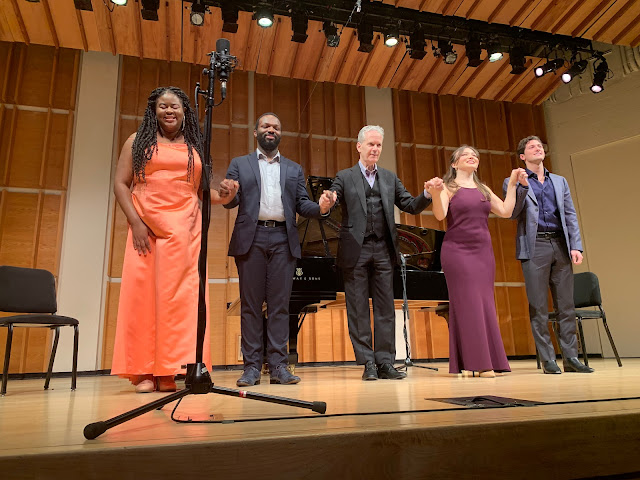
 Natalie Lewis, Shavon Lloyd, Brian Zeger, Shelén Hughes, and Colin Aikins

Masks off!!!!  Time to give Juilliard the attention they deserve.  After such a lengthy covid-induced hibernation, how happy we were to watch four gifted students showing off what this incomparable institution has to offer. Last week we reviewed some superb singers doing justice to Händel's glorious music in Atalanta and this week we had a grand time at the annual Juilliard Songfest.  

Brian Zeger, Artistic Director of the Marcus Institute for Vocal Arts, has lent his formidable collaborative piano artistry to some of the world's greatest voices; he offered no less to these post-graduate students. We loved his idea for the first half of the program--that of letting  the four singers choose their own programs.  Long ago, when Isabel Leonard was being coached by Maestro James Levine in a master class, he dropped some words of wisdom.  "Sing what you love!" Hearing these singers performing songs of their own choosing gave us a glimpse into their inner lives.

Leading off was soprano Shelén Hughes who impressed us as a student at Manhattan School of Music when she performed the lead in Snegurochka, Rimsky-Korsakov's opera of the same name (known in English as The Snow Maiden). This review is available by using the search bar. At the above-mentioned performance of Atalanta, she shone in the eponymous lead role. At this Songfest, her personal choice was Joseph Canteloube's Chants d'Auvergne.

Ms. Hughes' connection with the material was a deeply felt one. The dialect is strange and difficult to understand without looking at the program; but the several stories came across by virtue of the artist's winning personality and artistic choices. Regular readers know how much we love folk songs for their memorable melodies and simple direct meaning. In "Baïlero" we particularly responded to the nonsense syllables which reminded us of "scat" in the jazz realm. What an opportunity to show off exemplary bel canto technique expressively used to convey emotion. 

The emotion of "La delaïssádo" was a mournful one, painting a portrait of an abandoned maiden.  In "Lo fiolairé" Ms. Hughes flirtatiously portrayed a frivolous girl who gives two kisses to the boy who asks for one. We had a smile from ear to ear. The cycle ended with a paean to the joys of female singlehood.

Next on the program was Shavon Lloyd whose richly textured baritone lent gravitas to text by Langston Hughes set by Leslie Adams. A composer himself, Mr. Lloyd clearly responded to this music and sang with conviction. Text by Georgia Douglas Johnson, "The Heart of a Woman", had a satisfying rhyme scheme, as did "Creole Girl" with text by Leslie Morgan Collins.  What we observed about Mr. Lloyd's fine technique was the strong connection between his rich round sound and his precise embouchure. This is something we never noticed before and we love learning new aspects of technique. We might add that every single word was intelligible, a rare quality on which we place a high value.

Tenor Colin Aikins's performance also taught us something new--that a supernal performance can change our opinions. When we saw the program our first impression was one of despair. We have complained bitterly about composers setting prose because it's never musical and the vocal lines are not interesting. We gritted our teeth when we saw a cycle called Dear Theo, settings of Vincent van Gogh's letters to his brother, adapted and set by Ben Moore. We were sure to be bored.

Not only were we not bored, we were riveted. We experienced Mr. Moore's composition as music to support an intense monologue that was delivered so dramatically by Mr. Aikens that it seemed he was channeling the painter, expressing the intense joys and despairs of a seriously troubled artist; and he did so with impeccable diction. This was one of those performances for which our impoverished words are no match. It was unforgettable!

Finally we heard mezzo-soprano Natalie Lewis perform four songs from Gustav Mahler's Rückert-Lieder, omitting only the transcendent "Um Mitternacht". Mahler's music always has a profound effect on us with his memorable melodic lines and pungent harmonies. We tried to figure out what disappointed us about the vocal performance. Did we mind that the songs were not sung in the compositional order, nor the publication order? We don't think so.

Was the German muddled? No. As a matter of fact we did understand every word. Our German companion noticed that the ending consonants were crisply and accurately enunciated, although we both noticed the inconsistent enunciation of the terminal "ich" which seems to create problems for many American singers.

We found ourselves listening more to Mr. Zeger's piano--the earnestness of "Liebst du um Schönheit", the gentle airy lyricism of "Ich atmet' einen linden Duft", the hidden humor in "Blicke mir nicht in die Lieder", and the quiet resignation of "Ich bin der Welt abhanden gekommen".

It is just a speculation on our part but perhaps, although Ms. Lewis enjoys singing these songs, the singer needs more age and experience to do them justice. We have never felt this when hearing a young tenor tackling Schubert's two song cycles --Die Schöne Mullerin and Winterreise.

We had no such problem enjoying Ms. Lewis' charming performances of several selections from Hugo Wolf's Italienisches Liederbuch in the second half of the program. We have always been tickled by these miniature portraits of young lovers with all of their longings and adolescent angst. We are not familiar with the original Italian folk songs but the translation into German by Paul Heyse both rhymes and scans and surely inspired Wolf to write these accessible songs.

Mr. Zeger's idea to stage them with all four singers onstage interacting with one another was a clever one and added a new dimension. Ms.Lloyd seemed far more comfortable here and we were able to enjoy her ample sound and on point acting. There was courtship aplenty, jealousy, rejection, and every other shade of emotion found in early experimental relationships. We have never enjoyed this cycle more than we did with these four artists bringing the songs to life. They brought the evening to a satisfying close with "Nun lass uns Frieden schliessen".

© meche kroop