MISSION

We are here to encourage the development of gifted young singers and to stimulate the growth of New York City's invaluable chamber opera companies. But we will not neglect the Metropolitan Opera either. Get ready for bouquets and brickbats.
Showing posts with label Shannon Delijani. Show all posts

Wednesday, April 3, 2024

EUGENE ONEGIN (the Cliff Notes)


 Edwin Joseph and Emily Margevich
(photo by Russ Rowland)

Last night at the Baruch Performing Arts Center, we attended the premiere of Tchaikovsky's heartbreaking opera Eugene Onegin, performed by Heartbeat Opera (no relation);  at least we heard a 100 minute adaptation of the opera. The co-adaptors were Director Dustin Willis and Artistic Director Jacob Ashworth who also conducted the chamber orchestra.

We have been writing about Heartbeat Opera since their inception ten years ago (under different leadership-- by Louisa Proske and Ethan Heard). They have always put a unique spin on the classics, some of which thrilled us and some of which dismayed us or puzzled us.  This production had some very rewarding moments, some insightful ones, and some puzzling ones.

Chief among the delights was the singing. Soprano Emily Margevich made a believable and touching Tatyana. In the lengthy letter scene, she showed us all the unbridled passion of an adolescent girl with all of  its concomitant terrors. She reminded us of Juliet in the early scenes of the ballet version of Romeo and Juliet, almost dancing around her bedroom, trying to put her wild thoughts into words. It was a commendable performance.

As the "older man" she falls in love with (probably an older man of twenty-five) we found baritone Edwin Joseph thoroughly believable and as fine in his singing as was Ms. Margevich.

Flirtatious sister Olga was finely realized by the excellent mezzo-soprano Sichel Claverie and as Olga's devoted fiancé and childhood sweetheart Lensky, we thought tenor Roy Hage performed admirably, delivering a poignant "Kuda, Kuda". Also fine were Shannon Delijani as Madame Larina and Tynan Davis as Filipyevna, the nursemaid. Rounding out the cast was Lloyd Reshard, Jr as Prince Gremin.  More about him later.

Spoiler Alert! If you plan on seeing this production, and we hope that you do, you may want to stop reading here, especially if you are new to this standard of the Russian repertory. One difficulty for us was making the effort to block our memories of prior productions and comparing them. Still, we couldn't help seeing the falling Autumn leaves as Madame Larina and Filipyevna peeled apples or potatoes in the opening scene nor could we not hear in our mind's ear the chorus of peasants in the background, here omitted.

In this production, the nearly bare set made use of wooden frames and planks, metal step-ladders, and reams of fabric. One could see right through the performing area to a kind of workshop/storage room "backstage". The two older women were busy doing something we couldn't make out and Madame Larina appeared to be pouring something from a flask and drinking.  Vodka perhaps.

For the name-day scene, a raised platform was erected right in front of the audience with an abundant buffet set up upon it. Olga, dressed as a clown, sings the aria usually sung by the French tutor Monsieur Triquet. At this point, the chamber orchestra (comprising strings, French Horn, Clarinet doubling on Bass Clarinet, Harp, and Guitar) goes mad, out of tune and cacophonous with electric amplification. Perhaps this is to mark the flip from pleasant drama to tragedy as Olga flirts with Onegin, angering Lensky who then challenges Onegin to a duel.

Equally. puzzling was in the final act, when Prince Gremin sings his aria into a microphone (!) and then is wheeled off like a dressmaker's dummy (!!).

There are a number of liberties taken with the opera, chief among which is the subtext of a homosexual relationship between the two men. Was this "concept" suggested by the director? It is no secret that Tchaikovsky was homosexual and that he himself received a letter from a pupil whom he later married to no good effect. But does that mean that his stories have a homosexual subtext? There are a few scenes between the two men that were unconvincing and if Mr. Willis wanted to persuade us that Lensky's jealousy was directed differently than in the Pushkin verse novel upon which the opera is based, he failed.

There were several other puzzling episodes. What was the intent of having Maestro Jacob Ashworth interact with the singers, at times abandoning his post, so to speak? And watching the singers participating as stage hands constructing and dismantling the set?

The final scene, in which Onegin tries to persuade Tatyana of his love, is staged in a frame, reminding us of a marionette theater. The rest of the cast and some of the musicians are watching. When she bids him to get up, it is not an Onegin begging for her love, but an Onegin who has pressed her to the floor and lain on top of her. And then, off to the side, a bereft Onegin is cradling the dead Lensky in his arms.

Those puzzling moments aside, a good case could be made for an abridged version of the opera. Tchaikovsky's libretto uses much of Pushkin's text from the latter's verse novel, but he also altered certain things which one could learn from reading the original. So the current revision is not an insult. However it would have been better had it made theatrical sense. 

As far as the alteration of the music, lots of classical works have been altered or re-orchestrated and symphonic works have been reduced; we were not disappointed in this case.  As much as we love the orchestral original, the arrangement was interesting and the melodies we know and love were preserved. We cannot tell from the program who was responsible since the program indicates  Dan Schlosberg under "newly arranged".   Our guess is that Mo. Ashworth newly arranged the music and Mr. Schlosberg might have newly arranged the libretto with "co-adaptors" Mr. Willis and Mr. Ashworth.

We spoke to some women after the performance, women who had never seen or heard the opera. They loved it. Much can be said for a "virgin experience".

© meche kroop

Monday, December 13, 2021

GROWING WITHOUT GROWING PAINS


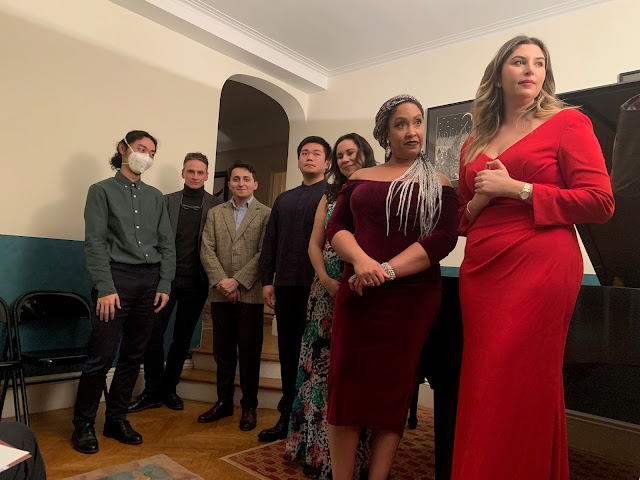
 Meet Classic Lyric Arts superstars--pianist Xu Cheng, director Daniel Isengart, tenor Scott La Marca, baritone Chen Xi, soprano Laura Soto-Bayomi, and mezzo sopranos Briana Hunter and Shannon Delijani!

Classic Lyric Arts, helmed by renowned professor, coach, and collaborative pianist Glenn Morton, is well known for its intensive summer programs in both Italy and France. They are now expanding into The Berkshires for yet a third program--this one focusing on the operas of Mozart. Staying that close to home this past summer because of Covid has made this new addition seamless. Growth is good! Students will have the opportunity to enroll in any or all of the programs.

We felt privileged to attend their soirée last week to hear some of our favorite artists, some of whom have sung at Voce di Meche's House of Music and others who were new to us. The evening was coached by Daniel Isengart who has added great performance value to CLA's intensive programs and is now an esteemed faculty member.

To avoid deciding which artist to mention first, let us go according to fach with pride of place given to Laura Soto-Bayoni who has a sizable soprano and a personality to match. Because of our focus on emerging artists, we rarely get to hear big voices and hearing Verdi was a special treat. An arresting account was given of "Non so le tetre imagine" from Il Corsaro. This aria is filled with emotion which colored her delivery of the text. The melodies are gorgeous and Ms. Soto-Bayoni leaned into them with effective phrasing and an affecting vibrato.

She was no less impressive in "Stridono lassu" from Leoncavallo's Pagliacci , showing a real flair for verismo. We are pleased to report that the birdsong so beautifully created on the piano by Xu Cheng entered our consciousness doubly as her stunning soprano convinced us that we could also see the birds in our mind's eye.  Now that's artistry!

More flexibility was demonstrated in a duet with Mr. La Marca--"Tornami a dir che m'ami" from Donizetti's Don Pasquale in which both young lovers expressed their affection by means of some lovely phrasing of Donizetti's charming vocal line. We do love duets and the two voices blended perfectly in happy harmony.

Shannon Delijani was heretofore unknown to us but we are glad to have this lack remedied. Ms. Delijani has a striking presence that seemed to announce the striking voice we heard. Our favorite piece was "O mon Fernand" from Donizetti's La Favorite. We have loved this aria so much in Italian and we didn't expect to enjoy the French version but, thanks to some perfect French diction we were similarly enthralled. We have a great enthusiasm for bel canto and it strikes us as more difficult to perform on French vowels but Ms. Delijani was undaunted. The handling of the lower register had just the right mix of chest and head voice. The cabaletta was powerful.

Her facility with French served her well in Chabrier's chanson "Les cigales" which requires rich coloration and good dynamic control.  Ravel's "Kaddisch" was performed in Hebrew which was made to sound as beautiful as French. We felt a sincere commitment, made doubly impactful by the spare and haunting piano accompaniment.

Mezzo-soprano Briana Hunter possesses an amazing repertoire of expressions and gestures, all of which were brought to bear on the Habanera from Bizet's Carmen. We forgot every time we had heard it before and experienced it as if brand new. Her Carmen is a mercurial one and each gesture and expression seemed to emerge from the text.

Ms. Hunter's complete comfort in the French language was heard in "Elle est la pres de lui" from Thomas' Mignon. It was emotional; it was believable; each gesture supported the voice. There is so much strength in the lower register!

Tenor Scott La Marca did his best work in Turina's "Los dos miedos" which he had  performed in our House of Music. Regular readers may recall how much we love Spanish music and this is one of our favorites; we have not heard it sung better. The text is psychologically valid; the musical line is apposite; the performance was stellar. As we said before, the romantic duet with Ms. Soto-Bayomi was a big hit in which Mr. La Marca paced his tenor part to perfectly match her soprano line. Beautiful blending!

As if that weren't enough, we had a surprise guest who wasn't on the program. Guest artist Chen Xi sang Tosti's "Ideale" with the same commitment we heard in the rest of the program--a feature which made it seem as new as the Habanera. We loved the resonance in his lower register.  This was the icing on the delicious cake served up by Classic Lyric Arts! 

Xu Cheng's collaborative piano served each piece, each style, each composer, and each singer. This versatility should serve him well in his future career.

© meche kroop


Saturday, November 9, 2019

CLASSIC LYRIC ARTS FALL GALA

Glenn Morton and participants in Classic Lyric Arts summer programs


The Classic Lyric Arts Fall Benefit Gala is a highly anticipated annual event; it is a golden opportunity to be introduced to participants in CLA's immersive summer programs in France and Italy. These stars of tomorrow have spent some very intensive time in the country of their choice--studying, coaching, learning the subtleties of the language, the culture, the food, and the music.

After a decade, the program is well established; young artists of promise are able to attend even if they cannot afford the tuition because, this year alone, 18 grants were made to help them along. Next year's goal is 28 grants and lovers of this very special art form could find no better means to make a valuable contribution.

The teachers and coaches have been selected for their dedication and desire to pass along their knowledge and expertise. Artistic Director Glenn Morton gave a wonderfully welcoming address to the select audience, pointing out that not every participant will achieve a major opera career; some will wind up in different capacities within the field and others will choose a different profession. But it seems that each and every participant soaked up what was offered to him/her and was greatly enriched.

Before and after the performance, we enjoyed a generous spread of goodies and an opportunity to mingle with the artists and to learn about their education and career goals, and also to hear them extol the benefits of their summer study. 

Alumna Caroline Lopez Moreno possesses a glorious soprano instrument that she uses well and which has captivated us on prior occasions. She has presence to spare as well, and spoke eloquently of her experience with CLA and her respect for Mr. Morton's astute and encouraging coaching.

She performed a divine duet with mezzo-soprano Sarah Fleiss, who is new to us. Rossini's Tancredi offers opportunities to show off and these two young women ran with it, giving an arresting account of this fraught scene in Act II. Rossini gave these conflicting lovers the most harmonious music; Ms. Moreno made a marvelous Amenaide and Ms. Fleiss sounded just grand as Tancredi. The overtones of each voice bounced off the overtones of the other. The fireworks in the cabaletta were dazzling.

We love listening to mezzo-sopranos who have a true mezzo texture to their voices and Ms. Fleiss surely does have the right sound. She was not the only one. Swedish mezzo Loella Grahn gave a winning performance as Rosina in the "note scene" ("Dunque io son") from Rossini's comic masterpiece Il barbiere di Siviglia. Ms. Grahn had all the right qualities--charm, presence, musicality, and good chemistry with her Figaro, wonderfully acted and sung by baritone Carlos Arcos.

Rossini's music is very kind to coloratura sopranos but Puccini demands a more substantial voice and we heard that in Johanna Will; she has a voice with plenty of substance that can effortlessly soar into the upper register. We greatly enjoyed her Cio-Cio San, singing in the Act I love duet from Madama Butterfly "Vogliatemi bene". Tenor Alexei Kuznietsov, whom we have written about several times, did an admirable job as Pinkerton. He just keeps getting better and better, a trajectory we love to witness in a young singer.

His versatility as an artist showed in the lighthearted "C'est l'amour" from Ganne's comic opera Les Saltimbanques, singing with Rachel Liss. We were excited to be introduced to a work and a composer that were new to us.

Similarly we got a kick out of  "Non, non jamais les hommes" from the Yvains operetta Ta bouche--another work and another composer new to us. The delightful Shannon Delijani was joined by Hannah Klein in this very cute number about how men can't understand women. In another number from this operetta, we heard Ms. Klein sing a duet with Wesley Diener entitled "Ta bouche a des baisers".

Soprano Lena Goldstein had a winning presence as Susanna in the scene from Mozart's Le Nozze di Figaro in which Susanna misunderstands the marital intentions of Figaro, here performed by Mr. Arcos who had to take a slap to the face which was quite convincing.

Marcellina was sung by mezzo Nanako Kato who also made a fine Isabella  in a scene from Rossini's L'Italiana in Algeri with Chang Liu singing the rejected wife of Mustafa (Mr. Arcos). 

There was a charming fluffy trio from Berlioz' Béatrice et Bénédicte with the voices of Temple Hammen, Bela Albett, and Melanie Dubil achieving perfect harmony.

We also enjoyed a sweet duet from Puccini's La Rondine--"Bevo al tuo fresco sorriso"-- with Ms. Lopez Moreno's Magda partnered by tenor Travis Benoit as Ruggero and a rousing "I Could Have Danced All Night" from Lerner and Loewe's My Fair Lady with Courtney Sanders singing Eliza Doolittle, joined by the chorus.

There seemed to be varying levels of experience in the singing. Some were "performance ready" and other showed promise. But all exhibited the kind of enthusiasm that warms our heart. And everyone sang with Italianate or Gallic style as the piece demanded. All had excellent diction which speaks well for their training with CLA.

Let us not forget the artistry of the collaborative pianists: Jake Landau, Migeun Chung, Vladimir Soloviev, Xu Cheng, and Ariela Bohrod. They too seem to have picked up a lot of French and Italian style during their residency abroad.

© meche kroop