MISSION

We are here to encourage the development of gifted young singers and to stimulate the growth of New York City's invaluable chamber opera companies. But we will not neglect the Metropolitan Opera either. Get ready for bouquets and brickbats.
Showing posts with label New Amsterdam Opera. Show all posts

Sunday, May 21, 2023

BORGIA NON BORING


(at left)  Toni Marie Palmertree

(Photo by meche kroop)
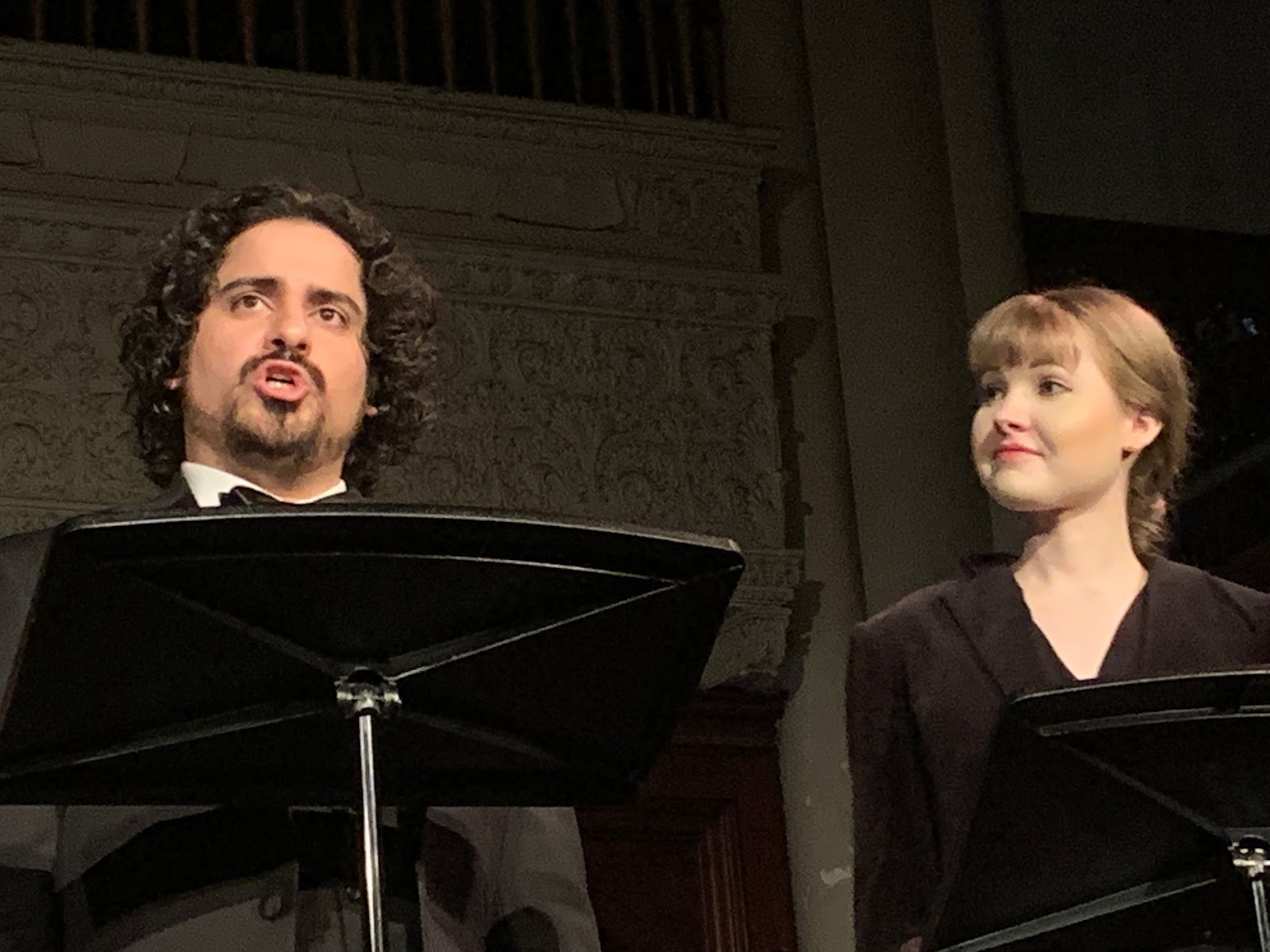


(at right)  Eric Botto and Madison Marie McIntosh

(photo by meche kroop)


Gaetano Donizetti's 1833 opera Lucrezia Borgia was given an impressive concert performance last night at The Center at West Park. With musical values this strong, it should have been staged at The Metropolitan Opera. Why is this bel canto masterpiece so rarely staged? Was Victor Hugo's play (on which Felice Romani based his libretto) too shocking by its incestuous hints? Are the lead roles too difficult to cast?

We do believe we saw it at Caramoor about 10 years ago with Angela Meade in the challenging title role. We don't recall sets so perhaps it was also in concert version. The opera has everything one would wish for in a bel canto opera--a melodramatic plot (very loosely based on history), engaging melodic aspects, interesting orchestration, and opportunities for superstar singers. Last night's performance met all those requirements from the opening percussive rumbles and horn declarations to the final tragic finale.

Maestro Keith Chambers elicited a superlative performance from his orchestra and the roles were sung as grandly as one would wish for. As the titular anti-heroine, Toni Marie Palmertree dazzled with fioritura fireworks and sensitively colored her voice to suit the various circumstances--from tenderness toward her son to firmness toward her husband. The vocal lines flowed like warm honey. The vibrato filled the sanctuary with overtones.One could not have wished for a better performance in this treacherous role.

As Gennaro, her illegitimate son who had been raised apart from his ill-reputed mother, we heard tenor Eric Botto who filled out his role nicely. Unaware of  Lucrezia's identity and having been warned of her dangerous nature, his approach to her was wary.  But when singing with his friend Maffio Orsini. his voice wa colored with warmth. When there are no sets and costumes to help the story along, and when audience members do not wish to distract themselves from the singing to look at titles on their cell phones, these vocal colorations assume an outsize importance. We particularly enjoyed his duets with Orsini.

Which brings us to the remarkable performance of mezzo-soprano Madison Marie McIntosh as Maffio Orsini. She excelled at creating a character, an important character by virtue of his closeness to Gennaro. The vocal colors that we so appreciated were augmented by meaningful facial expressions and gestures that defied the limiting aspects of the concert style production and the presence of the music stand. We couldn't help wanting to know more about Orsini's friendship with Gennaro. But that could be another opera! This artist has an enormous range and can dazzle with her upper extension and then wow us with husky low notes. We loved the accuracy of the embellishments and skips.

As the jealous husband, Don Alfonso, Duca di Ferrara, bass Eric Lindsey made a fine showing with growling low notes and an effective pianissimo As his confidant Rustighella, tenor James Danner made the most of a small but vital role.

The group of hotheaded young nobles who set the story in motion (by deleting the letter "B" in the Borgia family crest) was played by  four fine singers who held their own individually as well as in the ensembles. Tenors Scott Rubén La Marca and Pedro Barrera took the roles of Jeppo Liverotto and Oloferno Vitellozzo, respectively. Baritone Wilbert Kellerman sang the role of Ascanio Petrucci and bass-baritone Nate Mattingly took the role of Don Apostolo Gazella. Although it may not have been appropriate in this concert version, we longed for some differentiation of character. Nonetheless, the harmonies were deftly handled.

We enjoyed the lively chorus as well as they contributed to the musical texture. The score and orchestral parts were supplied by Maestro Eve Queler who must have conducted the work with her Opera Orchestra of New York at Carnegie Hall but that was probably before our time. It is indeed a pity that this opera has been so overlooked. The music is melodic and memorable.  And yet, the only piece that we heard before was the Brindisi "Il segreto per esser felice" and it is this piece that is running through our head!

© meche kroop

Sunday, May 29, 2022

THE SCOTTISH OPERA


 Nate Mattingly, Kofi Hayford, Arnold Livingston Geis, Katy Lindhart, Maestro Keith Chambers, Kathleen Norchi, Joe Lodato, and Laura Zahn

We have no idea what initiated Europe's fascination with Scotland in the early 19th c. but the stories of Sir Walter Scott were adapted by Eugene Scribe as the libretto for François-Adrien Boieldieu's opéra comique La Dame Blanche a full decade before another of Scott's gothic tales became the plot of Bellini's tragic opera Lucia de Lammermoor. Other operas with elements of the fantastic were to follow--Meyerbeer's Robert le Diable and Gounod's Faust.

Here we have the requisite castle in an exotic locale, a lost heir, a hidden fortune, and a ghost, a benevolent one. By virtue of the good graces of Maestro Keith Chambers' New Amsterdam Opera, utilizing the score donated by Maestro Eve Queler, who presented the work about 30 years ago with her Opera Orchestra of New York, opera lovers had an opportunity to thrill to Boieldieu's gorgeous melodies and some very fine singing.

A capacity crowd greeted the work with uncommon enthusiasm and gave the superlative cast the accolades they deserve. Maestro Chambers was in complete command of his orchestra, of which Stephan Fillare was concertmaster. Harpist Kate Sloat stood out by providing the soothing arpeggi running through the score at just the right moments.

The story concerns the fate of a castle in a Scottish town and whether it would wind up in the hands of the greedy steward Gaveston (sung by bass Kofi Hayford) or those of the tenant farmer Dickson (baritone Joe Lodato). The climatic auction scene resolves the bidding war and the castle winds up in the hands of the legitimate heir Julien (tenor Arnold Livingston Geis)  who had gone missing under strange circumstances and reappeared as the soldier Georges. Julien will marry the clever Anna (soprano Katy Lindhart) who was Julien' childhood sweetheart. Of course they will live happy ever after!

The work begins with a spirited overture involving sweet melodies alternating with a martial theme, and a frisky staccato one. One could be excused for thinking a ballet was about to follow since the overture was written by Adolph Adam, a pupil of Boieldieu who went on to compose the music for Giselle and Le Corsaire.

There is a celebratory chorus followed by Georges' entrance aria which announces his military profession. Mr. Geis evinced a full throated and well supported tenor which was given many more opportunities to shine. There was a lovely trio with Dickson and his wife Jenny ( soprano Kathleen Norchi) as the couple offer him hospitality and learn about the vagaries of his life.  Jenny's ballad about La Dame Blanche, the spirit guardian of the estate, was delivered with both wonder and soul. Ms. Norchi has a most appealing stage presence with a delightful feel for her character illuminated by a bright clear tone which soared over the orchestra. Mr. Lodato sang with geniality and firmness coloring his substantial baritonal resonance. 

In Act II, we finally get to meet the heroine, the lovely and clever Anna who has also had a strange and varied history. Ms. Lindhart is blessed with a superb instrument that she knows how to play. We appreciated her very fine vibrato and an abundance of overtones in the resonance. In duet with the old housekeeper Marguerite (mezzo-soprano Laura Zahn) the blended voices of the two women gave Boieldieu's harmonies a splendid execution.  Moreover, their exaggerated facial expressions amplified the storytelling of Steven Herring as he narrated the plot points.  His text was originally written by Nico Castle and he added quite a bit. In a concert production we have never seen the singers use facial expression so successfully and we enjoyed every grimace and grin.

Mr. Geis got another opportunity to show off his sweet tenor in the cavatina "Viens, gentille dame" with horn accompaniment. There was a change in force and tempo and a return to sweet melody.  What a fine messa di voce we heard! The act ended with a brilliantly composed and well knit septet which one might say owes a debt to Mozart. Ms. Lindhart got to show off an enchanting glissando.

The final act gave her yet another gorgeous melodic aria with more glissandi and some descending scale passages offering all manner of challenges which she met effortlessly. We don't know the French word for fioritura but we loved it just the same.

Mr. Geis got yet another chance to shine in his final aria in which Georges recognizes the castle he grew up in.  What a wealth of vocal effect!  Descending arpeggi and upward skips, all joined by that glorious harp.

There is much to be done to resolve the plot involving a disappointed Gaveston, so well portrayed by Mr. Hayford's deeply resonant bass and mobile expressions, and a Justice of the Peace named MacIrton, successfully sung by bass-baritone Nate Mattingly with requisite attention to the officious attitude of his character. Fortune is found, truths are revealed, and the estate is settled.

What a coincidence that we reviewed both of these fine singers already this month, Mr. Hayford in a vocal concert at the National Arts Club and Mr. Mattingly in Garden of Alice produced by City Lyric Opera. Both reviews can be found by using the search function on this page.

Photos of the singers can be found on both our Facebook pages--Meche Kroop and Voce di Meche.

© meche kroop

Sunday, March 31, 2019

NEW AMSTERDAM OPERA SALON GALA

Kofi Hayford, Kevin Johnson, Maestro Keith Chambers, Jonathan Green, Rachelle Pike, Sara Beth Pearson, Raymon Geis, and Eugenia Forteza

What a special Saturday night!  We enjoyed a surfeit of aural, culinary, and intellectual nourishment provided by New Amsterdam Opera. The legendary culinary creations of Leslie Ritch were accompanied by appropriate libations; renowned artist manager Ken Benson was on hand to instruct us about Massenet's rarely heard opera Hérodiade and how it differs from Richard Strauss' Salome; the cover cast of the upcoming May 10th (SAVE THE DATE) production by New Amsterdam Opera provided the entertainment, teasing us with a selection of arias, duets and an ensemble from the opera.

As much as we enjoyed eating, drinking, and socializing with the luminaries of the opera world who attended (including Eve Queler and Jane Shaulis) let us get right to the music which was outstanding. We were wondering "If the cover cast is this stellar, what must the first cast be like?" Maestro Keith Chambers was at the piano and the works were performed concert style, mainly "on the book".

There were only two selections that are well known. "Il est doux, il est bon", which we just heard at the Manhattan School of Music Ades Competition, is a tender aria upon which Massenet lavished abundant melody. Soprano Sara Beth Pearson as Salomé gave it a beautiful reading with bright tone in the upper register. As Mr. Benson pointed out in the introductory lecture, she is not the lascivious heroine of the Strauss opera, but an innocent young woman in love with the prophet Jean (John the Baptist).

There is an impressive duet between Hérode (sung by the fine baritone Jonathan Green) and his wife Hérodiade (given intense life by the excellent mezzo-soprano Rachelle Pike). Here the music was strange to our ear. "Venge-moi...Ne me refuse pas" is a wife's attempt to get her husband to soothe her injured feelings in a kind of "Let's you and him fight!". Ms. Pike sang with appealing resonance and fiery drama. 

In "Calmez donc vos fureurs", the lovesick Salomé tries to win over the resistant Jean, sung by the terrific tenor Raymon Geis.

The duet "Que ce philtre...Vision fugitive" is the other selection from the opera that one gets to hear rather often. Here, Hérode acquires some kind of sleeping potion from a Babylonian woman, portrayed by soprano Eugenia Forteza, whom we are always happy to hear. Here, we got a clearer picture of Mr. Green's pleasingly textured vibrato.

Just like at the Metropolitan Opera, we had an intermission special--an opera quiz which was way too challenging for us but not for the contestants--critic John Yohalem, pianist William Hicks, and OperaWire co-founder and editor-in-chief David Salazar.

Bass Kofi Hayford lent his interestingly textured voice to "Dors, o cité perverse!...Astres étincelants" in the role of Phanuel, an astrologer. We look at the stars and see STARdom!

Awaiting execution, Jean sings "Ne pouvent réprimer" and here we got to appreciate Mr. Geis' delicate vibrato and emotional connection, as well as some lovely arpeggi in the piano accompaniment, so beautifully played by Maestro Chambers.

The Act III ensemble "Peuple juif" brought all the singers together, along with Vitellius, the Roman Consul, sung by Kevin Johnson in warmly resonant low tones.

All of the singers exhibited fine French and were easily understood. We don't know who has been cast for the May 10th performance at The Center at West Park on West 86th St. but we would not have a moment's disappointment to hear any of the singers we heard tonight.

We hope you will be tempted to share this performance with us. We don't believe New York City has heard this opera in twenty years when Maestro Eve Queler conducted it with Opera Orchestra of New York at Carnegie Hall. It's about time to revive it!

We cannot close without lauding the encore which was from Richard Strauss' comic opera Die ägyptische Helena. Soprano Kirsten Chambers has a voice made for Strauss and we loved her aria "Zweite Brautnacht". Perhaps New Amsterdam Opera might consider giving us the whole enchilada!

If you like the sound of this gala evening, you too can become a member of the New Amsterdam Opera family. The post-salon reception lasted way longer than planned because the "family" remained in lively and rewarding conversation long after the food and drink were stowed.  Now that's a memorable evening!

(c) meche kroop

Sunday, November 4, 2018

NEW AMSTERDAM OPERA'S FALL FLING

Pianist Mark Cogley, John Viscardi, Holly Flack, Ta'u Pupu'a, and Kirsten Chambers


Beginning their third season, New Amsterdam Opera has exciting plans for the year and began with a festive salon in the home of a generous supporter.  This young company, helmed by Maestro Keith Chambers, deserves the support of the opera community.  We are speaking to you, dear reader! If you love opera and want the art form to survive, you will have to step up to the plate. Many of our most gifted young singers take off for Europe where opera gets a lot of support.  Let's keep them here by supporting the small companies that give them roles and stage experience!

That being said, we love NAO for supporting young singers and casting them alongside more experienced singers; we love them for bringing to the public underperformed works by the great composers; we love them for making opera accessible to underserved populations.

Last night's salon was a rare opportunity to hear some of today's finest artists up close and personal in a relaxed and comfortable environment.  The four artists performed three sets of three selections each. In between sets there were food and drinks and socializing. What more could one ask for!

We heard the oft reviewed soprano Kirsten Chambers sing in Italian for the first time and loved the sound. We heard soprano Holly Flack for the first time. We enjoyed being blown away by tenor Ta'u Pupu'a's huge sound. We witnessed the completion of John Viscardi's transition from terrific tenor to mellow baritone.  All were excellent.

The two gentlemen opened the program with the final act duet from Puccini's La Bohème--"O Mimi, tu più non torni" in which Rodolfo and Marcello sing of their lost loves. Mr. Viscardi was highly persuasive as Silvio imploring Nedda to run away with him in a scene from Leoncavallo's Pagliacci; Ms. Chambers found a great fit for her voice here and we loved their performance, imbued with passion and chemistry.

Mr. Viscardi got another opportunity to be persuasive as Don Giovanni trying to seduce Zerlina, winningly portrayed by Ms. Flack.  They also enacted the Papageno-Papagena Duet from Mozart's Die Zauberflöte, which we would have preferred in German.

Ms. Flack had two exceptional solos--in "Glitter and Be Gay" from Bernstein's Candide, we loved her use of vibrato and the accuracy of her coloratura.  In Ophélie's Mad Scene from Thomas' Hamlet she did justice to the many moods by means of vocal coloration. There were some gorgeous vocalises and smoothly rendered portamenti. The high B at the end might have shattered some crystal!

Puccini's Turandot requires some large voices and Ms. Chambers and Mr. Pupu'a filled the bill in the tension laden riddle scene with pianist Mark Cogley filling in for the crowd of peasants. Mr. Pupu'a makes a splendid Calaf, stageworthy with "Nessun Dorma".

Mr. Viscardi's solo was Danilo's Aria from Franz Lehár's Die Lustige Witwe in which he describes his flirtations with the famous Lolo, Doudou,and JouJou. Yes, he can do rakish; we'd like to hear it in German!

Ms. Chambers' solo was "Zweite Brautnacht" from Richard Strauss' Die ägyptische Helena, in which Helen celebrates her reunion with Menelaus. This work was made famous by Leontyne Price and we were happy to hear Ms. Chambers filling her shoes. 

We left fully satisfied by the artistry, the warm fellowship of the NAO's supporters, and the generous buffet.

Consult New Amsterdam Opera's website for more information. But here's a wee hint--if you ever wanted to see Massenet's Herodiade, save May 10th!

(c) meche kroop

Monday, November 13, 2017

WAGNER LEIT by NEW AMSTERDAM OPERA

Terina Westmeyer, Maestro Keith Chambers, Maestro Thomas Bagwell, Janara Kellerman, Hyona Kim, Megan Nielson, Kirsten Chambers, Thomas Hall, Melissa Citro, Heather Green, Tyler Smith and Errin Brooks

A late afternoon of Wagner on a cool Autumn afternoon seemed like a great idea and drew us up to Riverside Theater, the comfortable venue within Riverside Church where New Amsterdam Opera makes its home. But we can't help recalling that Wagner's own concept was that of "gesamtkunstwerk"--a work bringing together all the arts, aural and visual.

Planning a few arias in concert version gave us an opportunity to hear some new singers and to hear some others with whom we are acquainted and who are now essaying the Wagnerian repertory, with some interesting results. But we missed the staging, the costumes, the drama, and the sets. That most of the singers were on the book made attempts at acting look just plain silly. Supposed lovers rarely made eye contact!

At this point, let us give props to dramatic soprano Terina Westmeyer who sang Brunnhilde in "Wotan's Farewell" with dramatic baritone Thomas Hall as her father. The two sang without music stands for which we were grateful. We have favorably reviewed Ms. Westmeyer as Lady Billows in Britten's Albert Herring at the Bronx Opera and as La Badessa in Puccini's Suor Angelica. Three years ago we loved her singing of Verdi.

But we have not been present for her Wagner and we were delighted with the power of her voice and the tonal beauty. We see a lot of Wagner in her future and hope to hear more of it. Mr. Hall did not sound beautiful but he followed this scene with Siegfried's confrontation with Erda in which he sounded far better. Perhaps he just needed to warm up.

Erda was sung by mezzo-soprano Hyona Kim, whose dark chocolate sound was excellent for the role.  Ms. Kim first appeared on our radar screen four years ago when she won the Joy of Singing Award. Indeed, she is a superlative lieder recitalist who has been making inroads into the operatic repertory. She is such a fine actress that she dissolves into the part, as she did when she sang Suzuki in Puccini's Madama Butterfly with Martina Arroyo's Prelude to Performance and Wokli in his Fanciulla del West with New York City Opera.

We are also familiar with the work of mezzo-soprano Janara Kellerman whom we enjoyed greatly in the role of Preziosilla with New Amsterdam Opera's recent production of Verdi's Forza del Destino. Her plush sound was enjoyed and noted in the role of Mamma Lucia in Mascagni's Cavalleria Rusticana with Martha Cardona Opera and Santuzza with New Amsterdam Opera. It was a thrill to hear her expand her repertory into Wagnerian territory.

Soprano Megan Nielson has delighted us as Tatiana in Tchaikovsky's Eugene Onegin with Utopia Opera and as Nedda in Opera Ithaca's production of Leoncavallo's Pagliacci. We also remember her performance as the eponymous Suor Angelica presented by Chelsea Opera. Yesterday, she showed a lot of promise in Wagnerian territory singing Elsa in a scene from Lohengrin, with Ms. Kellerman adding some interesting texture as the conniving Ortrud and Mr. Hall as fellow conniver Telramund.

Tenor Errin Brooks seems to have gotten his huge instrument under better control and did well as the rejected Erik with soprano Heather Green as Senta in a scene from Der fliegende Hollander.

New to us is tenor Tyler Smith whose sizable instrument was colored with tenderness in the "Liebesnacht" from Tristan und Isolde with the beautiful soprano Kristin Chambers as his scene partner. We liked the way he modulated, successfully employing dynamic variety.  We have enjoyed Ms. Chambers more in other roles such as Fidelio. Ms. Kellerman lent gravity to the situation as Brangäne.

Mr. Smith appeared once again in the final scene of the program in which he has awakened the sleeping Brünnhilde, sung by soprano Melissa Citro.

We found no fault with the German. Alles klar!

Accompanists for the evening were beyond superb. Both Maestri Keith Chambers and Thomas Bagwell elicited most of Wagner's orchestral magic on the piano. Often, when the singers fail to connect with us (usually due to flipping pages on the music stand) our attention shifted to the piano and we heard things in the score that we might have missed.

A highlight of the evening was the presentation of New Amsterdam Opera's first Pathfinder Award to Maestra Eve Queler who broke the glass ceiling for female conductors. Ms. Queler is a girl after our own heart, and we are calling her a girl because she has never lost that youthful quality that we so admire.

We have so many memories of hiking up to the highest level of Carnegie Hall, where the sound is best, to be introduced to rarely performed and forgotten operas and new singers--right up until last year's production of Donizetti's Parisina d'Este. Ms. Queler founded Opera Orchestra of New York in 1971 when there were no female conductors. Brava Eve!

She has plenty of European fame that we haven't experienced but we tend to personalize things and the above describes our Eve Queler. Just one more note of interest is that she has shared all of her scores with New Amsterdam Opera. Dare we hope that we will hear repeats of these rarely produced operas?  Let us hope!

(c) meche kroop


Sunday, October 1, 2017

SWEET TO THE TONGUE AND SWEET TO THE EAR

Kyle Pfortmiller, Maestro Keith Chambers, Ira Siff, Aaron Blake, Olivia Vote, and Sandra Lopez


The tantalizing buffet of homemade sweets and the free-flowing champagne might have distracted us from the thrilling entertainment provided by New Amsterdam Opera at their Sweet Surprise Salon.  Indeed sugar is sweet but music is even sweeter and more nourishing to the spirit.

The salon inaugurated NAO's second season; if you, dear readers, read our reviews from the first season you may recall our enthusiasm for their fine Fidelio, their equally fine Forza del Destino, and a compelling gala concert--all performed with impressive professionalism and fine casting decisions.

Artistic Director Maestro Keith Chambers hand picked the quartet of singers for last night's salon and the excellent program which comprised not a single dud.  There were three acts of four selections each with an opportunity to socialize before, after, and inbetween. Many luminaries of Planet Opera were in attendance and we were so happy to learn that Maestro Eve Queler of Opera Orchestra of New York has generously donated all her orchestral scores, giving NAO just the impetus they need to present more operas that deserve to be heard but are not regularly performed.

The evening was hosted by the inimitable Ira Siff--singer/educator/raconteur/writer/radio personality. We know Mr. Siff for a longer period of time than any other singer. One of his youthful performances was responsible for our love of singing. His witty introductions had the audience in stitches.  He began rather straight-faced talking about the need for "budget operas" in today's economic climate but then rattled off a list that seemed to come right out of the late and lamented Gran Scena Opera Company, of which he was the star.  Who remembers Madame Vera???

We always love duets, especially when the voices are well balanced.  Opening the program were soprano Sandra Lopez and mezzo-soprano Olivia Vote (whom we enjoyed so much at Santa Fe Opera) singing "Belle nuit" from Jacques Offenbach's magnificent work Les contes d'Hoffman. Ms. Lopez' instrument is bright and beautiful with Ms. Vote's terrifically textured voice complementing hers to great effect. French diction was just about perfect.

If there is a more gorgeous duet for male voices than "Au fond du temple saint" from Georges Bizet's Les pecheurs de perles, we have yet to hear it. Tenor Aaron Blake joined forces with baritone Kyle Pfortmiller in this male bonding piece; both artists had an opportunity to show their dramatic chops in this emotional roller coaster. Like the two female artists, their French was impeccable.

As far as language is concerned, Mr. Pfortmiller distinguished himself with his superlative German in "Mein sehnen, mein Wahnen" from Erich Wolfgang Korngold's Die tote Stadt. This song of longing and nostalgia ends with the word "zuruck" (apologies for not having diacritical marks available) and Mr. Pfortmiller drew out the final "u" (the one with the umlaut) in an attenuated decrescendo that brought out the sentiment in a way that we have never heard before.

Readers may recall how fond we are of zarzuela and can imagine how delighted we were to hear "Maria la O" from the the 1930's work by Cuban Ernesto Lecuona. We just reviewed the same aria last week and are of the opinion that New York is ready for more zarzuela. Ms. Lopez gave it a fine performance, filled with sazon. To our ears, Spanish sings as well as Italian and caresses the ear.

Of course, there was Italian on the program as well. Ms. Vote performed "Stella del marinar", Laura's prayer for guidance from Amilcare Ponchielli La gioconda. Her vibrato was perfect and filled the room with overtones that bounced off the elaborate piano score, performed by Maestro Chambers, who was accompanist for the evening.

"Parigi, o cara" is the heartbreaking final duet from Giuseppe Verdi's La traviata, a duet filled with false hope and wishful thinking.  Ms. Lopez and Mr. Blake invested it with profound emotional resonance.

Equally heartbreaking is Edgardo's aria of suicidal despair from Gaetano Donizetti's Lucia di Lammermoor, in which Mr. Blake threw himself into the high notes with thrilling abandon.

It is rare that a piano reduction can come close to Richard Wagner's dense orchestration but Maestro Chambers got it right in "Einsam wachend in der Nacht", Brangane's Act II warning to Isolde, here performed by Ms. Vote.

Three of the artists enjoyed the opportunity to sing lighter works from the American musical theater. Mr. Blake let out all the stops for "Be My Love", popularized by Mario Lanza in 1950. It was passionate, persuasive, and very expressive.

Mr. Pfortmiller performed the English language lyrics to "Stars" from Claude-Michel Schonberg's Les Miserables.  Having heard Alain Boublil's French lyrics, we would have preferred that version, but the English lyrics by Herbert Kretzmer are quite good and Mr. Pfortmiller was strong and determined and overcame our preference.

The musical Kismet has Borodin's music written all over it; indeed Robert Wright and George Forrest adapted it for the Broadway stage and it opened in 1953 with an absurdly complicated plot and Borodin's luscious music. If we are not mistaken "And This is My Beloved" comes from the third movement of his String Quartet #2. Forgetting the elaborate plot, Ms. Lopez performed the song with beauty and simplicity.

The program concluded with the festive party song from Johann Strauss II's Die Fledermaus, which brought this quartet of superb singers together in an exhibition of brotherly love-- "Sing to Love' which we know as "Bruderlein, bruderlein und Schwesterlein".  Again, we prefer the original language but it was just fine.

After this banquet of vocal delights, we repaired to the banquet of gastronomical delights and shared our pleasure with the enthralled members of the audience.

The evening was a fund raiser for New Amsterdam Opera and this yearling company deserves your dollars. Their goal is to identify young talent and to give them performance opportunities right here in New York City. It seems as if the USA provides the best training for singers but is sadly lacking in performance opportunities.  So many of our gifted young artists leave for Europe where their artistry is more highly valued. Let's turn that around!

(c) meche kroop


Saturday, March 25, 2017

LA FORZA!

Errin Brooks and Kelly Griffin in New Amsterdam Opera's production of La Forza del Destino


How long we have yearned to hear Verdi's La Forza del Destino! Is it rarely performed because the roles are difficult to cast? Or does it have something to do with the superstition that surrounds it, much like Shakespeare's so-called "Scottish play" the name of which actors are reluctant to pronounce. We are happy to report that New Amsterdam Opera succeeded without any mishaps of which we are aware. The audience filled The Riverside Theatre and the applause was thunderous.

Artistic Director Keith Chambers conducted a pick-up orchestra which he pulled together quite well with only a few rough patches that were easy to overlook. But we could not overlook the fortuitous "flutery" of Rosa Jang and the happy "harpery"of Melanie Genin. Both were outstanding in their contributions. The overture is a masterpiece with one memorable theme following another. The initial "fate" theme is propulsive and highly rhythmic. Then along comes a sorrowful one, a lyrical one, a heraldic one, and a playful one. Although the 1869 opera is rarely performed, the overture is a concert staple.

New Amsterdam Opera aims to give young singers the opportunity to perform a role before a live audience in concert version. When one hears young singers eight nights a week one gets to recall quite a bit about them and to form a well-rounded picture of where their strengths and weaknesses lay and how they are growing.

For example, Kelly Griffin, the dramatic soprano who sang Leonora was possibly one of Daniel Cardona's "discoveries" about 3 years ago when she bowled us over with....(you guessed it, didn't you?)..."Pace, pace mio Dio". We heard her sing it again a few months ago; she has grown into the entire role and performed it with passion and intensity, well served by her generous instrument, which has an agreeable vibrato.

Her lover Don Alvaro was sung by Errin Brooks whose sizable tenor won him the Wagnerian prize from the George London Foundation. This is one of those huge voices that will take awhile to bring under control and fulfill its promise. In Act I, although we could understand every word of his Italian, he sang the line unmusically, as if it were English. As the evening progressed he did remember his legato and needed only to lighten up. He tends to emphasize volume and thereby squelches the overtones we want to appreciate in the tenor instrument. He would do well to bring his voice forward and to avoid pushing.

We loved the performance of mezzo-soprano Janara Kellerman as the gypsy Preziosilla. We have previously enjoyed her as Santuzza. This is an artist who throws herself into a role and clearly enjoys herself, seeming effortlessly.  Her "Rataplan" was a delightfully light moment in a heavy opera; she is urging the Spaniards to throw off the Austrian yoke. How Verdi must have loved that theme!

Leonora's brother Don Carlo was excellently sung by the polished Verdi baritone Stephen Gaertner whom we last heard at Lauren Flanigan's Comfort Ye recital. His duets with Mr. Brooks' were highlights of the evening. He was out to kill Don Alvaro but, unwittingly the two men became military buddies until their true identities were discovered.  Uh-oh!

Leonora's father the Marquis was sung by bass Hidenori Inoue whom we greatly enjoyed as Don Pasquale at The Manhattan School of Music this season.  His character got killed off in Act I and we were sorry not to hear any more of him! But we will surely hear a lot more of him in the future, since his bass is fully mature and ready for so many roles, needing only costuming and makeup to age him. 

We also liked Stefan Szkafarowsky, the bass cast as Padre Guardiano, the abbot of the monastery that gives Leonora a secret dwelling to hide from the cruel world. He sang his role with a nice legato and secure presence. The irritable Fra Melitone was sung by bass-baritone Daniel Klein whose over-the-top acting impressed us more than his grainy voice. It is rare for a singer to show so much acting chops in a concert performance!

Veteran tenor Robert Brubaker sang the role of Trabuco.  How well we remember his performance as Anna Nicole's husband in the opera of the same name, and his performance as Herod in Salome at the Santa Fe Opera.

Mezzo-soprano Melissa Serluco appeared briefly as Leonora's maid. We enjoyed her performance not too long ago as Dorothee, one of Cinderella's step-sisters in the Utopia Opera production of Massenet's Cendrillon.

And finally, we were introduced to a new voice, lyric baritone Wil Kellerman who nicely filled the roles of the Alcade (Mayor) and that of the surgeon who decides that the hero will survive his injuries.  We hope to hear more of him.

And we hope that some opera company in NYC will decide to produce this outstanding opera in a full production.  Hint, hint!

(c) meche kroop


Saturday, October 22, 2016

NEW AMSTERDAM OPERA GALA CONCERT

New Amsterdam Opera Gala Concert at Riverside Theater

What a great variety of singers we heard last night!  Concerts of operatic arias are most fun when there is a variety of artists and the piano accompaniment is supportive. Both requirements were met as the New Amsterdam Opera presented their first gala concert in the comfortable theater belonging to Riverside Church. Their first event, a terrific Fidelio (review archived) was somewhat marred by some pretty awful acoustics.  We hope this theater will be their new home.

The opening duet is one of our favorites--"Belle nuit" from the Venice act of Offenbach's Les contes d'Hoffmann. The sweetness of Alyson Cambridge's Giulietta harmonized perfectly with Janara Kellerman's resonant Nicklausse.  Conductor Keith Chambers was the piano accompanist for the evening and set up the feeling of the imaginary gondola.

Another admirable duet was performed by mezzo-soprano Madison Marie McIntosh who created a wily Rosina for baritone Suchan Kim's Figaro in "Dunque io son" from Rossini's Il barbiere di Siviglia. We love the moment when she produces her secret note for Count Almaviva and Figaro gets flummoxed. Ms. McIntosh's upper extension remains the most impressive aspect of her voice with flexibility to spare for the fioritura.

Everything Mr. Kim does is superb. We were impressed with his creation of the deformed character of the eponymous hunchback in Verdi's Rigoletto which he accomplished without any humping or limping.  It was all in the voice! The part of Sparafucile was well handled by burly bass Kevin Thompson who projected just the right degree of menace in "Signor. Va! Non ho niente"

Another duet we enjoyed was "Là ci darem la mano" from Mozart's Don Giovanni. Coloratura soprano Amy Owens made a sweet Zerlina who was converted from her initial resistance by a most persuasive Don, portrayed by the robust baritone Luis Ledesma whom we so enjoyed in Florencia en el Amazonas.  

He is another artist who seems to do everything well.  His solo "Nemica de la patria" from Giordani's Andrea Chenier was powerful and affecting.

Another fine soloist was soprano Zhanna Alkhazova who created the unhappy character Elizabetta from Verdi's Don Carlo. Hers is a substantial instrument which she colored effectively in her exploration of the character's musings in "Tu che le vanità". We were hoping to hear more of her but that was her only appearance on the program.

From the same opera we heard veteran bass Stefan Szkafarowsky in "Ella giammai m'amo" making the hateful character of King Philip somewhat pitiful. Kevin Thompson sang The Inquisitor but being "on the book" detracted from his ability to connect with Mr. S.

The use of music stands also impaired the full impact of the stunning final trio from Strauss' Der Rosenkavalier. Ms. Owens made an appealing Sophie with mezzo-soprano Sarah Heltzel a fine Octavian. As the Marschallin, the excellent soprano Kirsten Chambers, whom we so enjoyed in Fidelio, came on too strong for Strauss' delicate writing which Mr. Chambers so elegantly captured on the piano.

There were other examples of performances too intense for the material. We love soprano Jessica Rose Cambio's powerful instrument but found it too heavy for the role of Nedda in the duet "Nedda! Silvio" from Leonavallo's Pagliacci. She also oversang and overacted as Cio-cio San in "Una nave da guerra" with Ms. Heltzel as her Suzuki.

The closing duet was "Tu qui, Santuzza" from Mascagni's Cavalleria rusticana in which baritone Ta'u Pupu'a Turiddu was a fine match for Janara Kellerman's desperate Santuzza. This redeemed him from his awkward performance as Des Grieux in "Tu, tu, amore, tu" in which he and soprano Kelly Griffin failed to gel as a romantic couple and just seemed miscast.

Ms. Griffin was far better however in "Pace, pace mio Dio" from Verdi's La forza del destino.  Our companion shared our opinion that this opera needs to be produced more often and we were absolutely thrilled to learn that this will be New Amsterdam Opera's next production!

One other duet failed to come together--Ms. Cambridge's Mimi did not connect with Mr. Ledesma's Marcello in "Mimi?...Speravo di trovarvi qui" from Puccini's La Bohême. We could not put our finger on the cause but she was excellent performing "Song to the Moon" from Dvorak's Russalka, with great depth of feeling.

A late edition to the program was soprano Ashley Becker who sang “Ben t’io invenni…Anch’io dischiuso un giorno” from Verdi's Nabucco.

The Mistress of Ceremonies for the evening was the famed soprano Diana Soviero. We would have been happier had she contributed more to the evening than a hasty recitation of the revised second half of the program.

(c) meche kroop


Friday, June 10, 2016

BEETHOVEN'S SINGLETON

Lindell Carter, Madison Marie McIntosh, Steven Herring, Brent Reilly Turner, Maestro Keith Chambers, Kirsten Chambers, Kevin J. Langan, Kian Freitas, and Richard Cross

Last night we had the privilege of being present at a birth.  The birth went smoothly and the newborn is healthy and gave some lusty cries. The birthplace was adequate but this baby needs some growing room!  The babe was named....New Amsterdam Opera and was delivered by Maestro Keith Chambers,

We consider it ambitious to have tackled Fidelio, Beethoven's sole opera; thanks to some fine and highly accurate conducting as well as some excellent casting, the night was a huge success. The large church was filled to capacity and the standing ovation impressive. Musical values were so high that sets and costumes were not missed.

Beethoven wrote this opera in 1805 but tinkered with it until its final version was completed in 1814. Two interesting decisions were made by Maestro Chambers: although there were never any recitativi, the opera contained spoken dialogue and Mr. Chambers replaced this with narration by the eminent Richard Cross; although the original overture (thought to be too weighty for the opera) is generally presented as a concert piece, here it was inserted between the two scenes of Act II, not an original idea to be sure but not a treat one can take for granted. 

The story is a straightforward one. The wife of a political prisoner disguises herself as a man and gets a job at the prison where her husband has been unfairly incarcerated. She wins the trust of the warden and finally manages to rescue her beloved. She also inadvertently wins the love of the warden's daughter Marzelline who is pursued by Jaquino.

Soprano Kirsten Chambers has a sizable voice with great overtones, one in which musical values are never sacrificed for volume. As the loyal and heroic titular character (first "Fidelio" and later "Leonora" when her gender is disclosed) she was completely believable. We loved her passionate aria in Act I.

We also loved the duet between Ms. Chambers and Madison Marie McIntosh, whose focused voice and youthful appearance perfectly suited the role of the innocent Marzelline. The two very different sopranos sounded brilliant together.

We do not get to hear the voice of the imprisoned aristocrat Florestan until Act II. The character has been starving in a dungeon for two years but tenor Brent Reilly Turner managed to color his robust voice to indicate  both hope and faith. His big aria is introduced by a sorrowful theme in the orchestra, with Maestro Chambers' handling of the brass particularly impressive.

As the jailer Rocco, bass Kevin J. Langan was particularly fine, both vocally and dramatically. His German was especially fine, a quality we prize inasmuch as there were no titles. We were sitting to the side and his clarity was evident no matter which side of the stage he occupied.

Baritone Steven Herring has a powerful voice and created a threatening character in the role of Don Pizarro, the nobleman who was responsible for jailing Florestan.  We found ourselves hating the character and loving the singer in equal measure!

Entering at the very end of the opera, announced by offstage trumpet, was the Governor Don Fernando. Bass-baritone Kian Freitas did justice to the role.  It was a special moment when he allows the unmasked Leonora to remove her husband's chains. He makes the theme of the opera very clear--story and music both reflect Beethoven's passion for liberty and heroism.

Some special moments that we enjoyed were the quartet in Act I and the prisoner's chorus in Act II. Their placement up high behind and above the orchestra allowed their voices to be heard. Props go to Chorus Master Tony Bellomy.

We cannot comment on tenor Lindell Carter's portrayal of Jaquino because we could not hear him. Part of this can be attributed to his being stage right whilst we were sitting on the other side. Still, singers with larger voices or better focused voices could be heard from wherever.

And that brings us to our one disappointment with the evening. West Park Presbyterian Church does not have great acoustics. The orchestra filled the stage and the singers were placed in front. Our dearest wish for this new company is that they find a home with an orchestra pit or an elevated playing area. They deserve it!

(c) meche kroop